Celebrating the 4th of July During an Enemy Occupation

On January 5, 1942, days after invading Japanese troops occupied the Philippine capital of Manila, Josephine Waldo and her husband Bill, a Goodyear employee, along with other Allied nationals living in the Michel Apartments, were herded into army trucks and delivered to Rizal Stadium for registration. From there, they were transferred to the campus of Santo Tomas University, which served as an internment camp for Allied nationals for the duration of the enemy occupation.

Santo Tomas

Despite their circumstances, the American prisoners of the Japanese expressed national pride by celebrating holidays, especially the 4th of July. They risked raising the ire of the Japanese guards, but couldn’t stop themselves from marking the occasion.

On July 4, 1942, Josephine Waldo wrote in her diary, “Hurrah for the Stars and Stripes! It seems rather strange to be celebrating the 4th in a concentration camp, but it takes more than that to down the good old American spirit.” To celebrate, she and Bill ate ice cream and chocolate cake with friends, listened to firecrackers going off, and admired fellow internees’ red, white, and blue outfits. The day was topped off with a lecture about Thomas Jefferson and a group sing of “America the Beautiful.”

In 1943, Claire Phillips, an American woman who evaded internment by concocting a false nationality, marked the holiday by launching “Operation Hamburger.” She and some other Manila women had been smuggling food and supplies to Allied military prisoners held at the Park Avenue School for use as forced labor.

Claire and the women of “Operation Hamburger” sliced fifty loaves of rice bread and fried up meat patties to make hamburger sandwiches. They arranged with a local shop owner to slip the hamburgers to the men as they marched past. Nothing could be more American, Claire reasoned, than eating a hamburger on the 4th of July.

On July 4, 1944, the last 4th of internment, Ethel Thomas Herold, interned with her family in Baguio, a few hours north of Luzon, noted in her diary that she “hardly noticed” the day. The war had been going badly for the Japanese, who took their frustrations out on the prisoners. Food became scarce; many of the internees would soon start to exhibit signs of starvation. No one had enough supplies for a special meal or celebration on the 4th.

Still, Ethel described how some of the internees came to her room to look at and touch an American flag that she and some of the other women had been working on. “We women have slowly and lovingly button holed every star and sewed and resewed the seams just to be holding the flag. Whatever becomes of this flag, it serves its purpose in here, by just being secretly looked at and dearly cherished.” Both Ethel and her flag survived the war.

In occupied Manila, on that same 4th of July, Gladys Savary wrote about the day in her diary: “The Glorious Fourth–and I don’t dare hang out the American flag, but I have been admiring it all day, hung up in the bathroom.”

As the wife of a French citizen, American Gladys was exempted from internment, and she spent a lot of her time finding ways to help those inside Santo Tomas. “Can’t be much of a celebration, with nearly all Americans locked up. I am sure they are happy in the camp, what with the good news in the air. I’ve had several smuggled notes from camp and while the morale is good, they are getting increasingly hungry.”

Good morale could only do so much, though. These Americans would wait another seven months for liberation.


The Importance of Book Reviews

Book reviews are important. They help a book find an audience. They reach more people in more places than anything else.

Lately I’ve been reaching out individually to people I know, asking them to read Angels of the Underground and leave a review on Amazon. For anyone who hesitates to write a review because they’ve never written one before or think they aren’t qualified to do so, consider it a way to spread the word about a book you love, like, and/or find fascinating.

Here’s a handy visual that outlines how to write a review and why it’s important:

book reviewing


Write by the Lake: Day 5

Then it was Friday. Summertime weeks speed by; this one seemed to go doubly fast. Just when we got started, there we were, wrapping up.

I’d barely been able to finish my homework for Friday because of the author event at Mystery to Me on Thursday night. That turned out well. (Except for the drive into Madison, at the tail end of rush hour, causing me to arrive just in time.) The cozy crowd included my husband, a long-time academic friend who was also attending Write by the Lake, and a new friend from the workshop. And there were a few others, too, and some of them stayed around to chat a bit after the q&a with journalist Doug Moe. Doug asked great questions that allowed me to talk about Angels of the Underground, which I love to do. It all lasted for about an hour and a half, and Joanne kept the cash register open long enough for me to buy the new novel by fellow Wisconsin writer, Ann Garvin.

mysterytome

So I didn’t get to my workshop homework until Friday morning. But I got it done. During the session, we read through some of those completed assignments and worked on another writing exercise. To wrap things up, the instructor talked a bit about the querying process involved in finding an agent.

Overall, this was a good experience. There is great value in connecting with other writers (our workshop was a great group) and on developing writing skills. I wish there had been more of that latter thing, especially as applied to our individual projects. The six of us in the workshop all have book projects started. We need to keep going.

Throughout the week I kept thinking about how I would have structured a writing workshop. At the top of my list: have the attendees do a lot of writing, critiquing, and revising. Our homework assignments and in-class exercises were quality assignments for honing our skills of observation and description. We should have then applied what we learned to our manuscripts-in-progress, with the goal of writing 5-10 pages per night. Copies of those new pages could have circulated within the group for critiques and rewrites. That would’ve been a wonderfully productive workshop.

Now, the rest of the summer looms.


Write by the Lake: Days 3 and 4

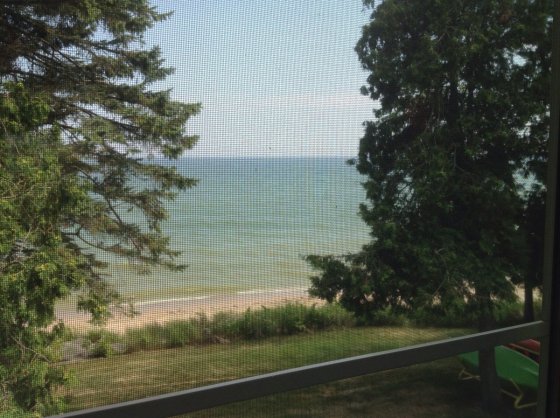
Two productive, packed days at Write by the Lake. Although I haven’t spent any lakeside time doing any actual writing, I’ve at least been able to enjoy looking at the lake every day. Yesterday was another warm (bordering on hot), sunny day. Today has been partly sunny and cooler. This was the view from our meeting room in the Pyle Center.

Write by the Lake

Yesterday began with a discussion about how the information you choose to exclude from your narrative matters as much in shaping your story’s point of view and theme(s) as what you decide to include.

We also talked about the slippery issue of voice. I really struggle with that–trying to figure out if I have an effective one, trying to figure out how to define it–so I especially appreciated that part of the session. We analyzed a passage from Frank McCourt’s memoir, Angela’s Ashes, to underscore certain points about voice.

Today we finished up reading and critiquing the 2000-word submissions. Mine was the final one. I stayed up late last night to do some revisions, and I was glad I did. The pages were better for it, I think, but still very much feel like a draft. So particularly at this stage in the project (early days), the comments and questions were very helpful.

It’s hard to believe that tomorrow will be the last day of Write by the Lake.

But before I get to that, I have my first author event at the Mystery to Me bookstore in Madison: a Q&A with journalist Doug Moe. I’ll post about it–and maybe include some photos–tomorrow.


Write by the Lake: Day 2

The rain held off through the afternoon; it was another beautiful day on the UW campus.

Workshop sessions started at 9:30 this morning. There are seven of us in this particular non-fiction workshop, and most of us arrived early to our assigned room. We had time for some catch-up conversations before the instructor arrived: talk about our individual projects and about how we fared with our writing homework.

Then the instructor pulled us into our business of the morning. We went over the homework responses–how we imagined the possible endings to a particular scenario. It was an interesting exercise, a way of getting us to think about how and why people respond to certain situations.

We discussed how to construct log lines and the purpose for constructing them. You can never tell when you might need a log line (also known as an elevator pitch), but it’s a good idea to be able to explain, clearly and concisely, what your book is about. Most people really won’t listen to a long, detailed explanation–no matter how interesting the topic. It’s hard to boil down a book’s essence to one or two sentences, yet crafting a log line can really help you to keep focused on the basics of your book: who is the main character and what is their central conflict or obstacle?

We learned about the components for a book proposal. I wrote one for Angels of the Underground, and I’m in the process of writing one for this new project, so this was a helpful review.

There was also another very good discussion of another group member’s 2000-word submission. The instructor delivered insightful comments, and the rest of us added a few additional points. Overall, another productive morning.