A 2912 Tale of Photographs, Memories, and Momories, Part II: Irene senior and Irene junior

I’ve been trying to write this second part of the 2912 Tale since last November. Every time I get to a certain section of it, my brain refuses to move forward. I keep thinking, nope, this is too much. Even though I’ve been writing and publishing for close to thirty years, for this part of the Tale, words fail me. Repeatedly.

Anyway, a quick reminder of the preceding post: Back in October, as I sorted through family pictures with my sister Kathi, I was hit with both memories and momories—my term for the stories our mom (aka Irene junior) told. I know that what I’ve been calling momories are really a form of oral history, the process of verbally passing along information and stories to the next generation. But for me, calling them momories makes their provenance clear and keeps our mom centered in my memories.

As Kathi and I went through those snapshots, we ran across a few of our mom that I didn’t remember seeing before. They had our mom’s careful all-capitals printing on the backs, where she jotted a few identifiers. These jarred a couple of more momories that made me further ponder the relationship between Irene junior and her paternal grandmother, Irene senior.

The first photo is of Irene junior at about a year old, with her father George, Irene senior’s firstborn son, who is holding her hands to help her walk. They are in the yard of the tiny summer home (always called the cottage) owned by Irene senior and her husband Edward (who died before we were born) near a small lake in northern Illinois.*

The second, which I found as startling as the one of Irene senior sitting on a donkey in Capri, shows our mom, probably no more than twenty years old, wearing a strapless swimsuit, smiling at the camera. This picture was probably taken in that same yard at the cottage. Despite the smile, Irene junior did not like warm weather and direct sunshine.
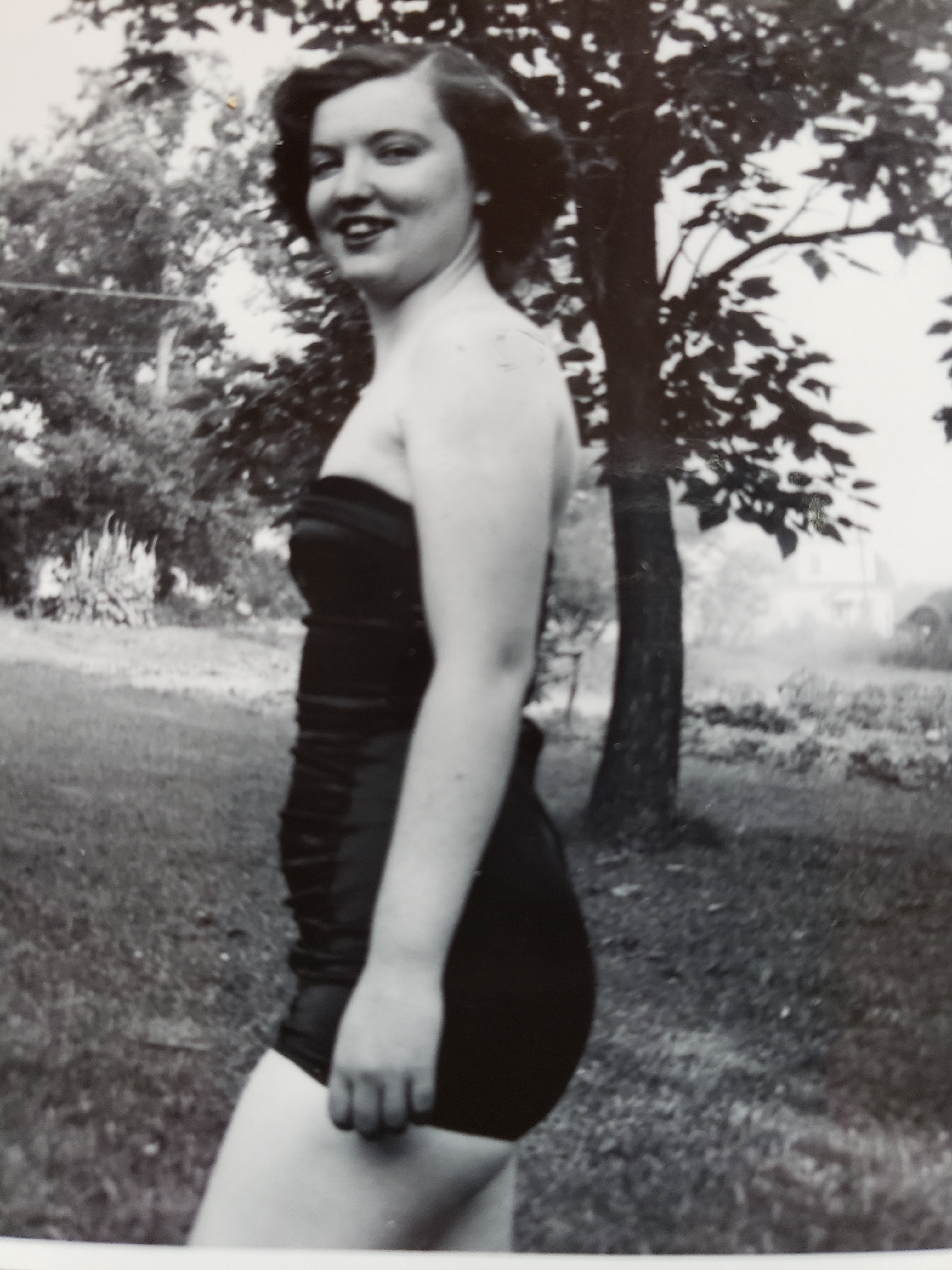
I have a momory about an incident that took place at the cottage probably sometime between the 1940s and early 1950s. Irene junior would have been old enough to be in the room when it happened—the only bedroom in the house, where a small group of female relatives, including her mother and grandmother, changed into their bathing suits before heading down to the lake—but I don’t remember her saying how old.

A younger married woman first raised Irene senior’s hackles by not modestly turning away from the others as she removed her clothing. Flashing portions of her naked body, this woman complained about her husband, said she wasn’t happy in her marriage, and wanted to leave him and get a divorce. Irene scolded the woman—I don’t remember if our mom said it was a niece, perhaps, or a younger cousin—telling her to stop talking foolishly, to behave herself, and go on home with her husband. Our mom related that the young woman felt properly chastised and indeed continued in her marriage, never again mentioning leaving her husband. Nana, our mom said in a tone ladened with finality, didn’t approve of divorce, so there was no divorce in our family.

Lately I’ve been considering that momory alongside another one that should be prefaced by this piece of information. At some point early in our parents’ marriage (or maybe just after they’d become engaged—my memory of the momory is faulty here), Nana bought our dad Mike a pair of sturdy leather work boots. Even if this had been a birthday or Christmas present, it was a generous gift and not inexpensive.

I have wondered if the boots might have been Nana’s way of apologizing for a remark she made, not in Mike’s presence, but one all the members of the Berwyn bungalow household probably chuckled about as they gleefully relayed it to him. Our mom still laughed about it decades later whenever she brought it up; our dad did something like an eyeroll when she did.

The story went like this: While our mom waited for our dad to pick her up for one of their first dates, Irene senior watched as he got out of his car and headed up the concrete front steps of the bungalow. She noted his appearance—loose-fit khaki pants, a Hawaiian-style shirt, dark sunglasses, probably a cigarette in his hand—and announced, “A hoodlum’s come to pick up our Irene.”

(Mike, about 10 years before he met Irene junior, cultivating that “hoodlum” appearance.)

Nana must have changed her mind soon after having an actual conversation with our dad. The two of them ended up liking each other. The work boots she bought for him were a thoughtful gift. Mike learned land surveying in the army, a trade he continued in civilian life, and quality footwear made a huge difference to his on-the-job comfort.

(Mike, somewhere in Korea sometime in 1951, wearing boots similar to the ones Irene senior later gave him.)

Our dad kept those boots for the rest of his life, carefully cleaning and polishing the leather, getting the soles and heels replaced when they wore down.** They probably reminded him of Nana and of that early kindness. He cried when she died, our mom told us. We understood the weight of that sentence. We never saw our dad cry so Nana must have been really special to him.

I sometimes think about the momory of that event at the cottage—our mom’s pronouncement that Nana would not tolerate divorce—and the momory of Nana’s first glimpse of our dad that prompted the hoodlum comment which may have led her to buy the boots. Then I imagine the connections among all these, and the subsequent strong bond between our dad and Nana that prompted his tears at her death.

But to explain how I’ve imagined those connections, I’d have to delve into two family secrets of 2912. That’s what brings me to a dead stop every time I reach this point. I’ve tried to write about them, and I still can’t. While the cat has long been out of the bag about both secrets (at least within the family), they are entangled in many other issues that seem too daunting to unravel. So every time, I just stop writing.

Why bring this up now? Well, sorting through those photographs made me think about it. Plus I’m at the beginning-ish stage of a new book project, which involves a lot of research, some of which ends in frustration because of what’s missing. Or what I believe is missing.

Researching and writing biography requires tracking down a variety of sources, including pictures, letters, and memoirs. I rely on not only what other people decided to save in terms of physical artifacts, but also what they chose to write about, whether as notations on the backs of photos, information passed along in correspondence, and/or remembrances included in memoirs and/or autobiographies.  

Decisions and choices like these produce silences in the archives leaving researchers to constantly ask how materials have been selected and saved, but also, very specifically, what’s missing and why it might be missing.

I’ve imposed some silences in my family’s archives by saving some photos and pitching others and by sharing some specifically collected and very consciously edited memories and momories.

After Kathi and I finished looking through all those pictures back in October, I headed off for my first major research trip for a book about Jane Grant, co-founder of The New Yorker magazine and lifelong women’s rights advocate. And there, in the vast collection of her papers, I faced silences. More on that in the next post.***  

(Jane Grant, c. early 1940s, Jane Grant Photograph Collection, PH141, University of Oregon Libraries Special Collections.)

Some asides:

*Decades later, when our parents Irene and Mike took us to the cottage in the summer, the first thing my dad had to do when we arrived was clean up the outhouse, especially to get rid of the spider webs. None of us siblings would go in there if we saw spider webs. Even in the 1960s, the cottage lacked an indoor toilet. Our mom disliked being at the cottage, probably because, with four children, she had more work to do during what was supposed to be a vacation. But, because of the four of us, our parents could only afford cheap vacations. The cottage was free to use, within a couple of hours’ drive, and was right near a lake that kept us busy during the long summer daylight.

**After Mike died, Charles, my husband, took the boots. They were still in relatively good shape, but after many decades they only fit one pair of feet so had finally outlived their usefulness.

***It’s Women’s History Month, so I hope to post one or two pieces about Jane Grant and what’s been happening with my research. This year, the National Women’s History Alliance has chosen the theme of “Women Who Advocate for Equity, Diversity, and Inclusion,” which is a good match for my Jane Grant project.

A Refinishing Tale from 2912

One of my mother’s talents (in addition to umpiring Little League baseball games and telling stories) was refinishing furniture. I think she may have been inspired by the 1970s hoopla surrounding the American Bicentennial. She developed an interest in Early American (sometimes called colonial) furniture and décor—not just original pieces (which she never could have afforded) but also the contemporary spin on them (now sometimes called Bicentennial Chic) as envisioned by furniture retailers like Ethan Allen.

(1970s Ethan Allen ad)

Even Ethan Allen furniture was more than my parents could afford. So my mother acquired pieces (garage sales, flea markets, family hand-me-downs) she thought looked antique and refinished them to make them appear even more so. She tackled old, yellowing varnishes and vanquished all evidence of paint (she did not approve of painting wood furniture). In my memory, she has a workspace set up on the driveway in front of 2912’s two-car detached garage. The portable radio, tuned as always to WGN and probably broadcasting a Cubs game, blares as she uses chemical stripper with abandon, forgoing safety glasses (she wore eyeglasses, which were enough) and rubber gloves (she didn’t have to actually touch the stripper). But she keeps her cigarette at a safe distance. This provides an acceptable amount of exercise for her as she walks back and forth for her nicotine fixes.

My mother’s best moment came as she carefully scraped off the bubbling stripper to reveal some beautiful wood. She always hoped for oak, her favorite, but she was pretty much happy with anything that wasn’t pine. Then she stained and sealed and had a lovely new old piece.

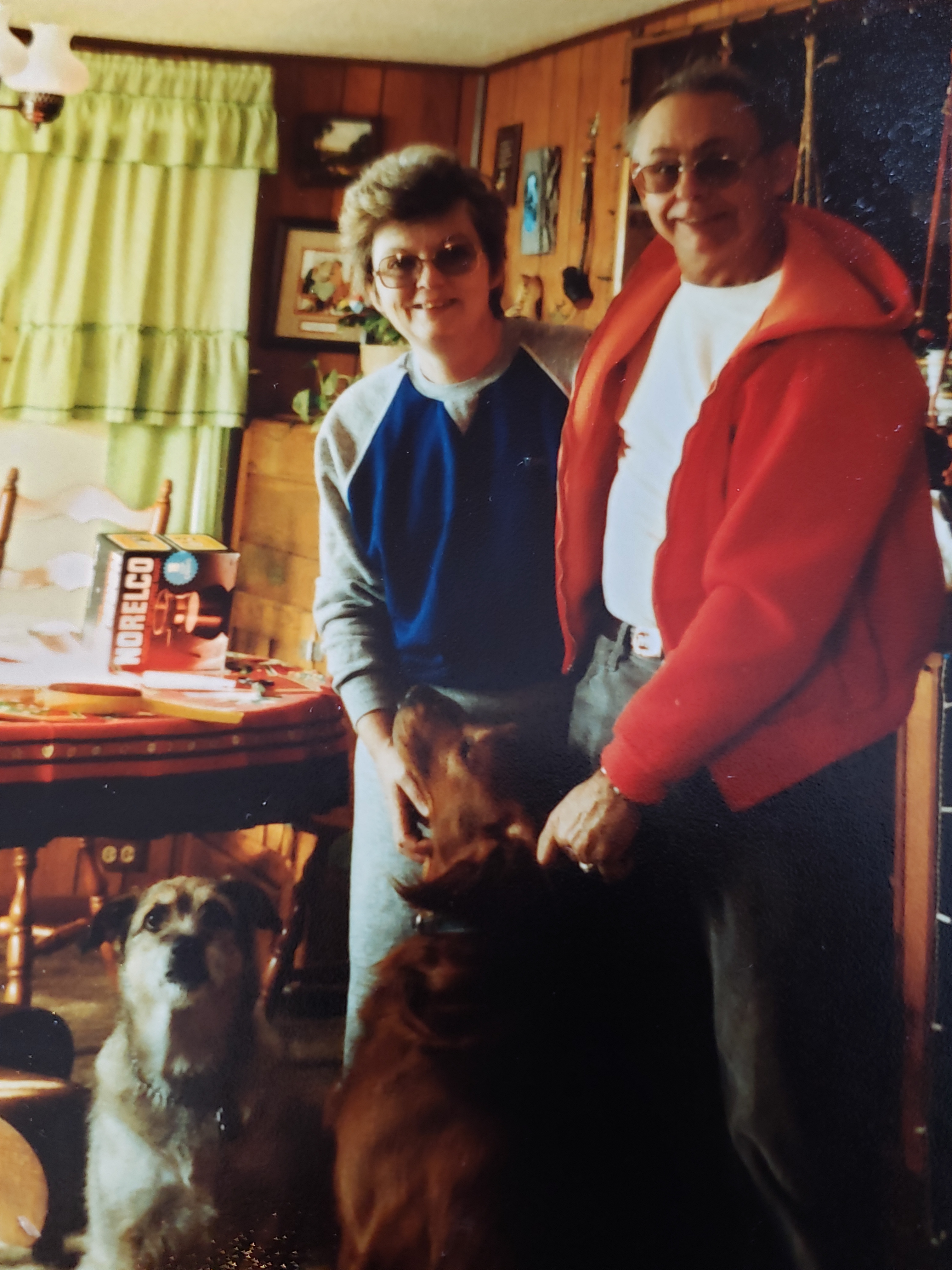
In this photo taken at Christmas time (note the little twinkle lights strung across the room divider and the bottom edge of a bell decoration hanging from the ceiling) of 1983 documents my mother’s design style. The green ruffled drapes and the milk glass light fixture signaled Early American to her. The round oak table, one of her best refinishing projects, was her pride and joy. My big sister reminded me that it once belonged to our great-grandmother, who used it in her summer cottage at Petite Lake. We used the table every day for our meals. On Thanksgiving and Christmas Eve, my father hauled the leaves up from the basement and wrestled them into place so there was enough room for the relatives. Behind my mother’s shoulder is the side of an old ice chest that she also refinished and turned into a bar cabinet. I think she was almost as proud of that piece. Both the table and the cabinet remained right there in the dining room until she died.

(For dog lovers: The golden retriever, the only purebred dog my parents ever owned and only because my father was friends with the breeder, was officially named Sir Ski Kaminski but nicknamed Ski. They chose this name because when they opened the back door to call him in, they could yell, “Come in, Ski.” The other dog, looking straight at the camera, was Mickey, a lovable but very, very dim mutt. He belonged to my sister, who wisely left him behind when she moved away from home.)

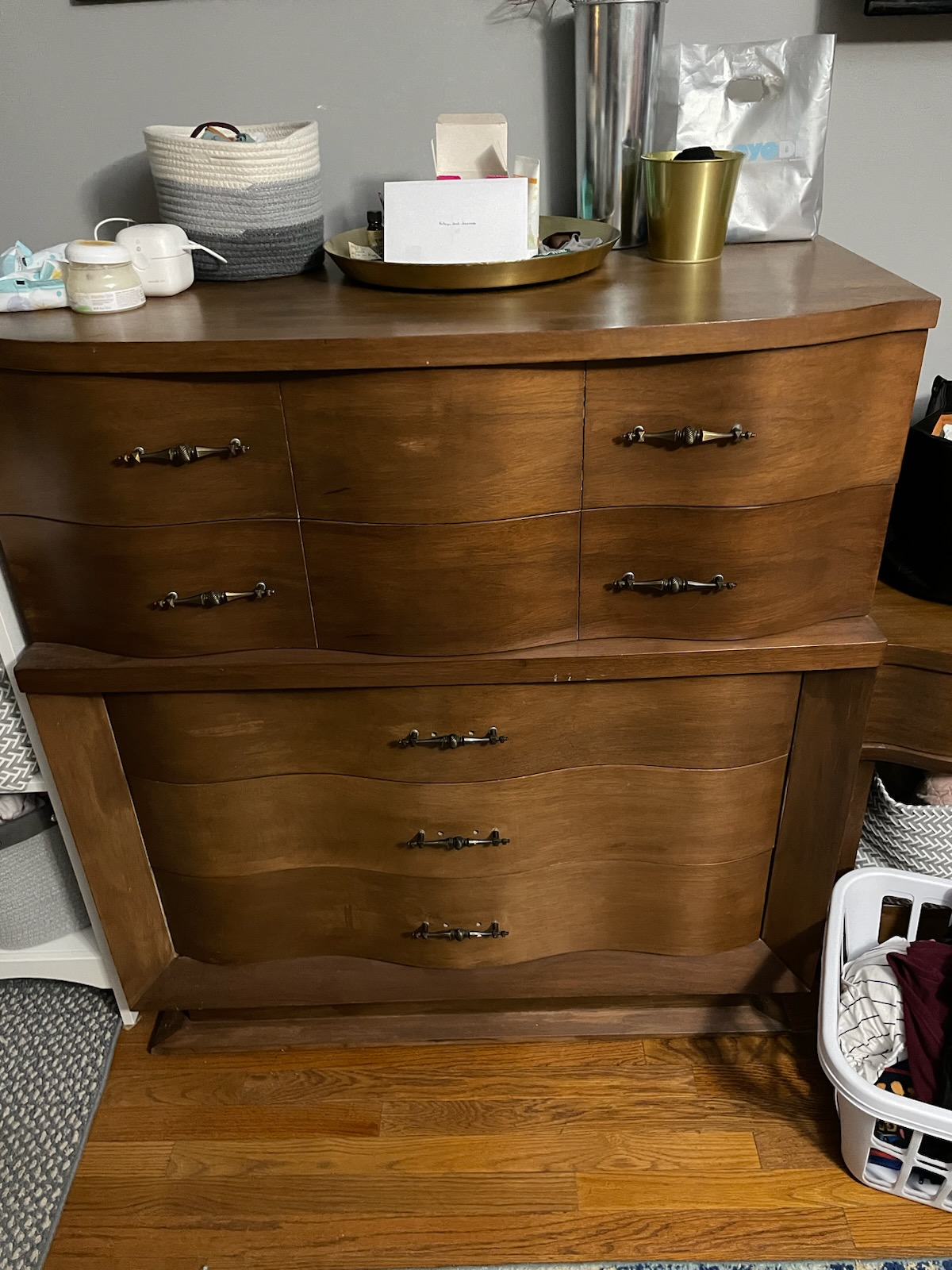
The last refinishing project I remember my mother completing was my parents’ bedroom set. They bought it—dresser, chest of drawers, two nightstands—the year they were married. It was made by the Kent-Coffey Manufacturing Company of Lenoir, North Carolina, which specialized in affordable, mass-produced, stylish furniture. The set was classic midcentury modern, finished in a silvermist grey coating with space-aged hardware. I haven’t been able to find a photo, but I did run across this furniture store ad that included Kent-Coffey bedroom sets.

Sometime in the 1980s or 1990s, my mother decided she’d looked at that grey finish long enough and wanted to get rid of it. (The midcentury mod enthusiast in me now cringes at that decision, despite, like my mother, a general preference for natural wood finishes.) I don’t think she could stand the thought of getting rid of the furniture itself, which was still in amazing condition, but she longed for the wood look. So my mother stripped all the pieces. She found nice wood, but it wasn’t oak—at least it doesn’t look like that to me—and she stained it a dark Early American color and replaced the sleek hardware with more ornate handles. I think she was pleased with the outcome. It was the only bedroom set she ever owned as an adult. She liked it; it was familiar, and it was comfortable.

(photos courtesy of R. Moore)

Then one day my mother was finished with refinishing. I don’t remember if she abandoned a project midway, but I doubt it. She finished what she started, though her satisfaction with the final product could vary from project to project. She learned from any mistakes and moved forward, determined to do better with the next.

The round table, bar cabinet, and bedroom set are still in the family, being used and enjoyed by a new generation. The first two may really qualify as antiques by now, though of course not Early American. Hopefully they will endure for another generation or so beyond that, tangible reminders of one of Irene Kaminski’s talents.

A Travel Tale from 2912

Now that summer is drawing to a close, I find myself thinking about the car trips we took when we were young.

car trip 1960s

Here we are in the way back of our station wagon in the summer of 1966. I’m on the right, looking bored (but probably already worried about getting carsick), holding my favorite doll, Susie, who went everywhere I went. We rarely took a big family vacation, like a week-long trip to anywhere, but we often went someplace that was driveable within a day. And many, many times, in any season, this meant a trip to Lake Geneva to visit my maternal great-grandmother.

3632 Oakrest Lake Geneva

We headed to this house, located on the edge of town, within walking distance of Linn Pier, a beach area with bright blue, frigid water, and a rocky bottom. Still, when the weather was warm, we liked nothing better than piling back into the station wagon for the bumpy ride down the road, and shoring up our courage to jump from the pier into the cold water. But if the weather wasn’t warm enough or the adults didn’t want to supervise us in the water, we improvised our own games in the big side yard. When we got bored with that, sometimes we could talk the adults into taking us to the tavern across the street. It was a neighborhood place that, though taken up by a big bar, catered to the neighborhood families. Children could often be found inside with their parents. We thought it was great fun to climb up on one of the bar stools and twirl around as we drank a glass of Orange Crush or 7-Up.

Lake Geneva c. 1966

My great-grandmother, Katie, was the heart of these visits. I’m not sure what this occasion was, but it looks like it took place in the early spring, before the arrival of warm weather. Our father, always the one with the camera, would have organized this photo. Katie is standing there at the far right, in all her white-haired glory, next to her eldest daughter, Martha (my maternal grandmother), who is next to my mother Irene (Martha’s only daughter), who is standing next to Grace, my mother’s favorite aunt and Katie’s younger daughter. Grace and her husband Jack (sitting on the front step, holding the youngest of us) lived in Katie’s house. This arrangement seemed normal to me because my other great-grandmother (we called her Nana), standing in front of Grace, lived with her daughter-in-law Martha. Both great-grandmothers and my grandmother were widowed by then.

My strongest memory of my great-grandmother is of her sitting on a straight-backed chair in the kitchen, quietly smiling at us as we raced around the house. I don’t remember ever having a long conversation with her. I guess I probably thought we wouldn’t have much to talk about. But I do remember a visit a few years after this photo was taken, when my mother asked if I noticed anything different about great-grandma. I looked at her sitting in her favorite chair, smiling, and nothing looked different. I shook my head. “She’s wearing pants,” my mother said. “Katie decided to wear pants.”

At the time I thought it was a little bit cool that such an old woman had ditched her day dresses for slacks, like so many pants-wearing women in the early 1970s. It didn’t occur to me that maybe Katie delighted in bucking tradition because it was something she liked to do. It didn’t occur to me that she had a whole big life long before I entered the world.

Katie was born in 1886 and grew up in Chicago, where her father was a butcher in a packinghouse. She married Clarence, a Dutch immigrant, in 1907. Their first daughter, Martha, arrived soon enough, but seven years passed before Katie gave birth to Grace. By 1920, the family lived in a rented house on Morgan Street. Clarence worked as a salesman in a shoe store; Katie kept house.

The next ten years brought changes to the family. Martha grew up and left home to get married. After the stock market crash of 1929, as the country sank into the Great Depression, Clarence managed to hold onto his job at the shoe store. But business likely slowed down and he may have had his hours cut. They still needed to make rent. They still had another daughter to finish raising. So Katie found employment at a local grocery store. It was not an easy thing to do. White middle-class married women weren’t supposed to work, not even during the Depression. Jobs were supposed to be for men who needed to provide for their families. But Katie and Clarence knew they both needed to provide to get themselves through the economic disaster.

Katie was apparently good at her job and probably liked it, too. By 1940, not long before the United States formally entered World War II, she had been promoted to manager. She brought 24-year-old Grace in as a clerk. They all made it through. 

Grace and Jack never had children. This may be why Grace was one of the first working women I ever knew. When we were young, most of the women we encountered were mothers like ours, who stayed home and took care of us. To me, Grace seemed unusual, even a bit strange, because she had a job. But when I was a child, I didn’t think to ask any questions about it. And now, I think a lot about my great-grandmother, sitting quietly in her chair, wearing her new pair of pants, probably proud that even late in life she could still do something new and daring.