Triangle Shirtwaist Factory Fire

On Saturday, March 25, 1911, just before closing time, a fire started in the upper floors of the Asch building at 23-29 Washington Place in Manhattan.

File:Triangle Factory fire 004.jpg

The Triangle Shirtwaist Company’s non-union shop employed about 500 workers, mostly young immigrant women from Italy and Eastern Europe.

trianglehbo.JPG HBO photo

They worked long hours under unpleasant conditions for minimal wages making shirtwaists, a popular clothing item of the New Woman of the early twentieth century.

Image result for shirtwaist

The fire, caused by a carelessly tossed match or cigarette, spread quickly through the various combustible materials on site. Many workers had no easy avenue of escape. Windows didn’t open properly, doors were locked, fire escapes didn’t function. In less than twenty minutes, 146 people died; all but 17 were women.

Image result for triangle shirtwaist factory

The best online resource about the Triangle Fire is the one maintained by the ILR School at Cornell University. It provides an informative historical overview and contains numerous primary sources, including photographs, oral histories, and a transcript of the criminal trial of the factory’s owners.

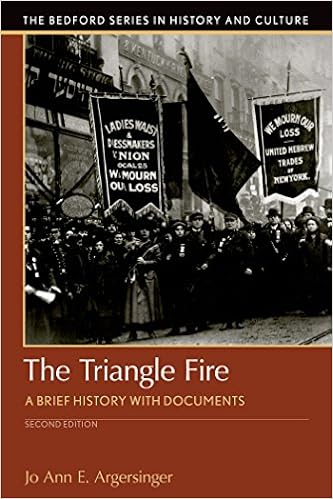
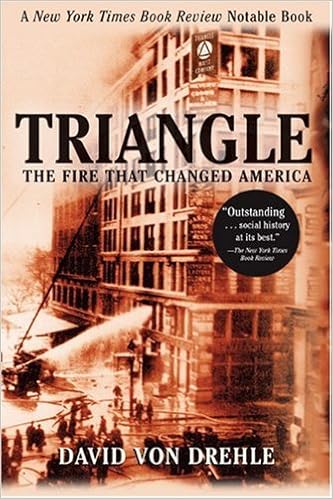
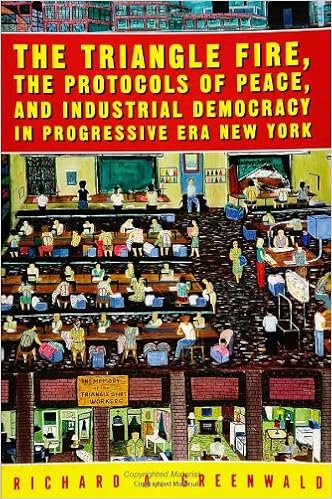
There are several good nonfiction books about the fire, including:

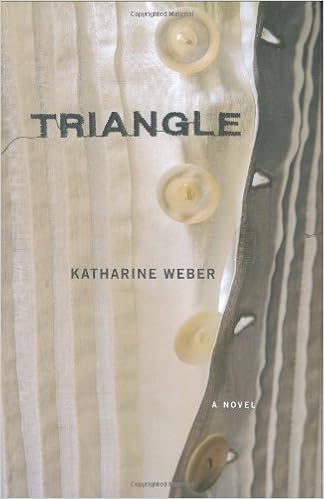
And there is one fine work of historical fiction about the fire:

In fact, Weber’s book is on my list of all-time favorite novels. It’s the very model of historical fiction for the way in which it evokes time and place while delivering memorable characters.

So pick up any one of these books to learn more about the fire. I recommend starting with Weber’s.


Women’s History Month 2018

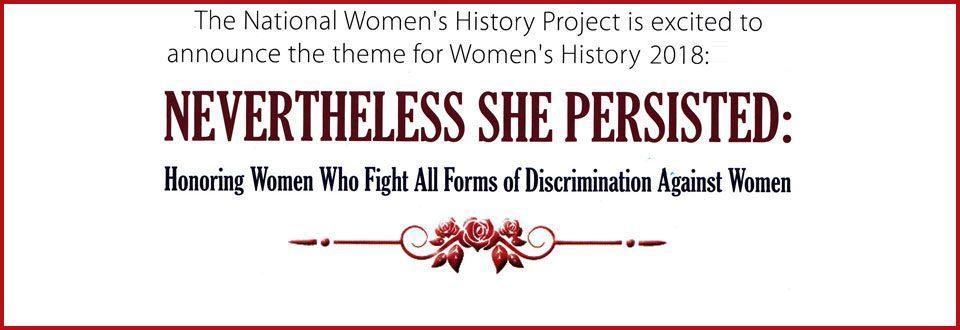
This year’s theme is wonderful, both timely and historical:

Image result for women's history month 2018

One of the 2018 honorees is a woman I admire very much, the lawyer/activist Pauli Murray. Here’s what the National Women’s History Project website has to say about her:

Pauli Murray was a civil rights and women’s rights activist decades ahead of her time. Facing lifelong discrimination based on her race and sex, she persisted and become an accomplished attorney, author, activist, academic, and spiritual leader.

Pauli Murray was extremely bright as a child, she finished first in her class at Howard Law School where she was the only female student. Despite her academic prowess, she was denied admission to UNC graduate school in 1938 due to her race and denied a fellowship to Harvard Law in 1944 due to her sex. She went on to be the first African-American awarded a law doctorate from Yale (1965) and later became the first African-American woman to be ordained an Episcopal priest (1977).

Murray was a critical figure in both the civil rights and women’s rights movements. In 1940, fifteen years before Rosa Parks, Murray was arrested for sitting in the whites only section of a Virginia bus. She coined the term “Jane Crow” referring to the intersecting discrimination faced by African American women and was highly critical of sexism within the civil rights movement. JFK appointed her to the Presidential Commission on the Status of Women (1961) and she was a co-founder of the National Organization for Women (NOW) in 1966. Many of Murray’s legal theories were decades ahead of their time and she is considered a pioneer of women’s employment rights. Her papers while a Howard law student arguing against segregation were used over a decade later in the landmark Brown v. Board of Education case (1955). Similarly, in the early 60s she argued that the 14th amendment forbade sex discrimination, a full ten years before the U.S. Supreme Court came to the same finding in Reed v. Reed (1971).

Pauli Murray died in 1985. The Episcopal Church honored her as one of its Holy Women in 2012. In 2016 Yale University announced it would name a residential college after Murray, and that same year her family home in Durham, NC was designated a National Historic Landmark by the National Park Service.

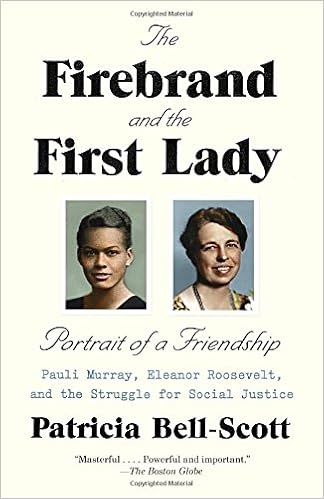
To learn more about Pauli Murray, I recommend:

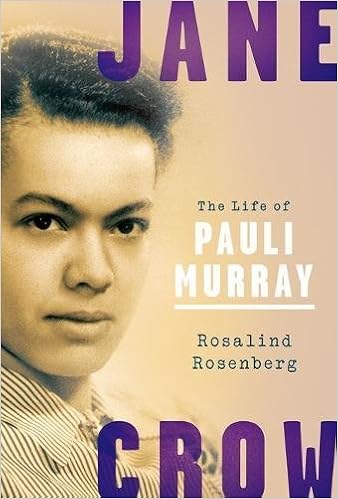
and


It’s Women’s History Month

In my line of work as a women’s historian, every month is women’s history month. Still, it’s nice to have a month designated for a special observation of the history of those who make up more than half of the population.

2017 Poster

This year’s theme is trailblazing women in labor and business. One of the women being honored by the National Women’s History Project is Kate Mullany, who in 1864 started what is considered to be the first all-women union in the United States, the Collar Laundry Union of Troy, New York. After a five-day strike, laundry owners began to capitulate to the workers’ demands and implemented a 25% pay hike. Women continue to be an indispensable part of working-class activism into the 21st century.


Celebrating Easter Under an Enemy Occupation

After Japanese forces occupied the Philippines in early 1942, American civilians and other Allied nationals were forced into internment camps. The camps had a plethora of rules, including a ban on “commingling”–an enforced separation between adult men and women, including husbands and wives–and rules on what women could and could not wear.

Camp commandants demanded that women be “decently” attired at all times with discreet necklines and long skirts, just like proper Japanese women. But because of the almost unrelenting heat of the Philippines, American women tried to get away with as few articles of clothing as possible while remaining seemly by their own standards.

In the Santo Tomas internment camp in Manila, women were particularly forbidden to wear shorts of any length. The camp’s civilian Executive Committee, run by men of the Allied countries, approved of the ban no matter how much the women resisted, believing they were saving their women from the possibility of sexual assault by the Japanese. However, by the end of 1943, clothing was in such short supply that the Japanese agreed to relax the ban. Women could wear shorts that were no more than four inches above the knee.

To take control of their appearance and to reassert American traditions, the women in the Baguio internment camp celebrated Easter of 1942 by attending a sunrise service with their families, then staging a parade during the Sunday night socializing hour.

Almost every adult woman created a new Easter hat, long an American tradition, and joined the parade. Missionary Fern Harrington recalled that “shrieks of hilarity punctuated the afternoon as the women fashioned their hats.” She covered a strawberry basket with a variety of flowers she had picked the day before. Harrington declared that the “smartest” hat was the one made from a roll of toilet paper tied to a woman’s head with a ribbon. Another woman wore a branch on her head adorned with a paper bird. Yet another hung onions from her ears as earrings and arranged long green sprouts on her head.

The parade was a big success. The internees laughed as they thoroughly enjoyed themselves, that is, until the Japanese guards heard the commotion and moved in to break up the event. It had been one of a few bright spots in what would stretch into three years of life under an enemy occupation.

Want to know more about American women’s experiences under internment? Read Prisoners in Paradise: American Women in the Wartime South Pacific.


Mabel Vernon: suffragist, pacifist

One of the most notable and important members of the National Woman’s Party, Delaware native Mabel Vernon gave up a stable, respectable teaching position to work on the campaign to secure a constitutional amendment for women’s suffrage.

Originally involved with the National American Woman Suffrage Association, Vernon joined Alice Paul’s Congressional Union in 1913 as an organizer and fundraiser. She was one of five suffragists who held up a banner asking, “Mr. President, What Will You Do for Woman Suffrage?” at Woodrow Wilson’s December 1914 address to Congress.

When Alice Paul created the National Woman’s Party out of the Congressional Union in 1916, Mabel Vernon became its secretary. She was instrumental in organizing the Silent Sentinels–the suffragists who picketed the White House beginning in 1917. Like many of those women, Vernon was arrested on charges of obstructing traffic, refused to pay the fine, and spent time in jail. Until the Nineteenth Amendment was ratified, she worked tirelessly for the cause, traveling state to state giving speeches and launching a major letter-writing campaign.

During the 1920s Mabel Vernon continued to work for the National Woman’s Party and its goal of securing the Equal Rights Amendment. She supported women who ran for public office, especially congressional seats. By 1930, though, Vernon had become more interested in pacifist issues. She joined the Women’s International League for Peace and Freedom, working for decades to prevent war through disarmament and diplomacy.