From Expert to Novice and Back Again

So I’m still here, at the start of a new project. I’m trying to stay focused on phase one: pull enough stuff together to write a winning book proposal.

Image result for winning 1950s

It’s strange to be back at the beginning where I’m still learning. Since the publication of my first book

PIP cover

I’ve been an expert on this one thing: the history of American women in the Philippines. I wrote two more books about them, so I’m not exaggerating the expert thing too much.

With the new book project, I only possess a very basic knowledge of the subject, barely enough to write a cohesive introductory paragraph. So I’ve been researching like mad, trying to get a feel for a new place and time, trying to understand the lives of a different group of women.

Image result for woman surrounded by books 1950s

And already I’ve been stunned by the professionalism and generosity of archivists at two different institutions who have responded to my inquiries with lightning speed, offering to get items to me as soon as possible and even offering additional suggestions. I wish I could name them right now, but that would prematurely give away my book’s topic. I’m already keeping a list of names to include in the book’s acknowledgments. It’s a small way to pay a big debt. (That, and maybe a free copy of the book.)

Image result for archivists 1950s

I know the archivists aren’t working just for me, but it seems like they are. No one writes a book alone, and archivists are an essential part of the book creation community. I’m fortunate to be able to tap into their expertise. Pretty soon, some of that will rub off on me.


Launching a New Book Project

I’m not a fast writer. When I hear authors talk about how it took them two or three long years to write a book, I struggle to hide my reaction.

I can take two or three years to research a book. Even then, research continues as I start writing.

Since Angels of the Underground was published last December, I’ve been casting about for a new project. I really wanted to return to one I’d started before Angels, but every time I raised the subject with my agent, she was skeptical. I was amazed at how quickly she could run down a list of concerns about the commercial viability of the project.

Although my day job is as an academic historian, I want to write books that will sell well. I figure if I invest so much in creating them, I’d like to see a material return on that investment.

I spent the early part of the summer working on an abbreviated book proposal, to clearly map out for my agent my vision for the project she was skeptical about. And she still wasn’t convinced.

So it wasn’t until this month that I started pitching other projects.

And one stuck. A very good one, we both believe. It’s another story of a group of “ordinary” American women who make an extraordinary contribution to a U.S. war effort. (No more details at this point. I don’t want to jinx it.)

I’ve started work on the book proposal, which will end up at around 50 pages of overview, market analysis, and chapter synopses. Then it will go out on submission in hopes of finding an editor who thinks the book is as exciting as we do.

Stay tuned. It may be a long haul.

The Day Before

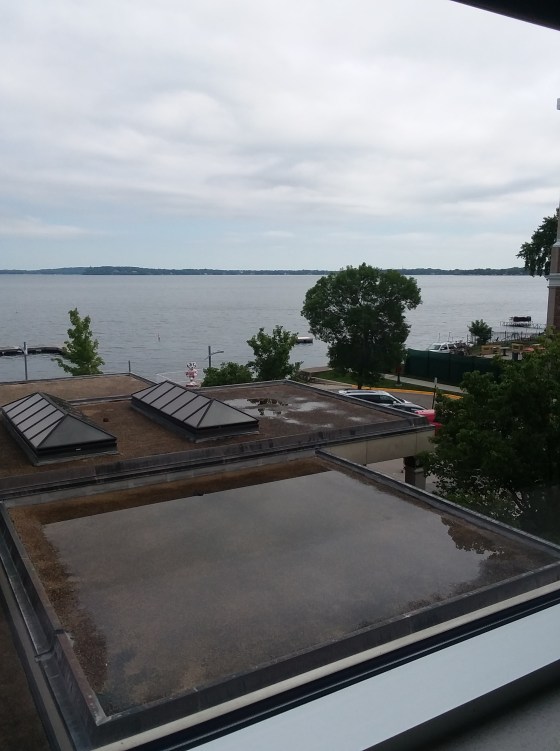
I’ve been on vacation. I try not to work during this time, but trying isn’t quite doing. I had a book review to write and submit by August 1. It was tough, especially since that deadline competed with views like this:

Sturgeon Bay

In the midst of this tranquility, I realized today is August 5. I wonder what that day was like in 1945. By the next day, the world had changed. More on that tomorrow.


Write by the Lake: Day 5

Then it was Friday. Summertime weeks speed by; this one seemed to go doubly fast. Just when we got started, there we were, wrapping up.

I’d barely been able to finish my homework for Friday because of the author event at Mystery to Me on Thursday night. That turned out well. (Except for the drive into Madison, at the tail end of rush hour, causing me to arrive just in time.) The cozy crowd included my husband, a long-time academic friend who was also attending Write by the Lake, and a new friend from the workshop. And there were a few others, too, and some of them stayed around to chat a bit after the q&a with journalist Doug Moe. Doug asked great questions that allowed me to talk about Angels of the Underground, which I love to do. It all lasted for about an hour and a half, and Joanne kept the cash register open long enough for me to buy the new novel by fellow Wisconsin writer, Ann Garvin.

mysterytome

So I didn’t get to my workshop homework until Friday morning. But I got it done. During the session, we read through some of those completed assignments and worked on another writing exercise. To wrap things up, the instructor talked a bit about the querying process involved in finding an agent.

Overall, this was a good experience. There is great value in connecting with other writers (our workshop was a great group) and on developing writing skills. I wish there had been more of that latter thing, especially as applied to our individual projects. The six of us in the workshop all have book projects started. We need to keep going.

Throughout the week I kept thinking about how I would have structured a writing workshop. At the top of my list: have the attendees do a lot of writing, critiquing, and revising. Our homework assignments and in-class exercises were quality assignments for honing our skills of observation and description. We should have then applied what we learned to our manuscripts-in-progress, with the goal of writing 5-10 pages per night. Copies of those new pages could have circulated within the group for critiques and rewrites. That would’ve been a wonderfully productive workshop.

Now, the rest of the summer looms.


Write by the Lake: Day 2

The rain held off through the afternoon; it was another beautiful day on the UW campus.

Workshop sessions started at 9:30 this morning. There are seven of us in this particular non-fiction workshop, and most of us arrived early to our assigned room. We had time for some catch-up conversations before the instructor arrived: talk about our individual projects and about how we fared with our writing homework.

Then the instructor pulled us into our business of the morning. We went over the homework responses–how we imagined the possible endings to a particular scenario. It was an interesting exercise, a way of getting us to think about how and why people respond to certain situations.

We discussed how to construct log lines and the purpose for constructing them. You can never tell when you might need a log line (also known as an elevator pitch), but it’s a good idea to be able to explain, clearly and concisely, what your book is about. Most people really won’t listen to a long, detailed explanation–no matter how interesting the topic. It’s hard to boil down a book’s essence to one or two sentences, yet crafting a log line can really help you to keep focused on the basics of your book: who is the main character and what is their central conflict or obstacle?

We learned about the components for a book proposal. I wrote one for Angels of the Underground, and I’m in the process of writing one for this new project, so this was a helpful review.

There was also another very good discussion of another group member’s 2000-word submission. The instructor delivered insightful comments, and the rest of us added a few additional points. Overall, another productive morning.