
I became totally engrossed with archival sources when I decided to look more closely at Jane’s pre-World War I romances. I spent the whole week not only piecing together her love life but also thinking about how and why people choose which documents to keep with them throughout their lives and how those items end up in boxes in archives for researchers to later scrutinize.
The papers in this particular box of Jane’s papers that are held at the University of Oregon comprise her correspondence from 1911-1918, but it is one-sided, made up of letters she received. Sometimes they provide clues about what Jane had written to prompt a response, sometimes they don’t. It’s up to the historian to figure out what was going on.
For example, one letter, undated (which adds another layer of difficulty), was addressed to “My Dear Little Jeanette” (Jane’s legal first name) and signed “Geo.” Someone had penciled in a date range of 1912-1915 at the top of the first page, which confirmed a year referred to by “Geo” within the letter.
The letterhead was printed with “Newton Farm, Los Gatos, California.” It was easy to conclude that the letter was written by George Newton. Supplied with a date range, location, and name, I turned to Ancestry and Newspapers.com, two online library databases. A few hours of searching enabled me to make some informed assumptions.
George F. Newton, born in Iowa and in the mid-1910s somewhere in his middling forties, owned the eponymous farm, but used it as a country getaway. He and his new wife Avis, some twelve years his junior, lived most of the year in the San Francisco/Oakland area where he ran a fireworks company.
Newton wrote to Jane to thank her for her “sweet little birthday letter.” Because he told her he couldn’t spend much time on the farm until after the Fourth of July (a big day for fireworks) and because he encouraged her to come visit in 1915, I think the letter was written in the spring or early summer of 1914.
But it’s not clear how Jane knew Newton. At one point, when he was young, his family lived in Kansas, so it’s possible he was an old family friend or even a relative. In the opening salutation, he called her Jeanette, the name she tried to put behind her when she moved to New York.
I’m still trying to figure out if this sentence provides a clue about their relationship: “I have the limousine in the city and think of you every time I ride in it.” Did Newton know about Jane’s career ambitions, and did he pick up on her desire to have fine things?
Newton wasn’t angling for an affair, though. Twice in the letter he mentioned his wife, and he explained the reason behind his invitation to visit. “I am sure you could get along better here than in that big cold city of N.Y. Mrs. Newton says for you to come out here and call us Father and Mother and see how you like this country. If I can find you a position in advance will you come?” Newton understood that Jane’s career was important to her.
And here’s the connection to Jane’s love life. Newton tried to sweeten the offer in his P.S.: “I have a dandy handsome fellow picked out here for you his name is Billie.” Apparently, he knew about how she socialized with young men and wanted to assure her that she would have plenty of options in California. But maybe Jane worried that Newton’s main purpose was to get her married and settled. That was not what she wanted.
It’s not surprising that Jane didn’t take Newton up on his offer. His letter only indirectly refers to Jane’s dating. There are no other letters in the collection from Newton, but there are some from men that provide more evidence about her relationships. These men were involved with her, and thought they knew her and knew how she felt about them. But it seemed they were very wrong.
For some reason, these letters ended up with all of Jane’s other papers at the University of Oregon. It’s hard to know if she kept them on purpose because they brought back particular memories, or if they just got stuck in a folder somewhere and never got tossed out. This may all become clearer after I conduct another round of research. Or it may not.
Women’s History Month
A reminder that I will appear live on John Heckman’s YouTube channel on March 24 at 2:00 p.m. Central to talk about Dr. Mary Walker. The installment bears the bold title, “She Defied Them All.” You can find The Tattooed Historian’s page on Facebook, follow him on Instagram, listen to his podcast, read him on Substack, and/or watch his YouTube channel.
Also remember to check out Pamela Toler’s annual WHM series on her blog, History in the Margins. She runs the best Q&As with people who write women’s history.
What I’m Reading
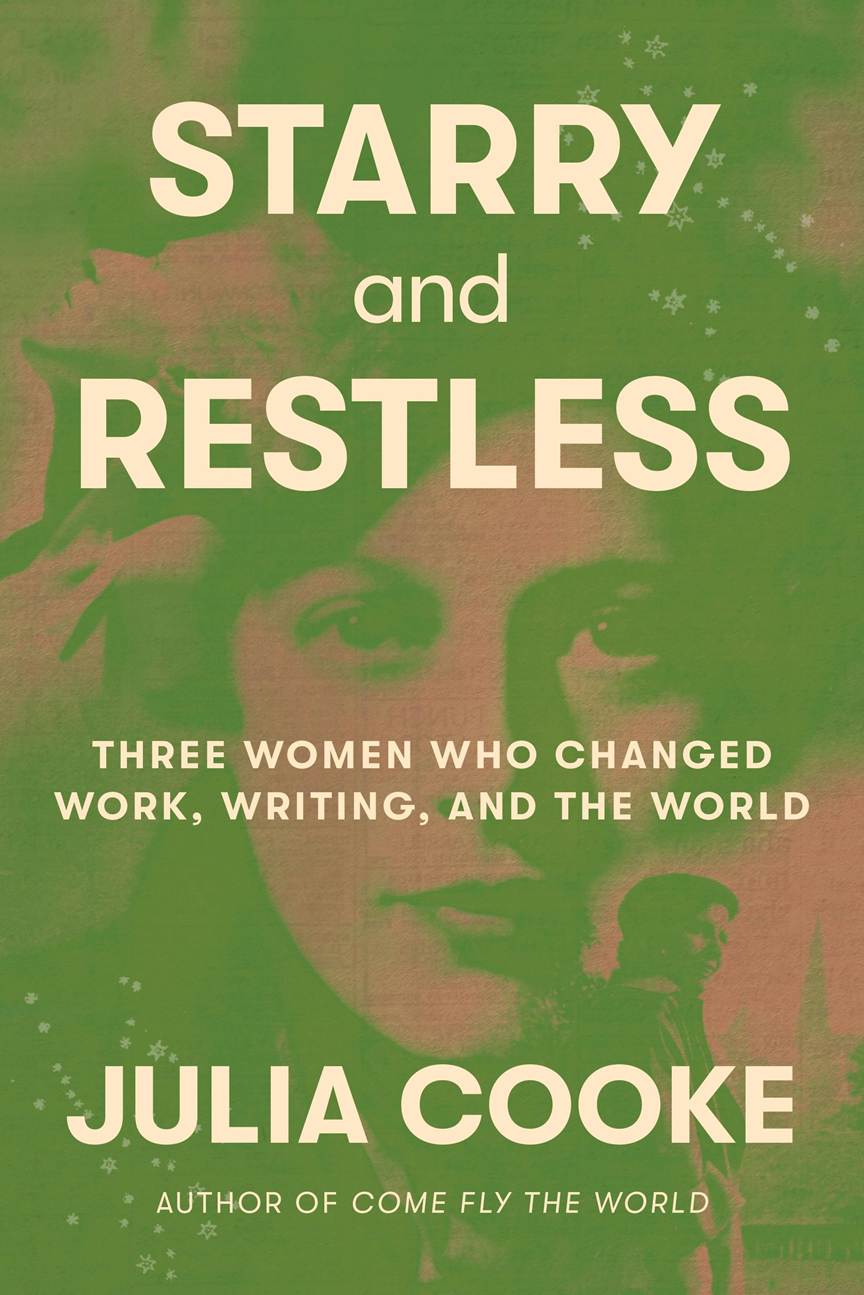
I picked up my library copy of Starry and Restless: Three Women Who Changed Work, Writing, and the World by Julia Cooke. I’ve been particularly interested to read about Emily Hahn, one of the women I wrote about in my very first book, Prisoners in Paradise. I’m pleased to see that Jane Grant’s name pops up a few times in Starry and Restless, and the book had got me thinking about some of the choices Jane made during the 1930s, after she’d been shut out of The New Yorker and she left her job at the New York Times. Jane was restless then, but not, I think, starry.
I’m continuing with Mike Pitts’s Island at the Edge of the World: The Forgotten History of Easter Island. It still holds my interest.
For pure leisure reading, I’ve been enjoying Dinner at the Night Library, a novel by Hika Harada, translated by Philip Gabriel.
What I’m Watching
Started Mudtown (BritBox), a crime series set in Wales, featuring a female magistrate, and it’s good so far. Better though—at least based on the first two episodes—is Young Sherlock (Prime). I always like a good reimagining of Sherlock Holmes.
I’m much more on the fence after watching the first episode of Scarpetta (Prime). I don’t mind the dual timeline, but the portion that takes place in the present day (with Nicole Kidman as Kay Scarpetta) reminds me of why I stopped reading the novels by Patricia Cornwell that the series is based on.
Hope Street (BritBox) has been a bit uneven, but I’ve been enjoying How to Get to Heaven from Belfast (Netflix).
Finished Starfleet Academy (Paramount+) and The Lincoln Lawyer (Netflix). The season finale of Starfleet displayed the qualities I’d hoped to see in all of the episodes but didn’t.
What Else I’ve Been Doing
Weekly bowling, two games. The first was abysmal, the second mediocre. So, progress, I guess.
Almost finished another very small sewing project: hemming a pair of jeans, something I’ve been meaning to do ever since I bought them two or three years ago. No matter how much I measure and pin and try them on, I keep thinking I’m going to make them too short.
Thanks for reading. I’m not sure what’s more ferocious than a March lion, but whatever it is, it’s barreling into the upper Midwest. Between Saturday night and Monday morning there might be at least twenty inches of snow, accompanied by high winds. Here at Southfork, we’re under a blizzard warning, and there is ample gasoline for the snowblower and a fully stocked refrigerator, both courtesy of the foreman (who is also my bowling partner and my partner in everything, especially life).
See you next week.
 Theresa Kaminski
You must be logged in to post a comment.