I made a bit of progress on revisions, still working through some history of World War I as it pertains to Jane Grant’s experiences. I read up on the 1916 Council of National Defense and the Woman’s Committee it created in April 1917. Once the United States entered the war, the government decided it needed the support of women and tapped into the well-established network of female organizations that had been around for decades.
Then I looked to see what kinds of articles the New York Times published about these developments to better understand the atmosphere at the newspaper where Jane worked. And I started considering how press coverage of the conflict and the existence of the Woman’s Committee (run locally by the upper-class women she covered for the Society Department) influenced the choices she made about what to do during the war.
Writing occupies a significant chunk of time almost every day, yet there are always other things going on, too. I used to think that I would have more time for writing in retirement, but I’ve found more flexibility in my schedule rather than more time. And that’s okay. This past week I met a friend for a leisurely lunch, wrote an endorsement (blurb) for a forthcoming book about the Philippines during World War II, and spent a lot of time getting ready for a weekend with family centering on a baby shower.
What I’m Reading
Gayle Feldman’s Nothing Random: Bennett Cerf and the Publishing House He Built remains absorbing. It’s due back at the library in five days and can’t be renewed, so I’ll have to finish it some other time. It’s a remarkable achievement.
What I’m Watching
Only one episode left to finish this season of The Forsytes (PBS).
Watched the first episode of the new Dan Levy comedy, Big Mistakes, on Netflix. Very unsure about it. The cast is great and I get the premise, but the execution didn’t quite land during that first episode. Still, with Levy, it’s probably worth watching at least one more episode. (I had to try Schitt’s Creek twice before I stuck with it, but that was mostly because of the presence of Chris Elliott.)
Nearing the end of all the available episodes of Animal Control on Netflix.
Finished the Netflix series, Detective Hole and the first season of Helsinki Crimes (PBS). I think we started Helsinki Crimes last week, but I forgot about it. Not that it’s bad, but it’s a pretty routine police procedural. It’s set in Helsinki, though, which gives it a little something special.
During one of the several family gatherings over the weekend, conversation turned to one of our favorite good bad movies: VelociPastor. I don’t know if any synopsis can do it justice.
What Else Is Happening
Slightly better bowling this week. There were gutter balls again during the first game, but the second game had a strike and a few spares. And afterward—ice cream!
The two pear trees and the mulberry tree survived a week of rain and winds, so that bodes well. There are more buds on all. A most welcome sight is the rapid growth of the peony bushes. Peonies are my favorite spring flower, and every year I closely watch their progress.
(not our peony bushes)
Have a good week. Hope you stop by for the next installment.
Lots of things happen during revisions, including moments when you feel like doing a gentle head-bang on the desk because you can’t believe you almost overlooked something. That’s also when you realize this is exactly why revisions are essential.
They were right there in the scans from the archives. Two brief letters from Elisabeth Marbury, one to Jane Grant, one To Whom It May Concern, both from the summer of 1918, both a part of Jane’s quest to get an overseas posting.
Jane volunteered for the Publicity Bureau of the Mayor’s Committee of Women on National Defense (MCWND) sometime in 1918. Marbury, who officially headed the bureau, was a powerhouse in New York City theater circles, so it’s also possible that Jane already knew her or at least had known of her through her job at the New York Times.
Elisabeth “Bessy” Marbury was born in 1856, the daughter of a prominent New York City lawyer. A former debutante, she drew from her family’s wealth and connections to set herself up in business to promote and manage actors and playwrights. Marbury met Elsie de Wolfe, an aspiring actor about ten years her junior, in the 1880s. The couple lived together for forty years while Marbury grew her company, opening offices in Paris, London, Berlin, and Madrid, and de Wolfe launched herself as an interior decorator.
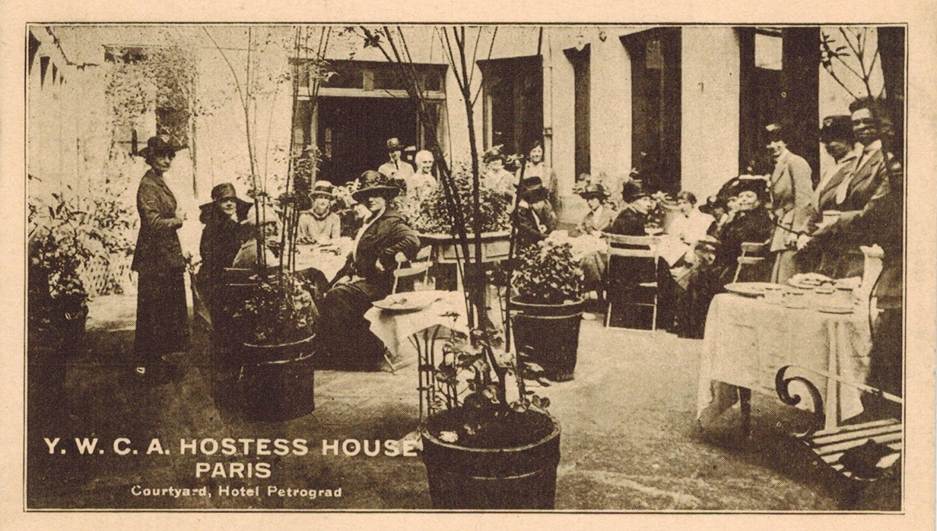
Together they bought a home in Versailles, France, where they spent part of every year until World War I made that impossible. But between 1914 and 1916, Marbury coordinated relief efforts for wounded French soldiers while she was still in the country. Queen Elizabeth of Belgium presented Marbury with a medal in honor of her war service in 1919.
(garden at Villa Trianon, Versailles, France)
Once back in the United States, Marbury worked with at least one other wartime organization in addition to the MCWND. Her business also remained open and thriving. Marbury utilized her theater contacts to put on programs to help fund the war effort. In the summer of 1918, Jane was “conducting the Publicity Bureau” for her on the MCWND and doing such a good job that Marbury both hated to lose her and willingly wrote a letter of recommendation to help her get overseas.
Jane didn’t forget Marbury. During the 1920s, when Jane was involved in two other quite different endeavors, she looped Marbury into those as well, one successfully, the other not. But by then, Jane was practiced in establishing connections with influential people and making good use of them.
What I’m Reading
Gayle Feldman’s Nothing Random: Bennett Cerf and the Publishing House He Built is very absorbing. It’s a huge book, and I admire all the careful research Feldman conducted and her skillful crafting of the narrative.
What I’m Watching
Two very quiet, excellent movies on Prime: Sam and Kate, starring Sissy Spacek and Dustin Hoffman, and The Summer Book, set on a small Finnish island, starring Glenn Close as the grandmother. No murders, nothing blows up. Just relationships.
More episodes of The Forsytes (PBS). Still very unlike the last series and clearly setting up a second season.
Only two episodes left of the Netflix series, Detective Hole.
Finished Mudtown (BritBox). The ending was a bit unexpected, and I still have some questions.
Animal Control (Netflix), an amusing workplace comedy, continues as filler watching.
What Else Is Happening
Voting happened on Tuesday. There were some local races plus the big statewide Supreme Court one that was a decisive liberal victory.
I listened to Megan Kate Nelson’s second appearance on the excellent Drafting the Past podcast, created and hosted by Kate Carpenter. If you like to read good history books, this is the place to hear authors talk about how they research and write them.
I also watched historian Pamel Toler on WW2TV on YouTube. Host Paul Woodadge designs great programs covering so many aspects of the war in addition to military history. It’s really worth a watch.
The usual two games of bowling served as a sharp reminder of the consequences of missing last week. A two-word summation of my experience this week: gutter balls.
More exciting was our first visit of the spring season to the garden center. We returned to Southfork with two pear trees and a mulberry tree, all of which the foreman planted in the front acreage. So far, the deer haven’t eaten them. They’ve also left alone the other tender green shoots that have been popping up in the garden beds. So far.
Have a good week. Hope you stop by for the next installment.
This past Tuesday, I enjoyed presenting “She Defied Them All.” This talk about Dr. Mary Walker is now available on John Heckman’s YouTube channel, The Tattooed Historian, for you to watch at your leisure. You can also find The Tattooed Historian page on Facebook, Instagram, this podcast, and on Substack. A lot of good history content is there.
Any presentation I give is the result of several days of preparation. I start with a basic set of PowerPoint slides and corresponding notecards (to keep me from wandering from my point) that I created back in 2020, when Dr. Mary Walker’s Civil War first came out. Then I tailor it for each individual event. This time, the talk revolved around the theme of defiance, and plenty of it was in evidence throughout Walker’s life.
That tailoring means I reread portions of my own book to reacquaint myself with the details of Mary Walker’s experiences and beliefs. And that’s hard for me to do because I always, always find sentences, paragraphs, and even entire pages that I wish I could rewrite to make them better. It’s less about historical facts and analysis and more about style.
I have yet to find the sweet spot where historical analysis meets elegant narrative. I have to keep working at it. I do this by doing: writing and rewriting. I also read books on craft written by very accomplished people. I take workshops with very accomplished people. I read and reread books that I admire.
Right now, I’m in awe of Julia Cooke’s style. I finished reading Starry and Restless: Three Women Who Changed Work, Writing, and the World this week, and it’s one of the best books I’ve read so far this year. That’s the way I wish I could write. It’s something to aim for.
And this may be one of the reasons why I’ve been drawn to Jane Grant’s story. She tried to do so many things with her life and rarely achieved the success she envisioned. In writing about her life, I am trying to uncover the source(s) of her motivation, how she handled disappointments, and what she marked as achievements.
These are the things I think about as I continue with this new draft of the Jane Grant book. It seems about as rough as the last one. But I’m still at it every day, still sticking with my decision to carve out a whole separate chapter about Jane’s determination to get the France during World War I. I think it’s crucial for understanding her aspirations for her career and her personal life. And it was a pivotal time for thousands of American women who, like Jane, felt compelled to decide how (or if) they were going to support the war effort.
Women’s History Month
It’s almost over for 2026. Pamela Toler’s annual WHM blog series on History in the Margins ends today, but you can always read the pieces any time. Be sure to take a look.
What I’m Reading
My leisure reading book is Ocean Vuong’s luminous novel, The Emperor of Gladness. I had to skip the section about the hogs.
I’ve started The Typewriter and the Guillotine: An American Journalist, a German Serial Killer, and Paris on the Eve of WWII by Mark Braude. Not that you would know it from the title (I know title and cover design are about marketing and selling books), but it’s about the great writer Janet Flanner, who Jane Grant recruited in 1925 as the Paris correspondent for The New Yorker.
I probably would never have picked up this book if I hadn’t read a review of it that actually identified Flanner as that American journalist. For me, that’s the book’s biggest draw. So far, I’ve been enjoying the sections about her life in France and her writing career. I’m curious about how and why a serial killer becomes important to Flanner. So, I keep reading.
I also have Gayle Feldman’s magisterial Nothing Random: Bennett Cerf and the Publishing House He Built. I’ve only looked through the table of contents, index, bibliography, and skimmed some of the 800+ pages of text. I don’t know how much of it I’ll have the time to read.
What I’m Watching
One episode in on each of the new PBS dramas, The Forsytes and The Count of Monte Cristo.
Started the new Netflix series, Detective Hole, set in contemporary Oslo, Norway.
Another weekly episode of Mudtown (BritBox), a crime series set in Wales, featuring a female magistrate. It’s intense.
Only one episode left of Young Sherlock (Prime)
The filler sitcom has been Animal Control (Netflix), an amusing workplace comedy.
Still haven’t been back to Hope Street (BritBox) or Scarpetta (Prime).
What Else Is Happening
Back to two games of mediocre bowling for me. But it was still fun.
Almost all the snow from the big blizzard is gone. The birds are singing again in the morning. I watched a young buck saunter through the back forty here at Southfork. But I haven’t seen any new greenery popping up yet.
I became totally engrossed with archival sources when I decided to look more closely at Jane’s pre-World War I romances. I spent the whole week not only piecing together her love life but also thinking about how and why people choose which documents to keep with them throughout their lives and how those items end up in boxes in archives for researchers to later scrutinize.
The papers in this particular box of Jane’s papers that are held at the University of Oregon comprise her correspondence from 1911-1918, but it is one-sided, made up of letters she received. Sometimes they provide clues about what Jane had written to prompt a response, sometimes they don’t. It’s up to the historian to figure out what was going on.
For example, one letter, undated (which adds another layer of difficulty), was addressed to “My Dear Little Jeanette” (Jane’s legal first name) and signed “Geo.” Someone had penciled in a date range of 1912-1915 at the top of the first page, which confirmed a year referred to by “Geo” within the letter.
The letterhead was printed with “Newton Farm, Los Gatos, California.” It was easy to conclude that the letter was written by George Newton. Supplied with a date range, location, and name, I turned to Ancestry and Newspapers.com, two online library databases. A few hours of searching enabled me to make some informed assumptions.
George F. Newton, born in Iowa and in the mid-1910s somewhere in his middling forties, owned the eponymous farm, but used it as a country getaway. He and his new wife Avis, some twelve years his junior, lived most of the year in the San Francisco/Oakland area where he ran a fireworks company.
Newton wrote to Jane to thank her for her “sweet little birthday letter.” Because he told her he couldn’t spend much time on the farm until after the Fourth of July (a big day for fireworks) and because he encouraged her to come visit in 1915, I think the letter was written in the spring or early summer of 1914.
But it’s not clear how Jane knew Newton. At one point, when he was young, his family lived in Kansas, so it’s possible he was an old family friend or even a relative. In the opening salutation, he called her Jeanette, the name she tried to put behind her when she moved to New York.
I’m still trying to figure out if this sentence provides a clue about their relationship: “I have the limousine in the city and think of you every time I ride in it.” Did Newton know about Jane’s career ambitions, and did he pick up on her desire to have fine things?
Newton wasn’t angling for an affair, though. Twice in the letter he mentioned his wife, and he explained the reason behind his invitation to visit. “I am sure you could get along better here than in that big cold city of N.Y. Mrs. Newton says for you to come out here and call us Father and Mother and see how you like this country. If I can find you a position in advance will you come?” Newton understood that Jane’s career was important to her.
And here’s the connection to Jane’s love life. Newton tried to sweeten the offer in his P.S.: “I have a dandy handsome fellow picked out here for you his name is Billie.” Apparently, he knew about how she socialized with young men and wanted to assure her that she would have plenty of options in California. But maybe Jane worried that Newton’s main purpose was to get her married and settled. That was not what she wanted.
It’s not surprising that Jane didn’t take Newton up on his offer. His letter only indirectly refers to Jane’s dating. There are no other letters in the collection from Newton, but there are some from men that provide more evidence about her relationships. These men were involved with her, and thought they knew her and knew how she felt about them. But it seemed they were very wrong.
For some reason, these letters ended up with all of Jane’s other papers at the University of Oregon. It’s hard to know if she kept them on purpose because they brought back particular memories, or if they just got stuck in a folder somewhere and never got tossed out. This may all become clearer after I conduct another round of research. Or it may not.
Women’s History Month
A reminder that I will appear live on John Heckman’s YouTube channel on March 24 at 2:00 p.m. Central to talk about Dr. Mary Walker. The installment bears the bold title, “She Defied Them All.” You can find The Tattooed Historian’s page on Facebook, follow him on Instagram, listen to his podcast, read him on Substack, and/or watch his YouTube channel.
Also remember to check out Pamela Toler’s annual WHM series on her blog, History in the Margins. She runs the best Q&As with people who write women’s history.
What I’m Reading
I picked up my library copy of Starry and Restless: Three Women Who Changed Work, Writing, and the World by Julia Cooke. I’ve been particularly interested to read about Emily Hahn, one of the women I wrote about in my very first book, Prisoners in Paradise. I’m pleased to see that Jane Grant’s name pops up a few times in Starry and Restless, and the book had got me thinking about some of the choices Jane made during the 1930s, after she’d been shut out of The New Yorker and she left her job at the New York Times. Jane was restless then, but not, I think, starry.
I’m continuing with Mike Pitts’s Island at the Edge of the World: The Forgotten History of Easter Island. It still holds my interest.
For pure leisure reading, I’ve been enjoying Dinner at the Night Library, a novel by Hika Harada, translated by Philip Gabriel.
What I’m Watching
Started Mudtown (BritBox), a crime series set in Wales, featuring a female magistrate, and it’s good so far. Better though—at least based on the first two episodes—is Young Sherlock (Prime). I always like a good reimagining of Sherlock Holmes.
I’m much more on the fence after watching the first episode of Scarpetta (Prime). I don’t mind the dual timeline, but the portion that takes place in the present day (with Nicole Kidman as Kay Scarpetta) reminds me of why I stopped reading the novels by Patricia Cornwell that the series is based on.
Hope Street (BritBox) has been a bit uneven, but I’ve been enjoying How to Get to Heaven from Belfast (Netflix).
Finished Starfleet Academy (Paramount+) and The Lincoln Lawyer (Netflix). The season finale of Starfleet displayed the qualities I’d hoped to see in all of the episodes but didn’t.
What Else I’ve Been Doing
Weekly bowling, two games. The first was abysmal, the second mediocre. So, progress, I guess.
Almost finished another very small sewing project: hemming a pair of jeans, something I’ve been meaning to do ever since I bought them two or three years ago. No matter how much I measure and pin and try them on, I keep thinking I’m going to make them too short.
Thanks for reading. I’m not sure what’s more ferocious than a March lion, but whatever it is, it’s barreling into the upper Midwest. Between Saturday night and Monday morning there might be at least twenty inches of snow, accompanied by high winds. Here at Southfork, we’re under a blizzard warning, and there is ample gasoline for the snowblower and a fully stocked refrigerator, both courtesy of the foreman (who is also my bowling partner and my partner in everything, especially life).
Chapter revisions of the Jane Grant book continued over this past week. Did I get as much done as I wanted? No. As I hoped? Again, no. Right now it looks like chapters two and three need to expand a bit to make room for some important historical context. I managed to answer a couple of questions I had about changes to the passport system during World War I and how the influenza pandemic affected New York City. Both had an impact on Jane’s wartime journey to France.
And I’m also thinking that chapter two needs to include something about Jane’s love life. There’s evidence that she had one well before she met Harold Ross, and I find it interesting that marriage did not seem to be her end game.
Women’s History Month
Just when I thought this would be the first Women’s History Month in recent memory that I didn’t have some kind of event planned, John Heckman, known on social media as The Tattooed Historian, invited me to appear live (!) on his YouTube channel on March 24 to talk about Dr. Mary Walker. You can find his page on Facebook, follow him on Instagram, listen to his podcast, read him on Substack, and/or watch his YouTube channel.
Here’s the information about my presentation/discussion, which bears the bold title, “She Defied Them All.”
And remember to check out Pamela Toler’s annual WHM series on her blog, History in the Margins. She runs the best Q&As with people who write or produce/promote women’s history.
What I’m Reading
I’ve started Mike Pitts’s Island at the Edge of the World: The Forgotten History of Easter Island. I probably wouldn’t have picked it up if I hadn’t seen reference to Katherine Routledge. In the book’s preface, Pitts writes, “Though I had never heard of Katherine and Scoresby Routledge, their visit was well known on the island, where it was said they had conducted the best statue survey and collected important histories. … Who was Katherine Routledge? My quest brought ever more surprises as I leafed through piles of rarely seen manuscripts in archives across England. …Why had the lifework of this woman, who seemed to have understood the place like no other outsider, vanished? The loss of this perspective mattered because, I realized, the story being told of the island’s ancient past, even today, is profoundly wrong.” (p. xviii) Of course I’m very curious to see where Pitts’s story goes.
I finished Winning the Earthquake: How Jeannette Rankin Defied All Odds to Become the First Woman in Congress by Lorissa Rinehart and liked it.
What I’m Watching
I saw the first episode of the new season of Call the Midwife (PBS), and it had a couple of interesting twists.
New in the rotation are the police crime drama Hope Street (BritBox) and the quirky, comedic, kind of murder mystery How to Get to Heaven from Belfast (Netflix).
Finished The Game (BritBox), which was an effective thriller, and All Creatures Great and Small (PBS), dependably sentimental.
Saw the latest, better than most, episode of Starfleet Academy (Paramount+) and watched more of The Lincoln Lawyer (Netflix).
The filler sitcom is still Ghosts (Paramount+), and if there’s time for a filler drama, it’s been The West Wing (Netflix).
What Else I’ve Been Doing
Took a whole day away from revisions this week to go up to Green Bay. Visited the Neville Public Musuem for the first time and found the exhibits well done, especially in ways that promote learning for children. Then it was off to lunch at the Copper State Brewing Company where no beer was actually consumed, but the food was good.
Weekly bowling, two games. Both quickly slid from mediocre to awful. That’s not the direction I was aiming for.
Finished a very small sewing project, in which I turned an outdated eternity scarf into a wraparound, making it much more versatile.
Thanks for reading. March has indeed arrived like a lamb, with slightly warmer temperatures and rain instead of snow. And now, in most of the United States, we’re headed into daylight saving time. Don’t forget to set your clocks forward. Regardless of how it registers on the clock, I’m always happy with more light in any given twenty-four hour period. See you next week.
You must be logged in to post a comment.