
This book I’m writing about Jane Grant will be the first full-length one focusing on her. She has turned up in a few other books published by both trade and academic presses, so I was able to consult some secondary sources for part of my research.
The information they contain needs to be verified, and occasionally that process sends me down research rabbit holes. This is what happened with one piece of chronology in my fourth chapter, in which Jane travels overseas with the YMCA in World War I.
The most valuable secondary source has been Susan Henry’s 2012 book, Anonymous in Their Own Names, a scholarly look at three women, including Jane, who pushed for legal changes to ensure that married women, if they chose, could keep their birth names. I always start my secondary source research with academic works.
Henry wrote about Jane’s trip: “In September 1918 she sailed for France. Her first stop was the Stars and Stripes office in Paris where she hoped to visit her friend Woollcott, who had been working there since February and with whom she had been corresponding. But he had left for the front, so she continued on to her duties in Tours.”
Henry took that information from a 1943 letter that Jane wrote to Woollcott’s biographer, Samuel Hopkins Adams. The letter is part of the Jane Grant papers at the University of Oregon and is one of the many documents I read and scanned on my research trip there a few years ago.
So I pulled up the letter and read what Jane wrote:
“In September, 1918, I went to France with the Motion Picture Bureau of the Y.M.C.A. When I arrived in Paris I went at once to the office of the Stars and Stripes in search of Aleck…and learned that I could not see Aleck, although he [a commanding officer she spoke to] would not tell me if Aleck was out of Paris or when he would return. I was mighty young then and mighty lonely and as Aleck was the only person I knew in Paris I made going to the office of the paper a regular stint until I was detailed to Tours.”
Jane’s 1968 memoir, Ross, The New Yorker and Me, contains this recollection: “Once I had hurdled the obstacles of getting to war Aleck resolved to have me detailed to the Entertainment Bureau of the Y. ‘They need singers badly and your dancing will be no hindrance,’ he wrote me at Tours. I was delighted with the prospect and elated when I was summoned to Paris to arrange for transfer to my new duties with the entertainment unit Aleck had assembled. He had met me at the station the evening before.”
I need to fashion a chronology that makes sense. I have to consider that Jane’s letter to Adams was written twenty-five years after her trip to France, which brings the issue of memory into play. Also, in 1943, in the middle of U.S. involvement in World War II, Jane had a lot going on. She was busy with a project for The New Yorker and with duties on the Writers’ War Board. She may have still been processing her feelings over Woollcott’s unexpected death early in the year.
Her memoir came even later. Jane spent over a decade researching, writing, and rewriting that book. But as much as she drew on her journalism training, the memoir wasn’t meant to be objective. She had a specific purpose for writing it. As with her letter to Adams and with Henry’s account of these events, the information in Jane’s memoir must be verified by other sources.
That’s what takes a lot of my time. I usually find some interesting things along the way, and in this case, I have. My goal is to get the information as correct as possible.
I thought once again of historian Jill Lepore’s “Plymouth Rocked: Of Pilgrims, Puritans, and Professors,” which I mentioned last week. (Here again is The New Yorker article, though it may be paywalled.) “History isn’t brain surgery,” she wrote. “Even when it’s done poorly, it’s not fatal. Still, it can knock you down.” I don’t want to do it poorly.
What I’m Reading
I started another big biography of another important man in the book world: True Nature: The Pilgrimage of Peter Matthiessen by Lance Richardson. It’s good but very stuffed with details. It reminds me of how hard it is as a biographer to figure out what to put in and what to leave out.
What I’m Watching
The second weekly episode of After the Flood (BritBox) and over on Netflix, Unfamiliar, a German spy thriller.
Still enjoying the amusing British version of Ghosts (Paramount+).
What Else Is Happening
Another very acceptable bowling this week.
It was a real bird week here at Southfork. Woodpeckers, orioles, and grosbeaks have been spotted at the front feeder. And in the neighborhood, a hawk (probably a Cooper’s hawk) and a few backyard chickens. Lucky chickens—the hawk wasn’t in the same part of the neighborhood.
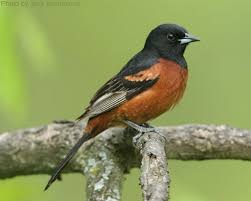
(an orchard oriole)
Have a good week. Hope you stop by for the next installment.
 Theresa Kaminski
You must be logged in to post a comment.