The chapter that covers Jane Grant’s efforts to get overseas during World War I, that is. I think this version finally works, so I’m calling it done. This version. There will assuredly be another.
For this one, I really had to focus on finding what I think of as the feeling or texture, a kind of “you-are-there” sense of the narrative. I’m an academic writer and these more creative “writerly” aspects are difficult for me to get right when I’m trying to tell a story. I could better utilize the tools of creative writers and journalists. Finding the right balance or blend is key. This week I was reminded how much writers of all kinds have to learn from each other.
Historian and Pulitzer Prize finalist author Megan Kate Nelson posted on BlueSky a few days ago: “Watching and waiting for more historians to write short sentences, short paragraphs, and short chapters.” She’s a very good writer and a very good historian, so her advice is worth considering. Once I’m satisfied with content, I’m going to go after style.
One of Jessica Meyer’s recent posts on her blog, Arms and the Medical Man, reminded me of the tensions that sometimes surface between different types of writers. Meyer is Professor of Social and Cultural History at the University of Leeds, and she researches the intersections of the histories of gender, disability and warfare.
Meyer’s piece, “Picking Up the Threads,” in part considers the differences between academic historians and what she calls “professional historians (that is, those who communicate historical research in order to earn a living).” I’m not crazy about the term “professional historians” to describe nonfiction writers who focus on historical topics, but I get her larger point. Meyer finds it “always slightly disconcerting” to read one of those works “that identifies a methodological approach or source base that I have long been familiar with as a new discovery.”
Academics and nonfiction writers generally have different reading audiences to address, but both could learn valuable skills from each other. Some academics have become very interested in writing for the non-academic reader, and sometimes they are referred to as public scholars. (Historian David M. Perry has just published a book on the topic.)
Meyer’s blog post in turn brought to mind one of my all-time favorite book reviews, “Plymouth Rocked: Of Pilgrims, Puritans, and Professors,” in which Harvard historian Jill Lepore cast a critical eye on Nathaniel Philbrick’s Mayflower: A Story of Courage, Community, and War. (Here is The New Yorker article, though it may be paywalled.) Along the way, she considers who writes history, how and why. Lepore takes Philbrick, who trained as a journalist, to task for his uncritical reading of sources, which to her, resulted in a misleading, distorted history.
She acknowledged, though, that “History isn’t brain surgery. Even when it’s done poorly, it’s not fatal. Still, it can knock you down.” I think about this a lot when I’m working on a book.
And, relatedly, worth a weekly read is Black and White and Read All Over, which carries the marvelous subtitle “Where Scholarship Meets the Public.” The website is hosted by scholars Vaughn Joy and Ben Railton.
What I’m Reading
I didn’t quite finish Gayle Feldman’s Nothing Random: Bennett Cerf and the Publishing House He Built before it was due back at the library. I really enjoyed what I read, though, and the way she presented Cerf as a multi-faceted person.
Not the kind of novel I normally read, but Heartwood by Amity Gaige kept my interest all the way through.
What I’m Watching
Got through all six episodes of Fallen, a Swedish police procedural set in a cold case unit. The first season is on Prime via MHz for a limited time. MHz is also home to the excellent World War II series A French Village, a wrenching examination of occupation and collaboration.
On BritBox there’s been Dark Heart, interesting if disjointed, and the second season of After the Flood, which seems so long after the flood that I can’t really remember much from the first season.
Started the British version of Ghosts (Paramount+), and it’s amusing.
Finished this season of The Forsytes (PBS) and all the available episodes of Animal Control on Netflix.
What Else Is Happening
Very acceptable bowling this week.
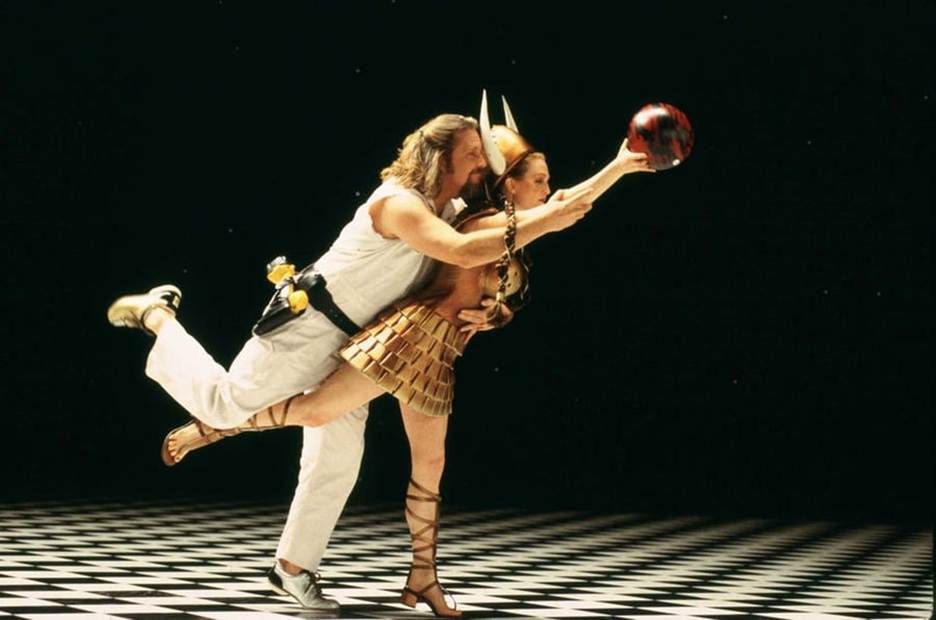
(Bowling scene from The Big Lebowski)
Flowers continue to bloom in the gardens here at Southfork, the pear trees are budding, and even the smallest peony bush has shot up. The birds are very active and vocal, and chipmunks and rabbits keep racing through the back forty.
Have a good week. Hope you stop by for the next installment.


You must be logged in to post a comment.