Over the last half of this past week, I had to swap my writing time for interview prep time. There is a documentary in progress on Dr. Mary Walker, Medal-of-Honor-winning Civil War physician and relentless women’s rights activist, and I was asked to talk—in front of a camera—about her life and the book I wrote about it.
I’ve given many presentations about Walker, but most of them focused on her Civil War experiences that led to the Medal of Honor. So, I was especially delighted with the opportunity to talk about her commitment to dress reform and women’s suffrage, plus a variety of other women’s rights issues.
On October 23, 1915, when Dr. Walker was in her early 80s, she turned up in New York City for a women’s suffrage parade. The event kicked off at Washington Square at 3:00 on a chilly but sunny afternoon and continued about three miles along Fifth Avenue to Fifty-ninth Street. Participants (just over 25,000, including 2500 men, according to The New York Times) represented the National American Woman Suffrage Association, the Women’s Political Union, the Women’s Trades Union League, and other groups.
It was a huge event; to that date, the largest suffrage parade held in the city. Crowd estimates ranged from tens of thousands, to a hundred thousand, to two hundred thousand.
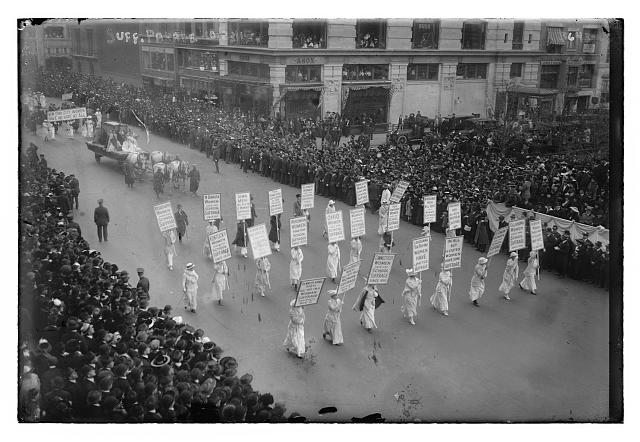
(Suffrage parade, October 23, 1915. Library of Congress. George Grantham Bain Collection.)
I like to imagine Jane Grant somewhere in that crowd of observers. If she was working that Saturday, she may have slipped away from her desk at The New York Times late in the afternoon to watch. Maybe she caught sight of Mary Walker—though it’s hard to believe that the elderly doctor marched for very long. I think about that overlap, two very determined women in the same place at the same time but knowing nothing of each other. Jane, young and at the beginning of her career, not yet realizing how important women’s rights would become in her life. Dr. Walker, near the end of her life, motivated for decades by a deep belief in gender equality.
These kinds of what-if, almost, maybe historical encounters always intrigue me. But now I’m back to those Jane Grant revisions, and who knows what will spark my imagination next.
What I’m Reading
I’m a couple of chapters into Jayne Anne Phillips’s memoir, Small Town Girls, and am finding the writing just lovely. Still reading and admiring historian and Pulitzer Prize finalist Megan Kate Nelson’s The Westerners: Mythmaking and Belonging on the American Frontier.
I’ve started The Librarians, a mystery by Sherry Thomas, which is intriguing so far.
I finished and enjoyed two novels: Virginia Pye’s Marriage and Other Monuments and Ann Patchett’s Whistler. I read Elizabeth Strout’s Things We Never Say in two sittings and have lots of opinions about it.
What I’m Watching
In the current watch rotation are season 2 of The Agency (Paramount+), Waking the Dead (BritBox), Lawmen: Bass Reeves and Mindfully Murder (both on Netflix).
I’m on the final season of A Place to Call Home (Prime). Deep Space Nine (Paramount+) has taken a backseat to this Australian drama.
Finished The Other Bennet Sister (BritBox), The Boroughs (Netflix), Legends (Netflix), and The Pembrokeshire Murders (BritBox), Spider Noir (Prime), and St. Denis Medical (Netflix).
The Other Bennet Sister was pleasant but irritatingly divided into 30-minute episodes. The Boroughs had its solid cast and good premise weakened by an anemic plot. Legends and The Pembrokeshire Murders were both well done. I really fell for the noir vibe of Spider Noir, which was the perfect vehicle for Nicholas Cage. And I’m looking forward to another season of St. Denis Medical.
What Else Is Happening
Weekly bowling had its usual highs (a sparrow) and lows (gutter balls and impossible splits), but it’s still fun.
And here at Southfork, we are cat sitting for three weeks, an elderly brother-sister feline duo. We are entertained.
Thanks, as always, for reading. See you next time.


You must be logged in to post a comment.