It’s Women’s History Month

In my line of work as a women’s historian, every month is women’s history month. Still, it’s nice to have a month designated for a special observation of the history of those who make up more than half of the population.

2017 Poster

This year’s theme is trailblazing women in labor and business. One of the women being honored by the National Women’s History Project is Kate Mullany, who in 1864 started what is considered to be the first all-women union in the United States, the Collar Laundry Union of Troy, New York. After a five-day strike, laundry owners began to capitulate to the workers’ demands and implemented a 25% pay hike. Women continue to be an indispensable part of working-class activism into the 21st century.


Alice Paul’s Early Birthday Present

Alice Paul, creator of the Equal Rights Amendment, was born on this day, January 11, 1885.

(Alice Paul Institute)

She was raised as a Quaker on a small farm in Mount Laurel, New Jersey. She graduated from Swarthmore in 1905, then went to England to continue her studies. While there, Paul became involved with the British women’s suffrage movement. Inspired by its political strategies and use of public demonstrations, she returned to the United States and began working on securing a constitutional amendment for women’s suffrage.

Yesterday marked the 100th anniversary of the launch of the perpetual delegation at the White House gates. Considering the timing, I’ve always thought of that as Alice Paul’s early birthday present to herself. She heated up the public drama of the suffrage movement at the beginning of a new year, probably hoping that by its close, her goal would be achieved.

It wasn’t. But the perpetual delegation ensured that the topic of women’s suffrage was never out of the public eye. President Wilson and members of Congress had to confront it, and eventually they embraced it.

As much as I admire Alice Paul–and I do, very much, especially for her willingness to endure force feedings–I have to remember her spectacular fail on racial equality. Paul didn’t treat white and African American suffrage supporters equally. She viewed the fight for racial equality as one for African Americans. Like many reformers of her time, race limited her vision.


Sending the President a Perpetual Delegation

On January 10, 1917, suffragist and political strategist Alice Paul sent a group of women from the National Woman’s Party (NWP) to the White House. Tired of fruitless discussions with President Wilson on the topic of votes for women (Wilson came up with a variety of reasons for not supporting a constitutional amendment), Paul decided to keep the message in the public eye: “If a creditor stands before a man’s house all day long, demanding payment of his bill, the man must either remove the creditor or pay the bill.”

Image result for silent sentinels

Inez Haynes Gillmore described that first delegation as consisting of a dozen women. Four carried lettered banners, eight carried ones made of the NWP’s colors of purple, white, and gold. Six women stationed themselves at the east gate of the White House, six at the west. The text of the banners contained the messages depicted above:

“Mr. President What Will You Do For Woman Suffrage”

“Mr. President How Long Must Women Wait For Liberty”

The questions were simple and direct, striking at the core of American democracy. The president tried to ignore the women, hoping they would give up and go away. When they didn’t, D.C. police arrested them on a variety of nuisance charges. Most women, including Alice Paul, chose jail over bail.

Image result for national woman's party silent sentinels Alice Paul

The perpetual delegation kept vigil for a year and a half, braving all kinds of weather and harassment from onlookers. Because of the perseverance of the NWP and other suffragists, American women achieved the right to vote in 1920.

For more on Alice Paul, see this fine biography:


Final Entry: Best Books I Read in 2016

In this list of the last three of my best books from 2016 are an old favorite author and two stories that were outside my reading comfort zone.

The first was:

As Good As Gone

Ever since I read and adored Montana 1948, I’ve eagerly awaited each of Watson’s novels. This, his tenth, is set in 1963 Montana, and focuses on the Sidey family. Bill asks his estranged father, Calvin, to move in and watch his children while he takes his wife Marjorie to Missoula for surgery. Watson layers in some good family secrets, both past and present, to create a truly effective domestic drama.

Outside of my comfort zone was:

I normally don’t read stories about children in jeopardy. I’ve grown tired of seeing the word “Girl” in book titles. But this one came with a blurb from Celeste Ng, which was enough to persuade me to give it a try. Hamer deftly negotiates a story that is the stuff of every parent’s nightmare: during a public outing, a child goes missing.

Finally, a contemporary crime story (not something I usually read) I wouldn’t have picked up if it hadn’t been for two things. First, other readers whose opinions I trust were raving. Next….

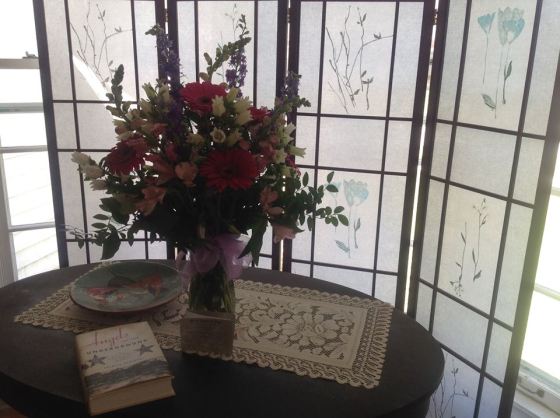
Angels Madison

early last year it showed up in a book display with Angels of the Underground.

Nicholas Petrie’s debut novel The Drifter introduces Peter Ash, a veteran of the wars in Iraq and Afghanistan, who looks into the death of a friend from the Marines. The next installment in the series, Burning Bright, is out this month, and I’m looking forward to reading it.

So, that’s my 2016 reading roundup. Until this time next year, my posts will be less about novels I’ve read and more about history and writing. I hope everyone’s year is off to a good start.


Part VII: Best Books I Read in 2016

I keep up with a lot of mystery series. Some of them are historical, some are contemporary, all feature strong female characters.

Unfortunately, 2016 was devoid of new entries from two authors I really, really look forward to: Sara Paretsky and Elizabeth George. Paretsky writes the marvelous V.I. Warshawski series, set among the muck of Chicago politics. Her latest, Brush Back, was published in 2015, as was the most recent of George’s Inspector Lynley stories, A Banquet of Consequences.

Another long-running series with a new entry in 2016 was:

25177005

Quite a startling title, considering Mary Russell is the main character of the series, which also features Sherlock Holmes. I liked the earlier books much better, but this is one of King’s more recent books that I’ve found interesting again. Lately there haven’t been too many stories in which Russell and Holmes are actually together solving a mystery, and that happens here as well. But King has taken a mostly successful risk in centering the plot around the beloved Mrs. Hudson. For that, the book is worth checking out.

An even better addition to a historical mystery series was:

Journey to Munich (Maisie Dobbs, #12)

The Maisie Dobbs series has been consistently strong because Winspear has been willing to grow and change her main character as she moves through the interwar period. In this novel, Maisie is still reeling from some devastating personal losses when she takes on a case that brings her face to face with the evils of fascist Germany.

I read the two most recent Chief Inspector Armand Gamache books in 2016. (The first was published in the summer of 2015, but I didn’t get to it until early 2016.)

24586590

28220985

Penny’s novels are set in a small Canadian village called Three Pines, but the stories are never provincial. Both of these deal with the devastation of events that cannot remain buried in the past. I’m a late arrival to this series, so I haven’t read it from the beginning, but you really don’t have to in order to appreciate Penny’s fine writing skills.

I’ll wrap up this 2016 reading roundup tomorrow.