Holiday Inn and a Missed Opportunity in the Life of a Future Queen

In my quest for a new-to-me Christmas-y movie, I finally watched Holiday Inn. I have always known that White Christmas was based on Holiday Inn, and I’ve seen White Christmas (the “Sisters” acts are perfection, and Doris’s comment, “Well I like that! Without so much as a ‘kiss my foot’ or ‘have an apple’,” is snortingly funny) too many times to count. It is one of the few musicals I will watch without fast forwarding through the song-and-dance numbers. (Yes, not a big fan.)

The 1942 Paramount Pictures musical Holiday Inn starred Bing Crosby as Jim Hardy and Fred Astaire as Ted Hanover. They have a singing and dancing act with Lila Dixon, played by Virginia Dale. After Jim’s engagement to Lila fails (she throws him over for Ted), he moves to a farm in Connecticut that he decides to turn into an inn that will only open on holidays. Aspiring entertainer Linda Mason (played by Marjorie Reynolds) shows up at the farm intent on getting a job, she and Jim sing “White Christmas,” and he falls in love with her.

All sorts of other things happen—there is a whole lot of plot here stretched out to link the many musical numbers—before another round of “White Christmas” and the happy Hollywood ending. I did my usual fast forwarding, though I have always enjoyed Crosby’s smooth voice and appreciated the genius of Astaire’s fancy footwork. Also, the racist elements (especially the blackface performance of “Abraham”) and the sexist attitudes (too numerous to mention) of the story make many of the scenes cringe-worthy.

I was particularly interested in Marjorie Reynolds’s performance. She had trained as a dancer and began appearing in silent films when she was a child. The 1930s found her in bit parts in several movies at the big Hollywood studios, including a small role in MGM’s Gone With the Wind in 1939. Reynolds did not turn down offers from B studios like Monogram and Republic, where, in 1941 she appeared opposite the popular singing cowboy Roy Rogers in Robin Hood of the Pecos. She was a working actor, and she likely believed her part in Holiday Inn, which put her alongside the star Fred Astaire, would quickly elevate her status.

According to IMDb, the role of Linda Mason in Holiday Inn had been written for Mary Martin, an accomplished vocalist and dancer who was already a hit on Broadway. She declined, saying she was pregnant so could not take the role. Director Mark Sandrich suggested Ginger Rogers (Astaire’s most famous dancing partner) and Rita Hayworth, but Paramount would not sign off. Sandrich would have to find someone else. Perhaps a Hollywood newcomer.  

In the summer of 1941, Dale Evans arrived in Los Angeles. She had been a professional singer since the late 1920s, and over the past few years her stints on Chicago radio stations and her appearances at some of the city’s trendiest nightclubs had gained her quite a following. Joe Rivkin, a Hollywood agent, made a point of listening to Dale every week on the radio. He sent telegrams offering to represent her if she was interested in making the move into motion pictures. Rivkin pestered her to send photographs that he could circulate to casting agents. Dale finally relented, sending off some old publicity stills, and thought no more of it. She did not think she was attractive enough for the big screen. Besides, she was twenty-eight years old, much too old for a start in Hollywood.

But Joe Rivkin liked Dale’s looks and told her she would be perfect for a new musical, Holiday Inn, that was still in the process of casting. He cabled her, “Come at once,” and she did. After a quick session at the beauty salon of the Hollywood Plaza Hotel (Rivkin found Dale’s appearance disappointing in person and ordered a new hairstyle and better makeup), the agent brought his client to meet Bill Meiklejohn, head of talent and casting for Paramount.

The trio sat together in the studio’s commissary. Dale endured another appraisal. Meiklejohn found her nose too long for her chin; Rivkin reassured him that could be taken care of with plastic surgery. Then Rivkin launched into his pitch to promote his client’s talents. Meiklejohn seemed impressed. He asked Dale if she could dance. Rivkin answered for her, “She makes Eleanor Powell look like a bum!” (It is doubtful any dancer could have made Powell, considered at the time the world’s best tap dancer, look like a bum.)

Dale could not allow this lie to linger. “No, I can’t dance, Mr. Meiklejohn,” she said. “I’m a pretty fair ballroom dancer, but that is as far as it goes.” Rivkin insisted that Dale was talented enough to quickly pick up any dance routine. But the casting agent knew better. He told Dale, rather gently given the circumstances, that the female actor they put in the role would have to dance with Fred Astaire. She would have to be a top-notch dancer. Dale clearly did not have that experience. She would not get the part.

But Meiklejohn liked Dale. He admitted Paramount had a hefty roster of singers on its payroll; still, he wanted Dale to stay and do a screen test. If it turned out well, the studio might offer her a contract.

So Dale Evans missed the opportunity to sing “White Christmas” with Bing Crosby because she was not a good enough dancer to pair with Fred Astaire in Holiday Inn. Marjorie Reynolds was cast because she was a good enough dancer, but her vocals were not up to Paramount standards. Her singing was dubbed by Martha Mears. (I still think Dale would have been better.)

Marjorie Reynolds remained a working actor, appearing in movies through the 1940s and then on television in the 1950s. Dale Evans never received a contract from Paramount. But Twentieth Century-Fox offered a one-year contract, so she left Chicago for Hollywood. In 1943, Dale signed on with Republic Pictures, which immediately put her in featured roles, then, in 1944, cast her opposite Roy Rogers in The Cowboy and the Senorita. The film was a hit with Rogers’s fans, so Republic continued pairing them. Dale would become known as the Queen of the West and reach the heights of popularity many entertainers only dream of. And it may have come about from a missed opportunity.

Curious about the life and career of Dale Evans? Check out Queen of the West: The Life and Times of Dale Evans.

How Dale Evans, the Queen of the West, Conquered Television

This is a bit of a heads up because I don’t think this issue of RetroFan Magazine has actually hit the newsstands yet (or Barnes and Noble or your local comic shop). But an article I wrote about Dale Evans is included in the November 2023 issue!

I think this is my first magazine article, and the whole process went very smoothly, thanks to editor Michael Eury and his great staff. I enjoyed the Beany and Cecil serendipity. That cartoon is the subject of the featured article, and I happened to mention it in my own piece. If you’re a fan of 1960s-1980s television shows, you will want to take a look at RetroFan.


Queen of the West Wednesday, Chapters Thirteen and Fourteen

This is it–the final Queen of the West Wednesday. The book officially launches on Friday, April 15. It’s hard to believe I started this series way back on February 2! Thanks for sticking with it or for popping in now and then. Here are the final two chapters, along with their opening lines.

Chapter Thirteen. A Date with Dale: Maintaining a Television Career

A period of calm set in for Dale Evans and Roy Rogers, so they took the opportunity to try something new to reach more existing fans and perhaps acquire new ones.

It was the late 1960s, and Dale was in her mid-fifties. She and Roy still hoped to land a prime time television show but had no luck. They opened a museum in Apple Valley to showcase their movie and t.v. careers. Dale wrote books as she wrestled with the social, political, and cultural changes of the decade. In the early 1970s she began planning her own Christian talk show. After more than a decade, it finally appeared in 1985 on the Trinity Broadcasting Network as A Date with Dale, a thirty-minute weekly program that focused on Christian and spiritual topics.

Roy Rogers Museum - Apple Valley, California | Apple valley california,  California, Roy rogers

(postcard of the museum in Apple Valley, CA)

Chapter Fourteen. “Thank Heavens for Dale Evans”: Becoming the Legendary Cowgirl

While Dale Evans was never exactly put on a pedestal, she received more honors during this late stage of her life, often accompanied by descriptions of her as a “legend.”

In 1990, a new, all-female group then known as the Dixie Chicks, wrote a song about her. Through that decade, despite a myriad of health problems, Dale filmed episodes of A Date with Dale, recorded more songs, and wrote more books. She endured the death of her beloved husband, Roy Rogers, in 1998, and died at home three years later, surrounded by family.

DixieChicksThankHeavensforDaleEvans.jpg

Happy trails, everyone!

Queen of the West Wednesday, Chapters Eleven and Twelve

We’re at the penultimate installment of this weekly series that reveals the first sentence of each chapter in Queen of the West: The Life and Times of Dale Evans. The book’s official launch date is April 15, but if you order it online now, chances are good that you’ll receive your copy before then!

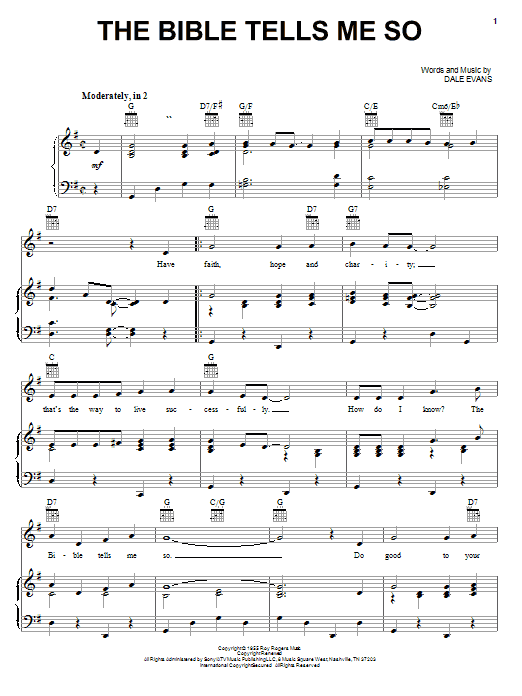
Chapter Eleven. “The Bible Tells Me So”: Creating Christian Celebrity

Dale Evans resumed work almost immediately when she and Roy Rogers returned from Great Britain in late March 1954. 

That overseas trip had not been a vacation. During February and March, the couple performed in England and Scotland, attracting huge audiences, then appeared with the Billy Graham Crusade in London. The Roy Rogers Show, about midway through its run, remained popular with television viewers, but Dale, now back stateside, was increasingly attracted to projects that carried a more overt Christian message. In 1955, she demonstrated that interest by writing the song “The Bible Tells Me So” for an episode of The Roy Rogers Show. The song caught on, and two versions of it hit the Billboard charts. Children would sing it in Sunday school classes for decades to come.

Dale Evans "The Bible Tells Me So" Sheet Music PDF Notes, Chords | Children  Score Lead Sheet / Fake Book Download Printable. SKU: 196020

Chapter Twelve. “I’d Rather Have Jesus”: Professional and Personal Struggles During the 1960s

Frustrated with trying to create an adult, family-friendly western, Dale Evans and Roy Rogers turned to another small-screen genre: musical variety.

The Roy Rogers Show ended in 1957. Despite the couple’s continuing popularity, they had difficulty landing another network show. It wasn’t until 1962 that they signed a deal with ABC for a prime time musical variety program called The Roy Rogers and Dale Evans Show. After working with Roy for almost twenty years, Dale finally received equal billing.

The Roy Rogers & Dale Evans Show (TV Series 1962– ) - IMDb

Thanks for sticking with this series. See you next week for the wrap-up!

Queen of the West Wednesday Doubleheader, Chapters Nine and Ten

Chapter Nine. “Happy Trails”: Becoming a Television Star

After Dale Evans gave birth to her daughter Robin, attendants wheeled her out of the delivery room.

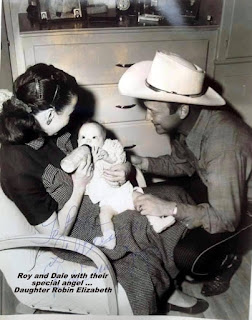
It was August 26, 1950, and the Queen of the West and the King of the Cowboys had a new baby girl. But the joy the parents felt was soon overshadowed by concern. Robin Elizabeth Rogers–Dale and Roy planned to nickname her Stormy–was diagnosed with Down syndrome and with an inoperable heart problem. Doctors were not optimistic about Robin’s future, but the loving parents took their baby home, determined to prove the medical experts wrong.

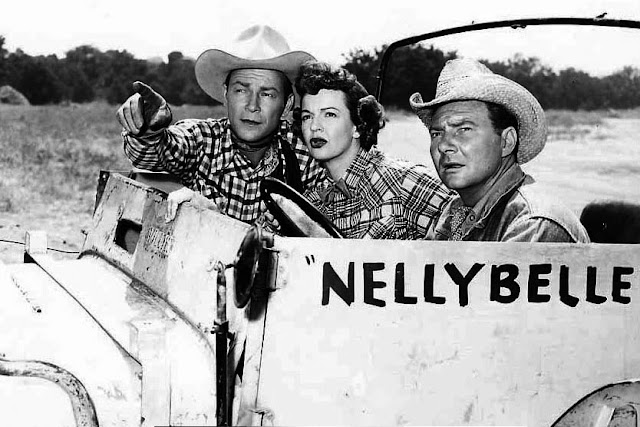
As Dale Evans worried about her daughter’s health, she and Roy embarked on another project together: a televised version of The Roy Rogers Show, a thirty-minute contemporary Western that ran on NBC from 1951-1957. The song Dale had written for their radio show, “Happy Trails,” now became the theme song for their small-screen show.

Chapter Ten. Angel Unaware: Faith and Celebrity

Dale grieved over Robin’s death but had no time to wallow.

Robin Rogers died two days before her second birthday. Dale Evans held herself together through work. She and Roy were scheduled to appear at the World’s Championship Rodeo at Madison Square Garden in about four weeks, a major event they could not afford to cancel.

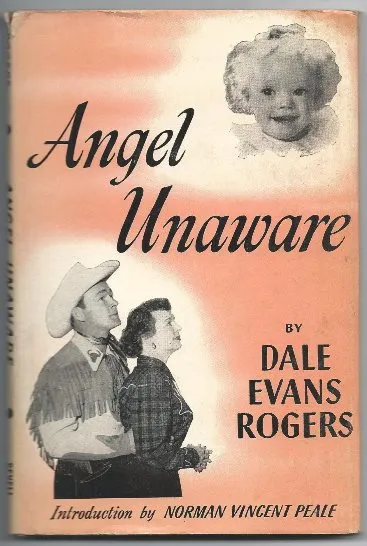
https://dygtyjqp7pi0m.cloudfront.net/i/23208/21367945_3.jpg?v=8D1F8D91EF2C950

Despite their hectic schedule in New York City, Dale found time to write about Robin. She penned her first book, Angel Unaware, published by the Fleming H. Revell Company in 1953. It quickly became a bestseller, and Dale donated the proceeds to charity.

And another bonus on this double edition of Queen of the West Wednesday, historian and writer Pamela Toler has featured me in her Women’s History Month blog series called Talking About Women’s History. I answered three questions about Queen of the West and asked Pamela a question about women’s history.