Edmonia Highgate: Teacher, Orator, Freedom Worker

Edmonia Goodelle Highgate, born in upstate New York in 1844, grew up in a community of free blacks committed to ending slavery and pursuing equality. Her hard-working parents made sure all seven of their children attended high school. In 1861, the year the Civil War started, Edmonia was one of the few African Americans to graduate from Syracuse High School. Though the Syracuse Board of Education issued her a teaching certificate, she could not get a job in the city because of her race.

She found a teaching position in Montrose, Pennsylvania, where she also volunteered with the Pennsylvania Freedmen’s Relief Association, which worked with newly-freed African Americans. She moved back to New York after finding a teaching job in Binghampton. In 1864, the American Missionary Association hired her to teach in Norfolk, Virginia.

The conditions Edmonia Highgate faced there prompted a breakdown, and she returned home for about a year to recover. Once she did, she set off again, this time to Darlington, Maryland to establish a school in 1865 before moving to New Orleans in 1866, where she and her sister taught school and founded the Louisiana Educational Relief Association. That summer, Edmonia witnessed a riot launched by ex-Confederates determined to regain control of the state. They killed over 200 African Americans.

New York Public Library

Edmonia Highgate wrote about this and her other experiences for the Christian Recorder. She remained in Louisiana until 1868, despite acts of violence aimed at her. The next year she gave up teaching for work as a paid lecturer, traveling through the north speaking on “Five Years Among Southern Loyalists.”

In 1870, before Edmonia Highgate moved to Mississippi to take a teaching position at Tougaloo College, she had an abortion. On October 16, she was found dead in Syracuse. She was 26 years old.

Image result for edmonia highgate

For more on Edmonia Highgate, take a look at the work of literary scholar Eric Gardner.


Looking Backward by Laura E. Foster

Laura Foster Looking Backward 1912(Library of Congress)

In 1912, Life magazine published this anti-suffrage illustration by Laura E. Foster. A well-known artist and illustrator, Foster was born in 1871 in San Francisco, where she first began doing newspaper drawings. After the 1906 earthquake, she moved to New York City, where her career continued to grow and thrive, and where she married Donald Monroe, a stockbroker about eleven years her senior.

This drawing is a stark reminder that the suffrage movement was not a straightforward march toward progress. It had begun in the late 1840s, and in 1912, when Life published Foster’s illustration, it was on the cusp of an infusion of radicalism by Alice Paul and Lucy Burns. This drawing attempted to convince women that love and marriage were incompatible with a career and “professional triumph.” The higher a woman climbed toward fame, the more riddled she would become with loneliness and anxiety. And suffrage was right near the top, contributing to those negative attributes.

Women’s suffrage was written into the Constitution with the ratification of the 19th Amendment in 1920, the same year Laura Foster died. Nearly one hundred years later, many women will still find the message of her illustration familiar.


Women’s History Month 2019

Since March 1 rarely brings any indication that spring is on the way, the ultimate consolation prize is that it’s always the beginning of Women’s History Month.

Image result for snow in wisconsin 2019

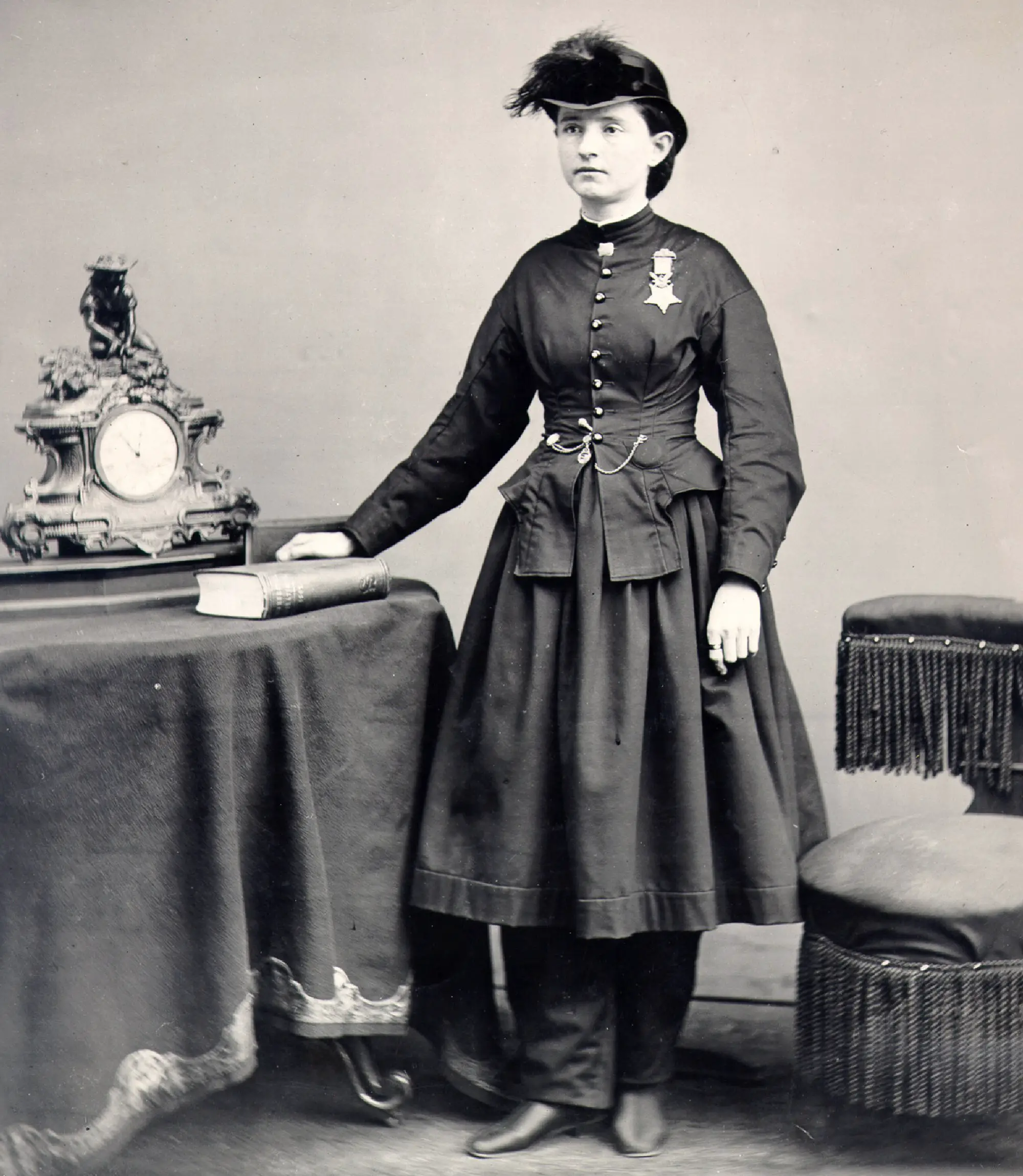
I also think of it as What I Do For a Living Month. My academic career focused on women’s history as does my current writing career. Right now I’m four chapters into a book on Dr. Mary Walker, the only woman to receive the Congressional Medal of Honor.

https://history.army.mil/news/2016/images/gal_maryEdwardsWalker/gal_drMaryEdwardsWalker_moh1.jpg(Army Center of Military History)

Dr. Walker was a dress reformer (notice she’s wearing trousers), temperance advocate, abolitionist, suffragist, and pacifist. As such, she fits squarely within this year’s theme for Women’s History Month:

Mary Walker had a grand vision of a world in which everyone was equal. Throughout March, I’ll be posting compelling images that reflect the concerns of visionary American women like Mary Walker. Next up, a commentary on the suffrage struggle.


Coming Soon to My Bookshelf

This may be the first time I’ve ever pre-ordered a book. (And the whole “pre-order” thing still confuses me. If you put something in your cart, pay for it, and arrange for it to be shipped, haven’t you, in fact, ordered it?)

I wanted to make sure I was among the very first to get a copy of Pamela Toler’s latest:

The cover alone makes me want to read it. The image is stunning and the title is strong. This book is about women–not girls or wives or daughters. And the “Unexpected History” points out that women have been left out of so much history.

In about two weeks this will be added to my bookshelf. I hope you consider adding it to yours. You can find it on Amazon, Beacon Press, IndieBound, and Barnes & Noble.


Into the Research Rabbit Hole with Samuel J. May, Abolitionist and Women’s Rights Advocate

Today launches the first in a series of occasional posts about something most writers of history are familiar with: falling down the research rabbit hole.

Image result for down the research rabbit hole

While I’ve gotten better at making sure it doesn’t become a bottomless pit, I always look forward to these jaunts that reveal something intriguing about my main subject. Today I’ve been working on a chapter of my book about Dr. Mary Walker, a 19th-century reformer and the only woman to receive the Congressional Medal of Honor.

Image result for dr. mary edwards walker

One of the many people she interacted with was a Unitarian minister named Samuel J. May. An 1820 graduate of the Harvard Divinity School, May fully embraced the new Unitarian theology, which emphasized the moral teachings of Jesus Christ. He was committed to putting this ideology into action and actively participated in a variety of antebellum reforms, including temperance, education, labor, and abolition. In 1830, May met William Lloyd Garrison and went on to serve as a lecturer for the New England Anti-Slavery Society. May eventually accepted a position at the Unitarian Church of the Messiah in Syracuse, New York, about forty miles south of Mary Walker’s hometown of Oswego. There, May’s abolition work expanded to assisting the underground railroad.

Image result for Samuel J. May

The Reverend Samuel May began promoting women’s rights with his November 1845 sermon, The Rights and Condition of Women, which was subsequently printed and widely circulated. Beginning with quotes from Genesis (“In the day that God created man, in the likeness of God made he him, male and female created he them; and blessed them, and called their name Adam.”) and Galatians (“There is neither male nor female, for ye are all one in Christ Jesus.”), he called for gender equality and women’s suffrage.

Image result for Samuel J. May the rights and condition of women

Exactly how and why Mary Walker and Samuel May knew each other will be explained in my book. And for those of you who think the surname May sounds familiar, the reforming reverend’s other claim to fame is that he was the uncle of Louisa May Alcott.