Sending the President a Perpetual Delegation

On January 10, 1917, suffragist and political strategist Alice Paul sent a group of women from the National Woman’s Party (NWP) to the White House. Tired of fruitless discussions with President Wilson on the topic of votes for women (Wilson came up with a variety of reasons for not supporting a constitutional amendment), Paul decided to keep the message in the public eye: “If a creditor stands before a man’s house all day long, demanding payment of his bill, the man must either remove the creditor or pay the bill.”

Image result for silent sentinels

Inez Haynes Gillmore described that first delegation as consisting of a dozen women. Four carried lettered banners, eight carried ones made of the NWP’s colors of purple, white, and gold. Six women stationed themselves at the east gate of the White House, six at the west. The text of the banners contained the messages depicted above:

“Mr. President What Will You Do For Woman Suffrage”

“Mr. President How Long Must Women Wait For Liberty”

The questions were simple and direct, striking at the core of American democracy. The president tried to ignore the women, hoping they would give up and go away. When they didn’t, D.C. police arrested them on a variety of nuisance charges. Most women, including Alice Paul, chose jail over bail.

Image result for national woman's party silent sentinels Alice Paul

The perpetual delegation kept vigil for a year and a half, braving all kinds of weather and harassment from onlookers. Because of the perseverance of the NWP and other suffragists, American women achieved the right to vote in 1920.

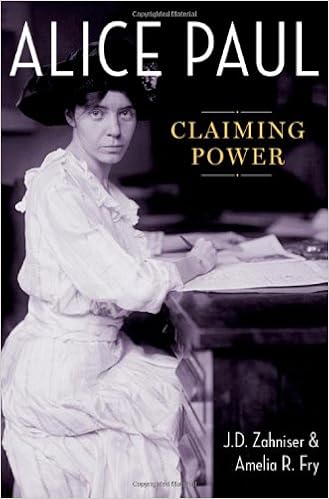
For more on Alice Paul, see this fine biography:


Part IV: Best Books I Read in 2016

Judging by the historical novels I normally gravitate towards, my favorite book from 2016 shouldn’t appear on this “Best” list. It’s the kind of book more likely to end up on one of my “Worst” lists.

Image result for surprised woman reading

My favorite novel of 2016 focuses on real-life historical figures, my least favorite kind of historical fiction. And one of those figures is a founding father. In my own real life as an academic historian, I haven’t leapt on the founding father bandwagon to devour big, bulky biographies of the men who kickstarted this country. And though I’ve heard some of the songs, I haven’t listened to the entirety of Hamilton or schemed to score a couple of tickets.

I still hold a grudge because those guys couldn’t see that the “course of human events” involved so much more than white men.

The first couple times I saw this novel–the one that turned out to be my favorite–on the library shelf, I passed it by. I looked at the title, winced, and left it there. Then one day I decided to add it to my check-out pile. It was a library book. It didn’t cost me anything. If I got frustrated with the first few pages, I’d just return it.

I didn’t get frustrated. I became mesmerized. This is the novel I think about more than any other from 2016:

Image result for thomas jefferson dreams of sally hemings

In my reading, O’Connor doesn’t romanticize what happened between Jefferson and Hemings, nor does he reduce Hemings to a one-dimensional victim.

The two best reviews I’ve read of the novel come from the always astute Ron Charles and the novelist Jean Zimmerman.

Charles concluded his review:

“Ultimately, this is a book in vigorous debate with itself, just as strange and contradictory as the author of the Declaration of Independence. With its magically engineered collection of fiction, history and fantasy, and particularly with its own capacious spirit, Thomas Jefferson Dreams of Sally Hemings doesn’t just knock Jefferson off his pedestal, it blows us over, too, shatters the whole sinner-saint debate and clears out new room to reconsider these two impossibly different people who once gave birth to the United States. It’s heartbreaking. It’s cathartic. It’s utterly brilliant.”

Here, Zimmerman highlights Sally Hemings:

“…after reading this novel I would love to know Sally Hemings…. She is one of history’s numberless mystery women, but she comes thoroughly and thrillingly alive in O’Connor’s telling.”

History is full of “numberless mystery women.” My fascination with them is the reason I so admire O’Connor’s novel.

Check back tomorrow, when I recommend two novels about slavery.


Write-by-the-Lake Writer’s Workshop and Retreat, June 26-30, 2017

Winter weather already getting you down? Looking forward to spring?

Image result for snow storm(WABC)

Registration has just opened for a great writer’s retreat on June 26-30, 2017, in Madison, WI.

I’ll be leading one of the new workshops, Writing Women’s Lives. Plan now to join me!

The 19th annual Write-by-the-Lake Writer’s Workshop & Retreat has expanded to 14 sections. There are several new instructors and topics, including children’s picture books, poetry writing, and a new step-by-step system to plotting fiction with urgency.

This national retreat offers something for all writers. Most of all, it offers the opportunity to work, work, work on your writing.

Plus, by popular request from past attendees who didn’t want the week to stop and who wanted ideas for their next steps, the program added a new special bonus Saturday workshop on July 1 with Tim Storm.

And the famous writing doctor, Kevin Mullen, is back!

Wait, there’s more! Someone who got her start here and is now a big success–hitting the USA Today list with her fiction–will deliver the keynote address and teach one of the new sessions. That’s right. Wisconsin’s own Ann Garvin is on board this year.

UW-Madison’s Memorial Union and its lakeside terrace have been renovated just in time for us to test out the new amenities. We can watch the sailboats go by as we share writing ideas over a glass of something good or a cone packed with the famous Babcock Dairy ice cream.

Image result for uw madison memorial union terrace

Please join me and your fellow writers from across the country.

Enrollment is limited in each section to maximize the attention on your writing.

Click here for full details.


I’ve Been on Television

All sorts of interesting things can happen once you’ve published a book. As an academic historian, I’m used to giving classrooms lectures and presenting research papers at scholarly conferences. The lectures usually involve large rooms of a mostly captive audience. The research presentations usually small rooms populated by other scholars interested in the same historical topic I am.

Image result for 1950s college classroom

After I published Angels of the Underground, I was invited to give a talk for a World War II symposium at the MacArthur Memorial. While most of the people who attended didn’t know much about those angels, they did know something about the war in the Pacific theater. It was a very engaging day, and I got to talk to a lot of interesting people.

The entire symposium was fascinating, and it was filmed. There was a C-SPAN camera rolling in the back of the auditorium while I gave my talk. I tried not to stare at it. I did pretty good with forgetting but not forgetting it was there.

C-SPAN3 American History TV aired the talk last night. You can watch it here:

https://www.c-span.org/video/?411781-4/us-women-spies-philippines-world-war-ii

So now I’ve been on t.v., and the angels have gained a wider audience.


From Expert to Novice and Back Again

So I’m still here, at the start of a new project. I’m trying to stay focused on phase one: pull enough stuff together to write a winning book proposal.

Image result for winning 1950s

It’s strange to be back at the beginning where I’m still learning. Since the publication of my first book

PIP cover

I’ve been an expert on this one thing: the history of American women in the Philippines. I wrote two more books about them, so I’m not exaggerating the expert thing too much.

With the new book project, I only possess a very basic knowledge of the subject, barely enough to write a cohesive introductory paragraph. So I’ve been researching like mad, trying to get a feel for a new place and time, trying to understand the lives of a different group of women.

Image result for woman surrounded by books 1950s

And already I’ve been stunned by the professionalism and generosity of archivists at two different institutions who have responded to my inquiries with lightning speed, offering to get items to me as soon as possible and even offering additional suggestions. I wish I could name them right now, but that would prematurely give away my book’s topic. I’m already keeping a list of names to include in the book’s acknowledgments. It’s a small way to pay a big debt. (That, and maybe a free copy of the book.)

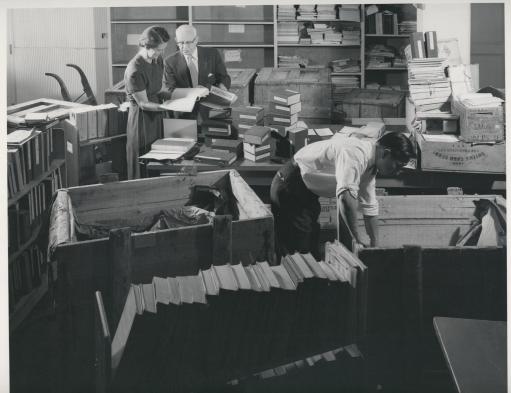
Image result for archivists 1950s

I know the archivists aren’t working just for me, but it seems like they are. No one writes a book alone, and archivists are an essential part of the book creation community. I’m fortunate to be able to tap into their expertise. Pretty soon, some of that will rub off on me.