Women’s History Month Wednesday: Harriot Stanton Blatch

In today’s language, Harriot Stanton Blatch was a suffragist nepo baby.

She was born in 1856 in Seneca Falls, New York, the sixth of Elizabeth Cady Stanton’s seven children. Throughout her childhood, reform occupied center stage in the household. Her mother was one of the organizers of the 1848 Women’s Rights Convention in Seneca Falls, which helped launch a movement that in some shape or form continues to this day. Harriot’s father, Henry, was an abolitionist, journalist, and politician.

Harriot received an undergraduate degree from Vassar College in 1878 and a master’s degree in 1894. In between, she joined the suffrage cause and helped her mother and her mother’s political partner, Susan B. Anthony, write their History of Woman Suffrage. Harriot also married a British businessman, William Henry Blatch, in 1882, and spent the next twenty years living in England with him and raising their two daughters, one of whom died young. By the 1890s, she’d become a proponent of “voluntary motherhood,” encouraging married women to choose when and how often to become pregnant, thus deciding when to have intercourse with their husbands.

(left to right: Nora Blatch, Elizabeth Cady Stanton, Harriot Stanton Blatch)

The Blatch family moved to New York City in 1902, following the death of Elizabeth Cady Stanton, and Harriot immersed herself in reform causes that highlighted the intersection of workers’ rights and women’s suffrage. After joining the Women’s Trade Union League, she founded, in 1907, what would come to be known as the Women’s Political Union. This brought some 20,000 New York City working women into the suffrage movement. Harriot further revitalized the movement by organizing public parades at a time when “proper” women didn’t flaunt themselves in such a way.

Harriot Stanton Blatch’s tactics and ideology overlapped with those of feminist Alice Paul; in 1915 she merged her Women’s Political Union with Paul’s Congressional Union, which became the National Woman’s Party. When the United States entered World War I, Harriot took on the directorship of the Woman’s Land Army, an organization that guaranteed farm labor would continue as American men joined the military.

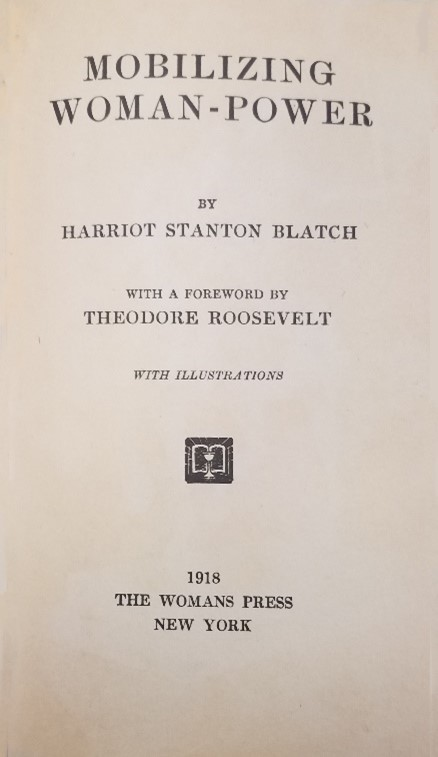
After the war, she published two books: Mobilizing Woman-Power, a celebration of women’s contributions to the war effort and a brisk reminder of their duties as citizens, and A Woman’s Point of View: Some Roads to Peace, which focused on the affects of war on women and children and the role of women in shaping peace.
The Nineteenth Amendment passed in 1920, guaranteeing most American women the right to vote. Harriot became a proponent of the Equal Rights Amendment, viewing it as the next necessary step to securing women’s rights. In 1922, she published a co-edited collection of her mother’s papers, Elizabeth Cady Stanton as revealed in her letters, diary, and reminiscences. Shortly before Harriot’s death in 1940, she finished (with the help of feminist Alma Lutz) her own autobiography, Challenging Years: The Memoirs of Harriot Stanton Blatch.

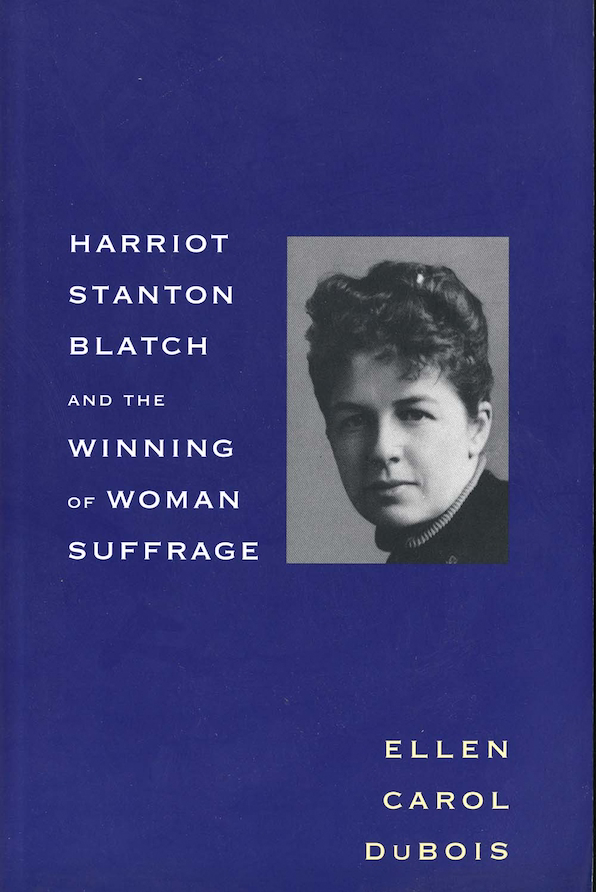
Historian Ellen Carol DuBois brought Harriot Stanton Blatch’s career to life in the 1997 prize-winning biography, Harriot Stanton Blatch and the Winning of Woman Suffrage. DuBois, now retired as a professor of history and gender studies at the University of California, Los Angeles, is considered a pioneer in the field of women’s history. As a graduate student at Northwestern University, DuBois became involved with the Chicago Women’s Liberation Union, the radical wing of the 1960s women’s rights movement. Her 1978 book, Feminism and Suffrage: The Emergence of an Independent Women’s Movement in America, 1848-1869, was considered for many years as the best book on the suffrage movement, inspiring many other historians to explore its multiple facets.
Women’s History Month Wednesday: Harriet Jacobs

The 2023 theme for Women’s History Month is “Celebrating Women Who Tell Our Stories.” Each week I’m highlighting one woman from the past who wrote about women along with one contemporary woman who wrote about her. Women writing about women who wrote about women. This week’s installment on Harriet Jacobs and Jean Fagan Yellin contains elements of a great literary detective story.

Harriet Ann Jacobs (1813-1897) is best known for her 1861 autobiography, Incidents in the Life of a Slave Girl. Jacobs had been born into slavery in Edenton, North Carolina, and as a girl came to live in the household of one of the town’s physicians, Dr. James Norcom. By the time she entered her teens, Norcom made clear his plans to force her into a sexual liaison. Jacobs, determined to avoid this and secure her freedom, began an affair with a local lawyer, Samuel Tredwell Sawyer, and had two children with him. Still, Norcom pursued her.

In the 1830s, Harriet Jacobs hid herself in her grandmother’s attic and orchestrated the sale of her children to Sawyer, who eventually got them to freedom in the North. Jacobs remained in the cramped space for seven years before she could arrange to safely follow. In New York, she became involved in abolition work and in the early 1850s began writing an account of her life as an enslaved person.

A sympathetic white friend had purchased Harriet Jacobs’s freedom. Jacobs no longer had to worry about Norcom using the Fugitive Slave Law against her, but she still chose to publish her autobiography under the pseudonym Linda Brent, and she changed the names of the other real-life people in her story. She told an unvarnished tale about the sexual violence endemic in slavery, something long whispered about but rarely publicly discussed. Jacobs also worried about reactions to her confession about her out-of-wedlock relationship with Samuel Sawyer. It took a great amount of bravery to write such a revealing book.

By the time it was getting into readers’ hands in early 1861, the secession movement had started in the South. The Civil War would begin in April. Harriet Jacobs worked in Washington, D.C. to assist the formerly enslaved people who fled there for safety. She and her daughter Louisa operated a school, too, before they headed back South after the war to help the newly freed people. Jacobs ultimately returned to Washington, where she died in 1897.

Harriet Jacobs’s book was largely forgotten by the time the twentieth century rolled around. Most historians who ran across old copies of it assumed it was fiction, penned by an abolitionist to promote the cause. But Jean Fagan Yellin (1930- ), then an English professor at Pace University who wrote about nineteenth-century women, race, and literature, wasn’t so quick to accept that assumption. She combed through archives for years, looking for mentions of the work and clues to its author’s identity. In 1981, Yellin published the article “Written by Herself: Harriet Jacobs’s Slave Narrative” in the journal American Literature. Six years later, Harvard University Press republished Harriet Jacobs’s Incidents in the Life of a Slave Girl, edited by Yellin.

The biography, Harriet Jacobs: A Life, came out in 2004, Jean Fagan Yellin’s expert narrative of Jacobs’s extraordinary life. Without Yellin’s willingness to ask new questions and explore new sources, Harriet Jacobs might have been lost to history for many more years.

Women’s History Month Wednesday: Charlotte Perkins Gilman

The 2023 theme for Women’s History Month is “Celebrating Women Who Tell Our Stories.” On Wednesdays during March, I’ll highlight one woman from the past who wrote about women along with one contemporary woman who wrote about her. Women writing about women who wrote about women.

I’ll begin with Charlotte Perkins Gilman (1860-1935), a writer, social activist, suffragist, and feminist who was a member of the socially and culturally influential Beecher family that included the minister Lyman Beecher and the writers Harriet Beecher Stowe and Catherine Beecher. Note: Gilman didn’t always like the feminist label and her views on race were hardly laudatory.

(Photo: Francis Benjamin Johnston via Library of Congress)

While separated from her first husband, Charles Walter Stetson, Gilman published “The Yellow Wallpaper” in 1892, a semi-autobiographical account of a young wife’s struggle with post-partum depression and the doctor-recommended “rest cure.” The story received mixed reviews at the time, but has since gone on to become a classic piece of feminist literature.

Feminism and social reform intrigued Gilman, leading her to reject the tradition gender conventions of the late nineteenth and early twentieth centuries. She was especially critical of the lack of financial independence for women. In 1898, Gilman published Women and Economics: A Study of the Economic Relation Between Men and Women as a Factor in Social Evolution. The book’s success turned her into an international figure in the women’s movement. Two years later, she remarried, this time more happily to her cousin, Houghton Gilman.

Charlotte Perkins Gilman has attracted the attention of scholars and biographers since at least the 1980s. In 2010, historian Helen Lefkowitz Horowitz published Wild Unrest: Charlotte Perkins Gilman and the Making of “The Yellow Wallpaper,” one of my favorites. Horowitz showed how Gilman’s experiences as a patient and then later as a writer documenting her treatment reflected the way nineteenth-century Americans understood mental health and illness. It’s one of the most interesting explorations of Gilman and her work.

Horowitz received her Ph.D. in American Studies from Harvard University in 1969, when “second-wave” feminism was at high tide in the United States. She went on to teach, ending her academic career at Smith College as the Sydenham Clark Parsons Professor of History. Many of Horowitz’s books, including Wild Unrest, focused on women’s history. Rereading Sex: Battles over Sexual Knowledge and Suppression in Nineteenth-Century America, published in 2002, was a finalist for the 2003 Pulitzer Prize.

Until next Wednesday…..

Women’s History Month 2023

“Welcome to My World of Women’s History”

That’s the greeting I chose for the home page of this website. Once every year, during the month of March, it takes on added significance because of the observance of Women’s History Month. I’ve marked that month in different ways on my blog. The 2018 entry, for example, highlighted that year’s “Nevertheless She Persisted” theme with information about the lawyer/activist Pauli Murray followed by a couple of book recommendations.

This year, Women’s History Month kind of snuck up on me, even though I knew Pamela Toler would once again be running her excellent blog series, Talking About Women’s History. The first installment, featuring biographer Cathy Curtis, is already up, and it’s wonderful.

So when I finally looked up this year’s theme this morning, I was especially intrigued:

This Women’s History Month is not only all about women as historical figures, but it’s also about the women who have written about them. It’s like getting a bonus Women’s History Month.

Over the next four Wednesdays of this month, to match the 2023 theme, I’ll be posting a book recommendation along with some information about its author.

Stay tuned.


A Refinishing Tale from 2912

One of my mother’s talents (in addition to umpiring Little League baseball games and telling stories) was refinishing furniture. I think she may have been inspired by the 1970s hoopla surrounding the American Bicentennial. She developed an interest in Early American (sometimes called colonial) furniture and décor—not just original pieces (which she never could have afforded) but also the contemporary spin on them (now sometimes called Bicentennial Chic) as envisioned by furniture retailers like Ethan Allen.

(1970s Ethan Allen ad)

Even Ethan Allen furniture was more than my parents could afford. So my mother acquired pieces (garage sales, flea markets, family hand-me-downs) she thought looked antique and refinished them to make them appear even more so. She tackled old, yellowing varnishes and vanquished all evidence of paint (she did not approve of painting wood furniture). In my memory, she has a workspace set up on the driveway in front of 2912’s two-car detached garage. The portable radio, tuned as always to WGN and probably broadcasting a Cubs game, blares as she uses chemical stripper with abandon, forgoing safety glasses (she wore eyeglasses, which were enough) and rubber gloves (she didn’t have to actually touch the stripper). But she keeps her cigarette at a safe distance. This provides an acceptable amount of exercise for her as she walks back and forth for her nicotine fixes.

My mother’s best moment came as she carefully scraped off the bubbling stripper to reveal some beautiful wood. She always hoped for oak, her favorite, but she was pretty much happy with anything that wasn’t pine. Then she stained and sealed and had a lovely new old piece.

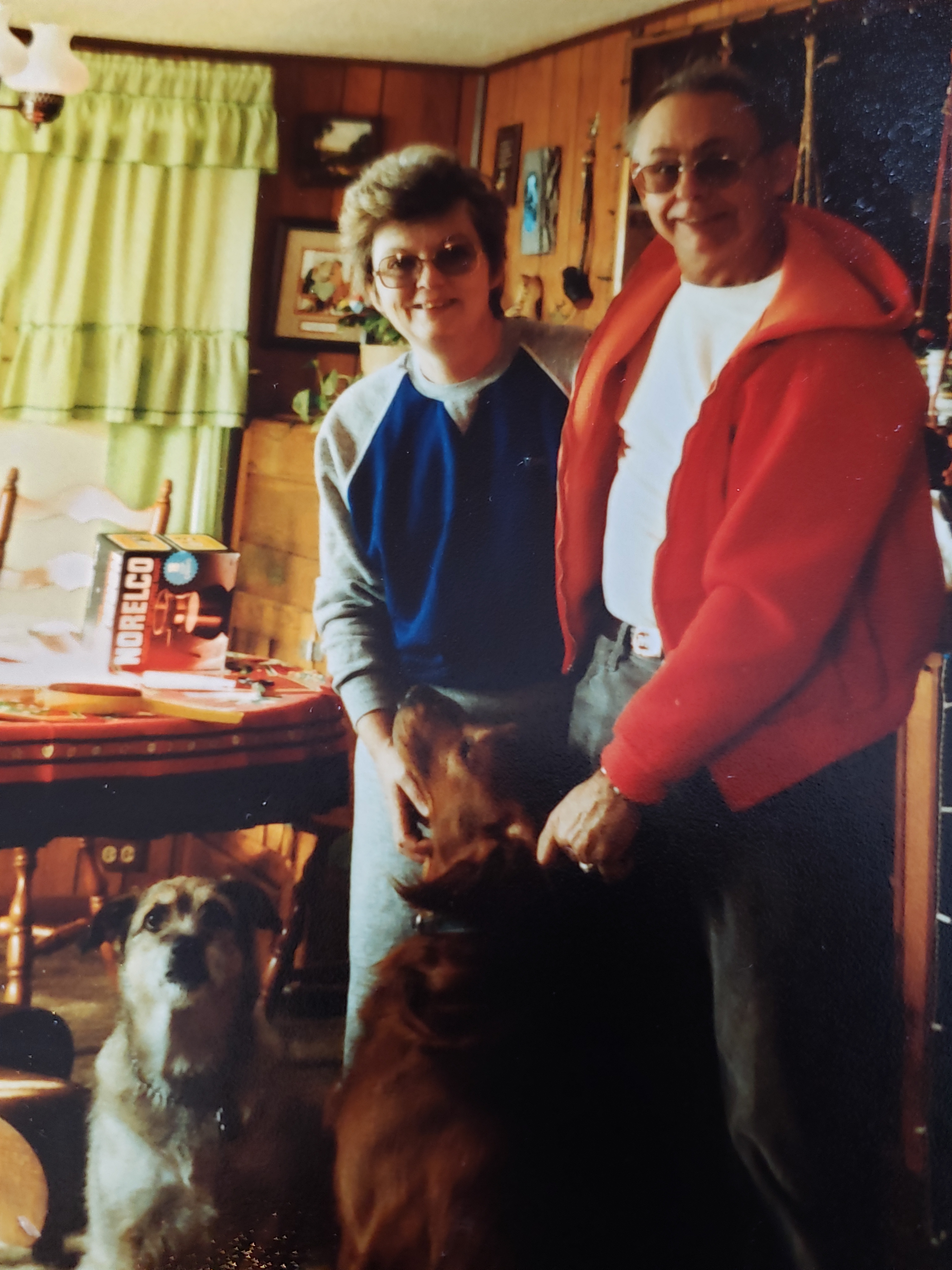
In this photo taken at Christmas time (note the little twinkle lights strung across the room divider and the bottom edge of a bell decoration hanging from the ceiling) of 1983 documents my mother’s design style. The green ruffled drapes and the milk glass light fixture signaled Early American to her. The round oak table, one of her best refinishing projects, was her pride and joy. My big sister reminded me that it once belonged to our great-grandmother, who used it in her summer cottage at Petite Lake. We used the table every day for our meals. On Thanksgiving and Christmas Eve, my father hauled the leaves up from the basement and wrestled them into place so there was enough room for the relatives. Behind my mother’s shoulder is the side of an old ice chest that she also refinished and turned into a bar cabinet. I think she was almost as proud of that piece. Both the table and the cabinet remained right there in the dining room until she died.

(For dog lovers: The golden retriever, the only purebred dog my parents ever owned and only because my father was friends with the breeder, was officially named Sir Ski Kaminski but nicknamed Ski. They chose this name because when they opened the back door to call him in, they could yell, “Come in, Ski.” The other dog, looking straight at the camera, was Mickey, a lovable but very, very dim mutt. He belonged to my sister, who wisely left him behind when she moved away from home.)

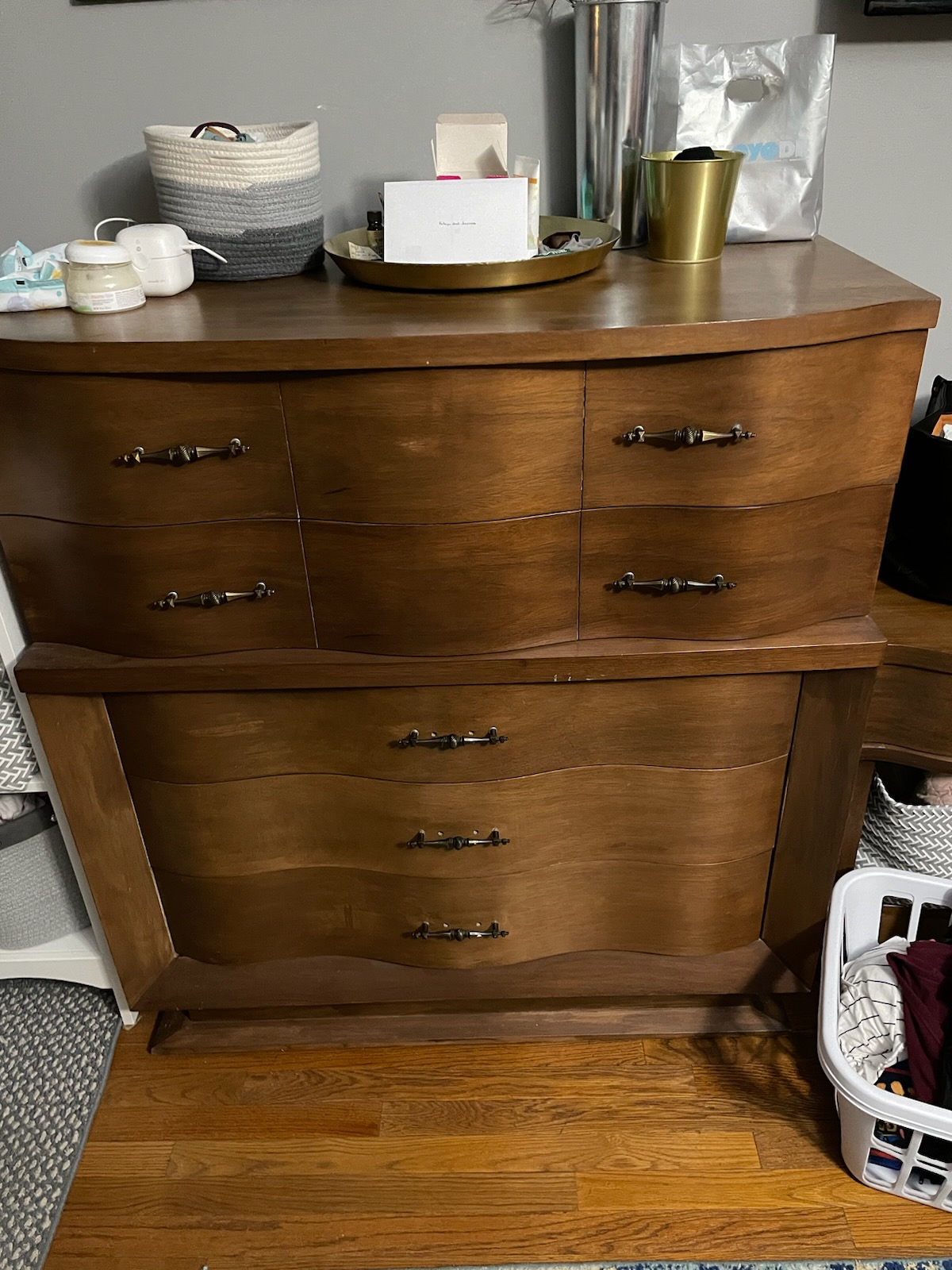
The last refinishing project I remember my mother completing was my parents’ bedroom set. They bought it—dresser, chest of drawers, two nightstands—the year they were married. It was made by the Kent-Coffey Manufacturing Company of Lenoir, North Carolina, which specialized in affordable, mass-produced, stylish furniture. The set was classic midcentury modern, finished in a silvermist grey coating with space-aged hardware. I haven’t been able to find a photo, but I did run across this furniture store ad that included Kent-Coffey bedroom sets.

Sometime in the 1980s or 1990s, my mother decided she’d looked at that grey finish long enough and wanted to get rid of it. (The midcentury mod enthusiast in me now cringes at that decision, despite, like my mother, a general preference for natural wood finishes.) I don’t think she could stand the thought of getting rid of the furniture itself, which was still in amazing condition, but she longed for the wood look. So my mother stripped all the pieces. She found nice wood, but it wasn’t oak—at least it doesn’t look like that to me—and she stained it a dark Early American color and replaced the sleek hardware with more ornate handles. I think she was pleased with the outcome. It was the only bedroom set she ever owned as an adult. She liked it; it was familiar, and it was comfortable.

(photos courtesy of R. Moore)

Then one day my mother was finished with refinishing. I don’t remember if she abandoned a project midway, but I doubt it. She finished what she started, though her satisfaction with the final product could vary from project to project. She learned from any mistakes and moved forward, determined to do better with the next.

The round table, bar cabinet, and bedroom set are still in the family, being used and enjoyed by a new generation. The first two may really qualify as antiques by now, though of course not Early American. Hopefully they will endure for another generation or so beyond that, tangible reminders of one of Irene Kaminski’s talents.