In 1941, an American woman named Gladys Savary owned and operated one of the most well-known restaurants in Manila, the capital city of the Philippine Islands. She and her French husband André, always looking for new adventures, opened the Restaurant de Paris, “Manila’s Smartest Restaurant,” in 1932. But most of its considerable clientele simply referred to it as Gladys’s, and the place filled up night after night. Almost any American living in Manila would acknowledge that everyone goes to Gladys’s.
When the war started in Europe in 1939, André left the Philippines (and his marriage to Gladys) to join the French military. Despite the European hostilities and the growing unease about Japanese aggression in the Pacific, Gladys had no qualms about remaining in Manila. “I even became a convert to the popular theory that Japan wouldn’t do any attacking of the Philippines because she could just walk into them in 1946 when Philippine independence [from the United States] would become effective.”
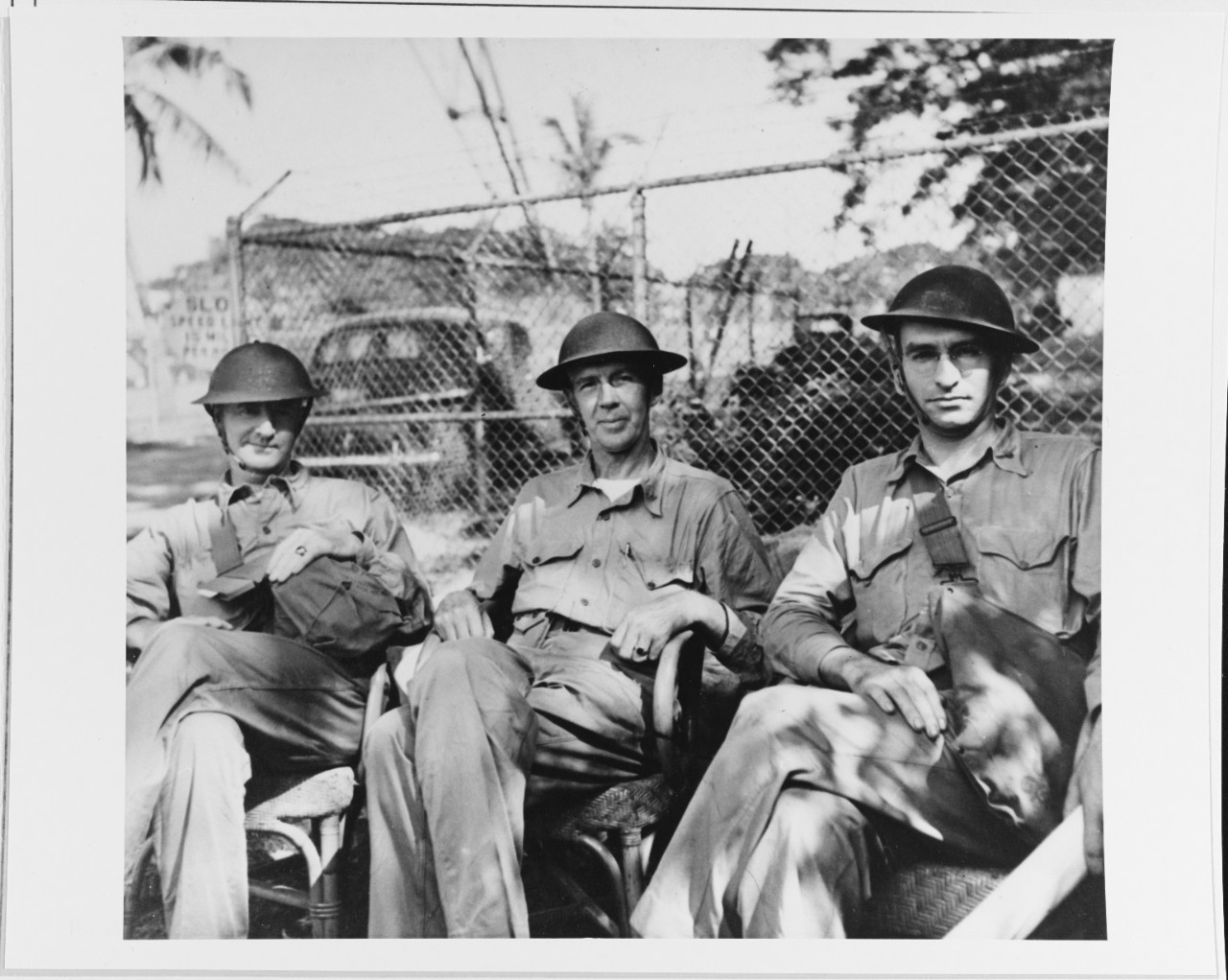
[Rear Admiral Francis W. Rockwell, USN (1886-1979), (center), Commandant of the 16th Naval District, at his headquarters after a Japanese air raid on Cavite Navy Yard, Philippines, 17 December 1941. With him are members of his staff: Lieutenant Commander Frank J. Grandfield (left) and Lieutenant Malcom Champlin. National Archives 80-G-243708]
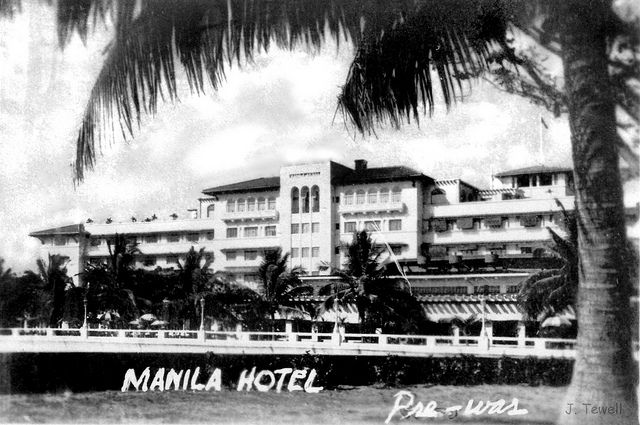
Gladys remained hopeful into the fall of 1941, though she witnessed daily the increased activities of the military in and around Manila. She never slept on Sunday night, December 7 (Manila is on the other side of the International Date Line). She had invited some friends to the restaurant for dinner in celebration of the promotion of a British naval officer she knew. After their meal, they headed over to the Jai Alai Club to watch a match, then stopped at a nightclub before moving on to the Manila Hotel for drinks on the pavilion. Gladys and her friends concluded their evening at an all-night gambling den where they played roulette until dawn.
Gladys had no time for sleep before she needed to get out to the market Monday morning to buy the day’s food for the restaurant. Her servant Nick brought her morning coffee and the newspaper and said, “Honolulu’s bombed. What’ll we do now?” Gladys’s first thought was about business. The restaurant would be busy, she predicted, because people were always hungry. She told Nick they would do their shopping as usual. “War or no war, we have to eat. Nobody can know what’ll happen.”
Indeed, she could not know, though she may have suspected, that things would get much worse. The Japanese bombed Manila, too, and by early 1942 they occupied the city. American nationals were rounded up and confined on the grounds of Santo Tomas University. But Gladys had no intention of sitting out the war in an internment camp. She decided to evade internment and do what she could to assist those who could not. She planned to undermine the Japanese occupiers whenever possible. She risked her life and resisted.
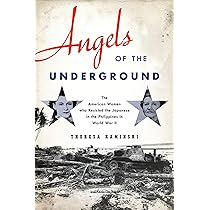
Gladys Savary was just one of many who defied the Japanese in the fight for freedom. I think about her every year on December 7 to remember and honor the variety of sacrifices millions of people made during World War II to stop the spread of tyranny. If you are interested in finding out exactly what Gladys did during the war, read Angels of the Underground: The American Women Who Resisted the Japanese in the Philippines in World War II.
I’ve been trying to write this second part of the 2912 Tale since last November. Every time I get to a certain section of it, my brain refuses to move forward. I keep thinking, nope, this is too much. Even though I’ve been writing and publishing for close to thirty years, for this part of the Tale, words fail me. Repeatedly.
Anyway, a quick reminder of the preceding post: Back in October, as I sorted through family pictures with my sister Kathi, I was hit with both memories and momories—my term for the stories our mom (aka Irene junior) told. I know that what I’ve been calling momories are really a form of oral history, the process of verbally passing along information and stories to the next generation. But for me, calling them momories makes their provenance clear and keeps our mom centered in my memories.
As Kathi and I went through those snapshots, we ran across a few of our mom that I didn’t remember seeing before. They had our mom’s careful all-capitals printing on the backs, where she jotted a few identifiers. These jarred a couple of more momories that made me further ponder the relationship between Irene junior and her paternal grandmother, Irene senior.
The first photo is of Irene junior at about a year old, with her father George, Irene senior’s firstborn son, who is holding her hands to help her walk. They are in the yard of the tiny summer home (always called the cottage) owned by Irene senior and her husband Edward (who died before we were born) near a small lake in northern Illinois.*
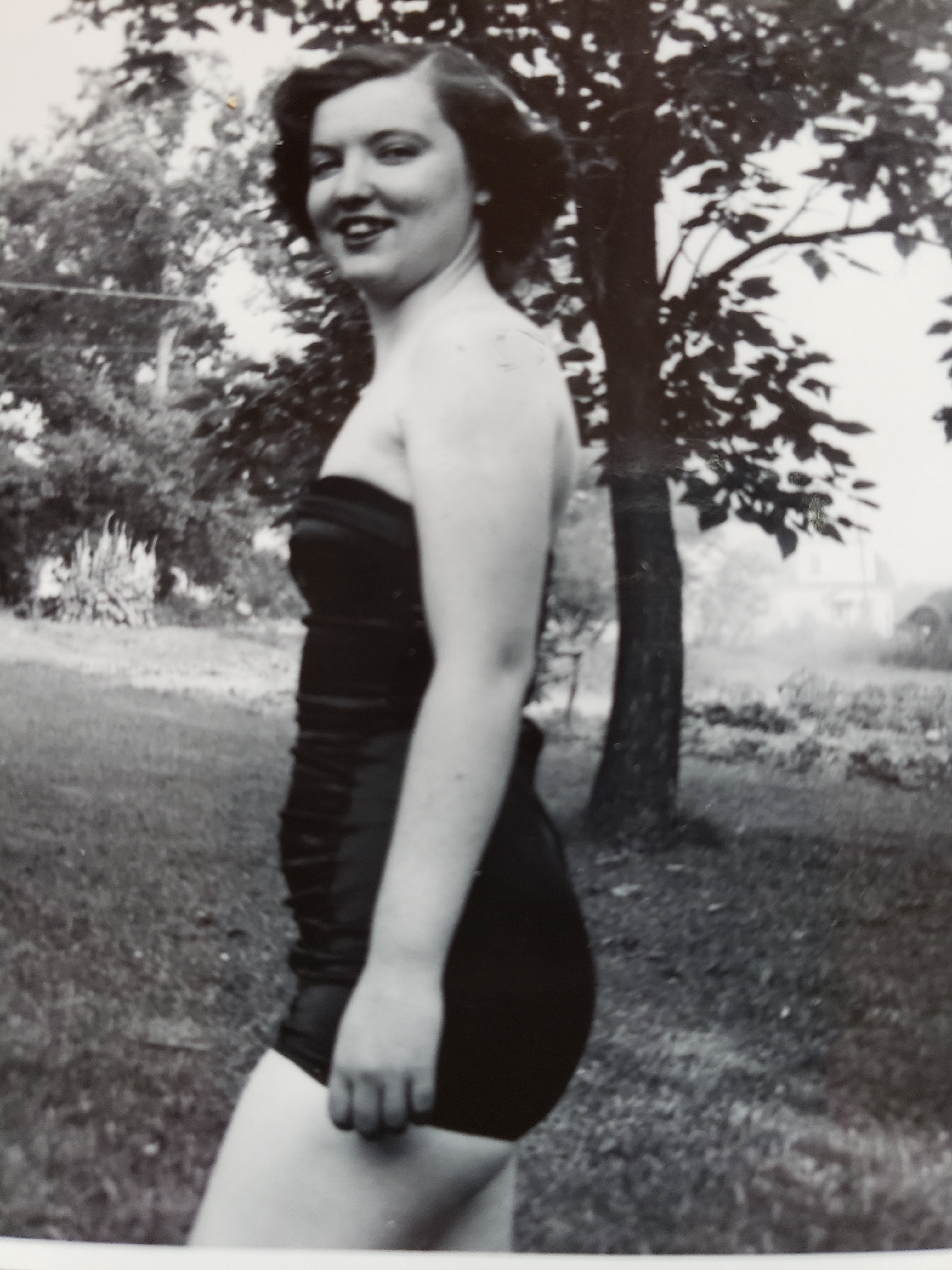
The second, which I found as startling as the one of Irene senior sitting on a donkey in Capri, shows our mom, probably no more than twenty years old, wearing a strapless swimsuit, smiling at the camera. This picture was probably taken in that same yard at the cottage. Despite the smile, Irene junior did not like warm weather and direct sunshine.
I have a momory about an incident that took place at the cottage probably sometime between the 1940s and early 1950s. Irene junior would have been old enough to be in the room when it happened—the only bedroom in the house, where a small group of female relatives, including her mother and grandmother, changed into their bathing suits before heading down to the lake—but I don’t remember her saying how old.
A younger married woman first raised Irene senior’s hackles by not modestly turning away from the others as she removed her clothing. Flashing portions of her naked body, this woman complained about her husband, said she wasn’t happy in her marriage, and wanted to leave him and get a divorce. Irene scolded the woman—I don’t remember if our mom said it was a niece, perhaps, or a younger cousin—telling her to stop talking foolishly, to behave herself, and go on home with her husband. Our mom related that the young woman felt properly chastised and indeed continued in her marriage, never again mentioning leaving her husband. Nana, our mom said in a tone ladened with finality, didn’t approve of divorce, so there was no divorce in our family.
Lately I’ve been considering that momory alongside another one that should be prefaced by this piece of information. At some point early in our parents’ marriage (or maybe just after they’d become engaged—my memory of the momory is faulty here), Nana bought our dad Mike a pair of sturdy leather work boots. Even if this had been a birthday or Christmas present, it was a generous gift and not inexpensive.
I have wondered if the boots might have been Nana’s way of apologizing for a remark she made, not in Mike’s presence, but one all the members of the Berwyn bungalow household probably chuckled about as they gleefully relayed it to him. Our mom still laughed about it decades later whenever she brought it up; our dad did something like an eyeroll when she did.
The story went like this: While our mom waited for our dad to pick her up for one of their first dates, Irene senior watched as he got out of his car and headed up the concrete front steps of the bungalow. She noted his appearance—loose-fit khaki pants, a Hawaiian-style shirt, dark sunglasses, probably a cigarette in his hand—and announced, “A hoodlum’s come to pick up our Irene.”
(Mike, about 10 years before he met Irene junior, cultivating that “hoodlum” appearance.)
Nana must have changed her mind soon after having an actual conversation with our dad. The two of them ended up liking each other. The work boots she bought for him were a thoughtful gift. Mike learned land surveying in the army, a trade he continued in civilian life, and quality footwear made a huge difference to his on-the-job comfort.
(Mike, somewhere in Korea sometime in 1951, wearing boots similar to the ones Irene senior later gave him.)
Our dad kept those boots for the rest of his life, carefully cleaning and polishing the leather, getting the soles and heels replaced when they wore down.** They probably reminded him of Nana and of that early kindness. He cried when she died, our mom told us. We understood the weight of that sentence. We never saw our dad cry so Nana must have been really special to him.
I sometimes think about the momory of that event at the cottage—our mom’s pronouncement that Nana would not tolerate divorce—and the momory of Nana’s first glimpse of our dad that prompted the hoodlum comment which may have led her to buy the boots. Then I imagine the connections among all these, and the subsequent strong bond between our dad and Nana that prompted his tears at her death.
But to explain how I’ve imagined those connections, I’d have to delve into two family secrets of 2912. That’s what brings me to a dead stop every time I reach this point. I’ve tried to write about them, and I still can’t. While the cat has long been out of the bag about both secrets (at least within the family), they are entangled in many other issues that seem too daunting to unravel. So every time, I just stop writing.
Why bring this up now? Well, sorting through those photographs made me think about it. Plus I’m at the beginning-ish stage of a new book project, which involves a lot of research, some of which ends in frustration because of what’s missing. Or what I believe is missing.
Researching and writing biography requires tracking down a variety of sources, including pictures, letters, and memoirs. I rely on not only what other people decided to save in terms of physical artifacts, but also what they chose to write about, whether as notations on the backs of photos, information passed along in correspondence, and/or remembrances included in memoirs and/or autobiographies.
Decisions and choices like these produce silences in the archives leaving researchers to constantly ask how materials have been selected and saved, but also, very specifically, what’s missing and why it might be missing.
I’ve imposed some silences in my family’s archives by saving some photos and pitching others and by sharing some specifically collected and very consciously edited memories and momories.
After Kathi and I finished looking through all those pictures back in October, I headed off for my first major research trip for a book about Jane Grant, co-founder of The New Yorker magazine and lifelong women’s rights advocate. And there, in the vast collection of her papers, I faced silences. More on that in the next post.***
(Jane Grant, c. early 1940s, Jane Grant Photograph Collection, PH141, University of Oregon Libraries Special Collections.)
Some asides:
*Decades later, when our parents Irene and Mike took us to the cottage in the summer, the first thing my dad had to do when we arrived was clean up the outhouse, especially to get rid of the spider webs. None of us siblings would go in there if we saw spider webs. Even in the 1960s, the cottage lacked an indoor toilet. Our mom disliked being at the cottage, probably because, with four children, she had more work to do during what was supposed to be a vacation. But, because of the four of us, our parents could only afford cheap vacations. The cottage was free to use, within a couple of hours’ drive, and was right near a lake that kept us busy during the long summer daylight.
**After Mike died, Charles, my husband, took the boots. They were still in relatively good shape, but after many decades they only fit one pair of feet so had finally outlived their usefulness.
***It’s Women’s History Month, so I hope to post one or two pieces about Jane Grant and what’s been happening with my research. This year, the National Women’s History Alliance has chosen the theme of “Women Who Advocate for Equity, Diversity, and Inclusion,” which is a good match for my Jane Grant project.
In October 2023, on my way out West for a research trip, I spent a couple of days with my siblings in the Chicago suburbs, which is always a treat. And it gave me the time to help my sister Kathi go through the last few boxes of photos from our childhood home at 2912.
Kathi set all the boxes on her big dining room table, which once belonged to our mom’s mother and served as the grownup table for holiday dinners. Many of the photos in those boxes depicted our parents, Mike and Irene, at various stages of their younger lives, with their extended family members.
Most snapshots lacked identifying information that would have provided the who, where, and when. With some regret, we threw them away. Kathi kept saying, as we pitched photo after photo, these were our parents’ memories, not ours.
But I couldn’t help holding on to some of their memories, because they have seeped into mine. That’s because our mom, the great storyteller of the family, loved to relate tales about her relatives. I think of these handed-down memories as momories.
Uncle Gaston is one of them. These days, when we four siblings are together and reminiscing, just a mention of Uncle Gaston will trigger a lot of laughs. That’s because we remember our mom talking about this relative of hers who died before any of us were born. We were impatient with those stories when she told them because they had nothing to do with us. Sometimes we teased her that she made him up—we couldn’t imagine anyone with the name Gaston. So the momories I have of Uncle Gaston are limited to his World War I service in the navy that never took him further away from home than Lake Michigan.*
That day with my sister I was delighted to find a black and white picture of three people, their names written in full on the back: Uncle Gaston along with his wife Evelyn, and Evelyn’s sister, Irene. That Irene—later called Nana by us—was the paternal grandmother of our mom, which means Gaston was our mom’s grand uncle by marriage. There’s no location or date noted on the snapshot, though Evelyn’s peep-toed, ankle-strap shoes suggest the picture was taken in the late 1940s or early 1950s.
Irene senior, already widowed by the time she posed for that photo, stands next to Gaston. She wears a fashionably tilted hat and a slight smile. She looks jaunty. Another photo from that box shows Irene on a street on the Isle of Capri in 1953, the year she turned seventy, sitting on a donkey. She appears remarkably capable, though not totally at ease, as she holds the reins. The man standing to her left looks at her, impressed.
I have my own memories of Irene senior because I knew her for the first several years of my life. As a child, I wouldn’t have recognized her as the woman in those two photos. I knew her as the Nana who wore housedresses and, at Thanksgiving and Christmas, baked pumpkin pies (with lard crusts) in the kitchen of her Berwyn bungalow. If we great-grandchildren behaved while visiting, she let us go into the pantry and coax a cookie—iced oatmeal or an almond-studded Windmill—from its crackling plastic package. (Holiday pies were homemade; cookies were not.) But only if we behaved. Nana wasn’t indulgent.
I learned from census records that Irene was born in 1883 and grew up in Chicago, the eldest of five siblings (including Evelyn) whose father was a cabinet maker from Germany. She worked for a time as a clerk in a pickling factory before, at age nineteen, she married Edward, a salesman for a plumbing supply business.** During the 1910s, the company transferred Edward to Kansas
City, Missouri. He, Irene, and their two sons remained there through part of the 1920s but returned to Illinois before the end of the decade, settling in a new two-bedroom brick bungalow in Berwyn.
What follows is a momory, a story our mom, Irene junior, told often. Sometime after 1930, when the economic reversals of the Great Depression had sunk in, Edward and Irene’s son George, his wife Martha, and their two children, George, Jr. and Irene junior, came to live with them in their Berwyn home. George and Martha had recently bought their own brick bungalow in nearby Elmwood Park, but because of the Depression, there was only enough money across two households to save one home. So our mom ended up growing up in the Berwyn bungalow, surrounded by extended family members.***
(Irene senior is at the top right, Irene junior is on the floor with her dog Jerry, in the living room of the Berwyn bungalow, December 1950.)
Our mom would not like me referring to her as Irene junior. She always said she hated her name, but I don’t think that’s because she hated her grandmother. Resented, maybe, on some level because Irene junior also did not like having extended family members around. The Berwyn bungalow belonged to Irene senior, yet even after the Depression ended, George and Martha remained there with their two children. Irene junior never had her parents all to herself. She spent the rest of her life determined never to live with any of her children, and she never did.
But I think a lot about the relationship between the two Irenes. I’ll get into that next time in A 2912 Tale of Photographs, Memories, and Momories, Part II: Irene senior and Irene junior
Additional asides about the family:
* Gaston served in the Navy Auxiliary Reserve in 1918, then married Evelyn the following year. In civilian life he mostly worked in the milk industry, first as a driver, then as a salesman for Bowman Dairy. Evelyn stayed at home, which was a rented apartment in Chicago, and raised their daughter, Aline, who was likely named for Gaston’s younger sister, Aline, who died in 1914 at age twenty.
Through the decades, after the deaths of her aunt and uncle, our mom kept in touch with her cousin Aline, even when Aline settled with her husband way out in California. (Irene junior didn’t approve of people moving away from where they grew up. To her, no place was better than the Chicago suburbs.) As teenagers, Kathi and I accompanied our dad on a business trip to California. We stayed at Aline’s house, which had a swimming pool in the backyard and was located within an easy driving distance of Disney Land. We even took a day trip to Tijuana where I bought a very hip brown suede jacket with fringe. I still have the jacket.
** Edward had a younger sister named Albina who became a statistician, and our mom sometimes told stories about her, none of which I remember in detail. But we had two such great names in the extended family.
***Our mom never shared the details of that decision. Did Edward, as patriarch, pull rank? Did the size of the house factor in? (The Berwyn place had more square footage.) Was the mortgage payment on that house lower, making it more affordable? Edward and George, both salesmen, would have realized that their jobs were always in jeopardy. Did they both manage to hold on to full-time positions or did they find their hours and salaries cut? Did they have to move on to different sales jobs? Was there ever a discussion of Irene senior and/or Martha looking for work? How did Martha and her mother-in-law get along, especially with young children in the house to raise? I think of all these things now, but of course they never occurred to me to ask such questions when I was a child listening to our mom.
The best narrative nonfiction books I read in 2023 comprise an unusually short list. I think there was something about my reading mood last year that affected my reactions to books. “Best” and “favorite” are subjective, anyway, so I’m sticking to that as an explanation.
All of these books deal with the past, and all but one are biographies. The outlier of the group, though, could be described as a collection of mini-biographies. Here they are, roughly in the order of my admiration.
In Master Slave Husband Wife, Ilyon Woo traces the perilous journey from enslavement to freedom of Ellen and William Craft. The Crafts fled Georgia with Ellen disguised as an invalided white man and William posing as her “servant.” Their life in the “free” North was dangerous because of the Fugitive Slave Law, yet the couple became part of the great abolitionist movement in the years prior to the Civil War. It’s an unforgettable story of moral and physical courage.
Catherine McNeur introduces readers to Margaretta and Elizabeth Morris in the dual biography Mischievous Creatures. The historian makes a convincing case that the largely self-taught sisters, one an entomologist, the other a botanist, made significant contributions to scientific knowledge in the decades before the Civil War. Margaretta and Elizabeth are fascinating women, and McNeur expertly weaves in the science without slowing down the story of the women’s accomplishments and the barriers they faced because of their gender.
Leaning heavily on literary analysis and historical context, David Waldstreicher recreates the life of an eighteenth-century Black poet in The Odyssey of Phillis Wheatley. Kidnapped and enslaved as a child, Wheatley learned how to read and write while living in Boston and began turning out poetry as a teenager. This is a finely detailed story that took me some time to read, but I thought it was wonderful.
I learned a lot about South Africa from Jonny Steinberg’s dual biography, Winnie and Nelson. Steinberg traces apartheid through the lens of the Mandela marriage, focusing on Nelson’s long imprisonment and Winnie’s increasing political influence. It’s a riveting and important book.
Emma Southon’s lively voice adds an extra layer of enjoyment to A Rome of One’s Own, which reveals the history of the Roman empire through the lives of twenty-one mostly-forgotten women. This serves as a nice reminder that there was more to Rome than gladiators and pontificating politicians.
There were also a couple of other books I liked, both biographies. I appreciated learning more about the Queen of Crime in Agatha Christie: An Elusive Woman by Lucy Worsley, and it was interesting to find out about the intrepid twentieth-century journalist Elsie Robinson through Julia Sheeres and Allison Gilbert’s Listen, World!
Now for the bonus: memoirs. Last year, I included them in with the other nonfiction I read, but this time I decided it was more appropriate to give them their own category. While it’s true they are nonfiction, memoirs are very different from the historical, fact-based nonfiction that I usually read.
There are three memoirs I read in 2023 that I keep thinking about.
I’m certainly not the first person to rave about poet Maggie Smith’s You Could Make This Place Beautiful, but I may be among the last to have never run across her poem “Good Bones.” Its last line was turned into the title of her lyrical story of the unraveling of her marriage and her enduring love for her children.
Love for her children is a strong undercurrent in Life B, author and book critic (known in online circles as The Book Maven) Bethanne Patrick’s clear-eyed account of her decades-long struggle with double depression. She hits and maintains a sweet spot of narrative voice that is neither too bleak nor too Pollyanna-ish. I rooted for her all the way through.
Marsha Jacobson rounds out this trio of devoted mothers. In The Wrong Calamity she describes how she survived an abusive marriage, established herself as a successful businesswoman (even earning a Harvard MBA) and as a role model to her daughters, then suffered a shattering disappointment with her second marriage. Like both Smith and Patrick, Jacobson shows restraint in parceling out the gritty, personal details of these relationships, giving readers just what they need but never tipping into a salacious tell-all.
That’s it for my 2023 reading recap. I’m delighted (and slightly relieved) to report that 2024 is off to a blazing start. I could hardly bear to put down Vanessa Chan’s The Storm We Made and Anne Enright’s The Wren, the Wren, plus I’m swiftly moving through Mott Street by Ava Chin.
Up next: some pieces that are more or less connected to my new book project.
In 2023, I read at least 46 books. As in previous years, I can’t provide an exact number. Sometimes I forget to add a book to Goodreads, and I usually don’t count the books I read for Publishers Weekly reviewing, a gig I finally ended in the fall after ten years.And I normally don’t include books I read as background material for my own writing projects. So, about 46 for 2023. Not bad. Not great.
In terms of quality over quantity, though, well, even that seemed to fall a bit short. I rarely deliver a tidy top ten list—usually going a bit over that number because of the many books I loved. For the fiction I read in 2023 (which included books published in other years), I gave five stars to eight novels. But I liked many others without feeling wowed by them. This is totally subjective, of course.
Of those eight five-starred novels that I read in 2023, I’ve already identified three for www.shepherd.com , which I posted about on January 1, 2024.
These represent the kind of novel I’m most drawn to: historical fiction written by women with plots heavily centered on women. I loved the expansiveness of Quinn’s story, which ranges over the two world wars of the twentieth century. (A t.v. series is purportedly in the works. Yay!) I loved how Jiles and Moustakis contained their poetic narratives in a briefer time frame. All three authors excelled at both character and place. I still think about these books often.
I consider Paulette Jiles’s novel an example of a new style of Western, and I would put Lucky Red by Claudia Cravens in the same category. It’s a delectable romp about a plucky teenaged orphan, Bridget, who must support herself in Dodge City. Prostitutes and gunslingers populate this entertaining, thrillerish, action-packed coming out story.
Catherine Lacey’sBiography of X is a compelling mash-up of alternative history and love story, with the widowed C.M. Lucca gathering information about her deceased wife, an artist known as X, to write a “true” biography of her life. A stunning riff on how we create ourselves and how much we can ever really know another person.
Leila Mottley’s debut, Nightcrawling, was longlisted for the 2022 Booker Prize and was an Oprah Book Club selection. It features a teenaged main character, Kiara, who turns to sex work to support herself, her brother, and an abandoned neighbor boy in Oakland, California. It was a tough story to read but beautifully done.
The same can be said of Brotherless Night by V.V. Ganeshanathan, set during Sri Lanka’s civil war. As Sashi studies to become a doctor, her family unravels, and she loses her four brothers in different ways. It’s a moving meditation on what it means to be a patriot and/or a terrorist during times of great political upheaval.
I was very late to Amor Towles’s debut, Rules of Civility. I’d really liked A Gentleman in Moscow, so when I found a used copy of his first novel, I decided to give it a try. It takes place in the Depression-era United States, following a young woman named Katey as she struggles to carve out a career and develop a relationship with the enigmatic Tinker Grey, who has links to the wealthy and powerful of New York City. It’s a fascinating story that surprised me in several places.
In addition to these eight, there were seven others that I enjoyed reading in 2023. Most centered on families. For some reason I’d left off reading Anne Tyler, so it was nice to return to her with French Braid, a solid example of her signature quirky family drama. Tom Lake by Ann Patchett is a nicely structured path-not-taken story with a lot of heart. Celeste Ng’s Our Missing Hearts is a chilling parent-and-child tale set in an alternate (but scarily plausible) United States. Day by Michael Cunningham is a heart-pulling piece about the affects wrought by the Covid pandemic. And Demon Copperhead, Barbara Kingsolver’s updated, reimagining of Charles Dickens’s David Copperfield, is a sad—and at times grim—story of a young boy’s search for family.
Rebecca Makkai’s sophisticated mystery I Have Some Questions for You takes place at a boarding high school. Bodie Kane, a former student, has returned to teach a short winter session, and in her spare time digs into the decades-old murder of her roommate there.
The only historical of the bunch is The Literary Undoing of Victoria Swann by Virginia Pye. (I posted a review of it in 2023.) I was especially fond of the titular character, a talented Gilded Age writer determined to control her career.
And finally, I read Anna Karenina by Leo Tolstoy. I would describe it as a plus-one to the seven enjoyable books. It’s one of those novels that I always thought I should read, and last year the nonfiction author Laurie Gwen Shapiro, organized an online book discussion of it so I decided to join in. I have to admit that it took some dogged dedication to get through the novel. It has a lot of plot. There are dozens of characters whose names spawn nicknames. There are big political and philosophical discussions. It is a big, big book.






 Theresa Kaminski
You must be logged in to post a comment.