Holiday Inn and a Missed Opportunity in the Life of a Future Queen

In my quest for a new-to-me Christmas-y movie, I finally watched Holiday Inn. I have always known that White Christmas was based on Holiday Inn, and I’ve seen White Christmas (the “Sisters” acts are perfection, and Doris’s comment, “Well I like that! Without so much as a ‘kiss my foot’ or ‘have an apple’,” is snortingly funny) too many times to count. It is one of the few musicals I will watch without fast forwarding through the song-and-dance numbers. (Yes, not a big fan.)

The 1942 Paramount Pictures musical Holiday Inn starred Bing Crosby as Jim Hardy and Fred Astaire as Ted Hanover. They have a singing and dancing act with Lila Dixon, played by Virginia Dale. After Jim’s engagement to Lila fails (she throws him over for Ted), he moves to a farm in Connecticut that he decides to turn into an inn that will only open on holidays. Aspiring entertainer Linda Mason (played by Marjorie Reynolds) shows up at the farm intent on getting a job, she and Jim sing “White Christmas,” and he falls in love with her.

All sorts of other things happen—there is a whole lot of plot here stretched out to link the many musical numbers—before another round of “White Christmas” and the happy Hollywood ending. I did my usual fast forwarding, though I have always enjoyed Crosby’s smooth voice and appreciated the genius of Astaire’s fancy footwork. Also, the racist elements (especially the blackface performance of “Abraham”) and the sexist attitudes (too numerous to mention) of the story make many of the scenes cringe-worthy.

I was particularly interested in Marjorie Reynolds’s performance. She had trained as a dancer and began appearing in silent films when she was a child. The 1930s found her in bit parts in several movies at the big Hollywood studios, including a small role in MGM’s Gone With the Wind in 1939. Reynolds did not turn down offers from B studios like Monogram and Republic, where, in 1941 she appeared opposite the popular singing cowboy Roy Rogers in Robin Hood of the Pecos. She was a working actor, and she likely believed her part in Holiday Inn, which put her alongside the star Fred Astaire, would quickly elevate her status.

According to IMDb, the role of Linda Mason in Holiday Inn had been written for Mary Martin, an accomplished vocalist and dancer who was already a hit on Broadway. She declined, saying she was pregnant so could not take the role. Director Mark Sandrich suggested Ginger Rogers (Astaire’s most famous dancing partner) and Rita Hayworth, but Paramount would not sign off. Sandrich would have to find someone else. Perhaps a Hollywood newcomer.  

In the summer of 1941, Dale Evans arrived in Los Angeles. She had been a professional singer since the late 1920s, and over the past few years her stints on Chicago radio stations and her appearances at some of the city’s trendiest nightclubs had gained her quite a following. Joe Rivkin, a Hollywood agent, made a point of listening to Dale every week on the radio. He sent telegrams offering to represent her if she was interested in making the move into motion pictures. Rivkin pestered her to send photographs that he could circulate to casting agents. Dale finally relented, sending off some old publicity stills, and thought no more of it. She did not think she was attractive enough for the big screen. Besides, she was twenty-eight years old, much too old for a start in Hollywood.

But Joe Rivkin liked Dale’s looks and told her she would be perfect for a new musical, Holiday Inn, that was still in the process of casting. He cabled her, “Come at once,” and she did. After a quick session at the beauty salon of the Hollywood Plaza Hotel (Rivkin found Dale’s appearance disappointing in person and ordered a new hairstyle and better makeup), the agent brought his client to meet Bill Meiklejohn, head of talent and casting for Paramount.

The trio sat together in the studio’s commissary. Dale endured another appraisal. Meiklejohn found her nose too long for her chin; Rivkin reassured him that could be taken care of with plastic surgery. Then Rivkin launched into his pitch to promote his client’s talents. Meiklejohn seemed impressed. He asked Dale if she could dance. Rivkin answered for her, “She makes Eleanor Powell look like a bum!” (It is doubtful any dancer could have made Powell, considered at the time the world’s best tap dancer, look like a bum.)

Dale could not allow this lie to linger. “No, I can’t dance, Mr. Meiklejohn,” she said. “I’m a pretty fair ballroom dancer, but that is as far as it goes.” Rivkin insisted that Dale was talented enough to quickly pick up any dance routine. But the casting agent knew better. He told Dale, rather gently given the circumstances, that the female actor they put in the role would have to dance with Fred Astaire. She would have to be a top-notch dancer. Dale clearly did not have that experience. She would not get the part.

But Meiklejohn liked Dale. He admitted Paramount had a hefty roster of singers on its payroll; still, he wanted Dale to stay and do a screen test. If it turned out well, the studio might offer her a contract.

So Dale Evans missed the opportunity to sing “White Christmas” with Bing Crosby because she was not a good enough dancer to pair with Fred Astaire in Holiday Inn. Marjorie Reynolds was cast because she was a good enough dancer, but her vocals were not up to Paramount standards. Her singing was dubbed by Martha Mears. (I still think Dale would have been better.)

Marjorie Reynolds remained a working actor, appearing in movies through the 1940s and then on television in the 1950s. Dale Evans never received a contract from Paramount. But Twentieth Century-Fox offered a one-year contract, so she left Chicago for Hollywood. In 1943, Dale signed on with Republic Pictures, which immediately put her in featured roles, then, in 1944, cast her opposite Roy Rogers in The Cowboy and the Senorita. The film was a hit with Rogers’s fans, so Republic continued pairing them. Dale would become known as the Queen of the West and reach the heights of popularity many entertainers only dream of. And it may have come about from a missed opportunity.

Curious about the life and career of Dale Evans? Check out Queen of the West: The Life and Times of Dale Evans.

In Praise of Scrappy Women

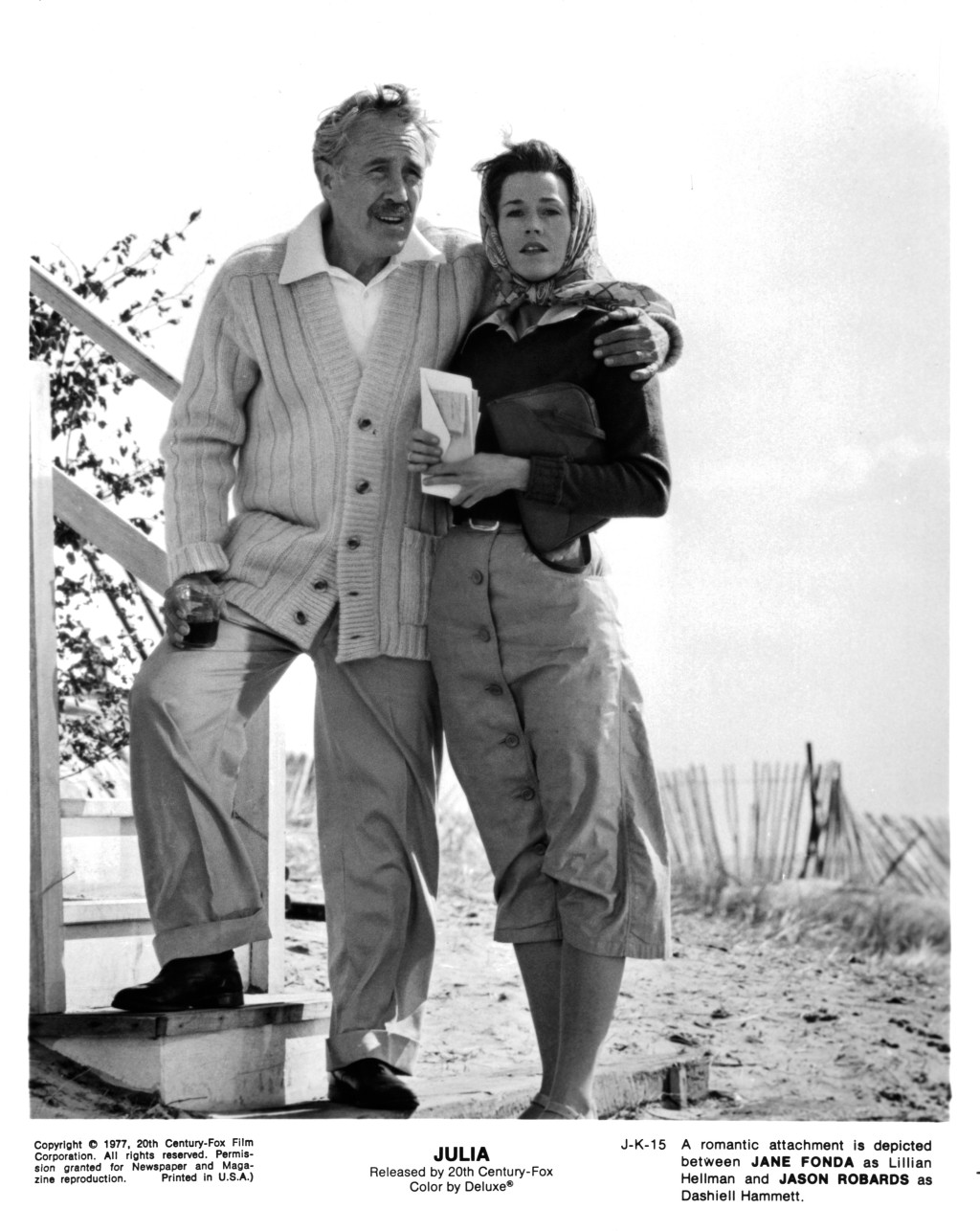
One of my favorite movies is Julia, the 1977 Jane Fonda-Vanessa Redgrave vehicle based on Lillian Hellman’s book Pentimento. In the movie, while Hellman (played by Fonda) is struggling with her writing career in the 1930s, Julia has moved to Europe to fight the growing power of the Nazis.

Image result for julia movie 1977

One of my favorite parts of the movie involves a conversation between Lillian Hellman and Dashiell Hammett (played by Jason Robards), the famous mystery writer who was her partner for decades.

Julia Photos (1/8)

The exchange centers on Hellman’s frustrations about her writing and goes something like this:

Hammett: Go to Spain. There may be a civil war in Spain. You’d help somebody win it. You’re scrappy.

Hellman: I’m not scrappy. Don’t call me scrappy. You make me sound like a neighborhood bulldog.

Hammett: You are the neighborhood bulldog, Lilly, except you’ve got some cockeyed dream about being a cocker spaniel.

Since I’ve been writing books about women in American history, I think a lot about scrappy women. Scrappy is the most perfect word to describe the kinds of women I’m interested in writing about. Scrappy women are dogged and determined. Backed into a corner, they might be dangerous, but the fights they get involved in aren’t physical.

Image result for julia movie 1977 i'm not scrappy. don't call me scrappy

Women like Ethel Thomas Herold, Margaret Utinsky, Mary Edwards Walker, and Dale Evans were all stubborn–persistent–and worked hard to get what they wanted from life and to make the world a better place (according to their own visions) while they were at it. They are fascinating women to research and write about. They are the kind of women I prefer to read about.

So I’m wrapping up this year’s Women’s History Month by praising scrappy women and honoring their contributions. I’m looking forward to writing (and reading) more about them.


A Star is Born and the Promise of 1970s Feminism

In December 1976, Warner Brothers released the third film version of A Star is Born. This time the story was set in the world of rock music instead of Hollywood. The movie starred Kris Kristofferson as John Norman Howard, the rocker headed for a flame-out and Barbra Streisand as Esther Hoffman, the struggling songstress on her way up. Ahead of yet another music-industry based version due out later this year with Bradley Cooper and Lady Gaga, the 1976 film is now streaming on Netflix.

AStarisBorn1976.jpg

The movie itself didn’t receive much critical acclaim when it was released. Roger Ebert gave it a reluctant two-and-a-half star review. He didn’t buy–not for a single minute–Streisand as a struggling singer, but he loved her voice. Movie-goers flocked to see it, though. A Star is Born grossed $80 million at the box office, which made it the third highest earner of 1976. The movie’s theme song, “Evergreen,” topped the pop charts, and won an Oscar for best original song.

I watched the movie last night on Netflix, probably the first time I’ve seen it in 20 or 30 years. I saw the movie in the theater at least once when it came out, maybe more. I bought a cassette of the soundtrack, and I still have it (and play it). I’ve probably seen the movie on video, too.

I’ve never been sure why I like the movie so much. I’d never been a huge fan of the music of Kristofferson or Streisand. I think it has much more to do with that particular time–the mid-1970s–and the movie roles Streisand chose. I’d enjoyed her foray into screwball comedies with What’s Up, Doc? and For Pete’s Sake. (Of course, there was The Way We Were, but I found the heavy drama annoying.) I liked Streisand’s quirky characters, the strong women who knew their own minds.

As Esther Hoffman in A Star is Born, Barbra Streisand portrayed a very modern woman, talented and driven, who assumed she could have both a great career and a satisfying personal life. She didn’t intend to compromise on either. The best thing: she was totally confident in her abilities. She knew who she was, with or without John Norman Howard.

Esther Hoffman personified the goals of 1970s feminism. During that decade, gender equality seemed achievable. The National Organization for Women, founded in 1966, provided support for challenging legal inequalities. Women’s liberation groups offered consciousness raising and other tools for addressing more personal concerns. And after decades of languishing in various congressional committees, the Equal Rights Amendment finally passed through both houses of Congress and was sent on to the states for ratification in 1972. By 1977, the year after A Star is Born was released, 35 of the required 38 states ratified it.

Image result for era ratification 1977

In the first musical number featuring Streisand in A Star is Born, she sang “Queen Bee,” a song that blatantly trumpets women’s sexual desire as it calls for new ways of looking at women. And it includes some pretty great lines:

The queen bee, no way, and even tho’ they think they’re the kings
(escatological things)
Who are they foolin’? Playin’ at rulin’
It’s the queen behind the scene who pulls the strings
So, in conclusion, it’s an optical illusion
If you think that we’re the weaker race
Men got the muscle, but the ladies got the hustle
And the truth is staring in your face.

And tucked in near the end:  “Write me a sequel; Give me an equal.”

The feminist/equality theme of the movie continued with Streisand’s next big number, “The Woman in the Moon.”

Those opening lines:

I was warned as a child of thirteen
Not to act too strong
Try to look like you belong but don’t push girl
Save your time and trouble
Don’t misbehave
I was raised in a “no you don’t world”
Overrun with rules
Memorize your lines and move as directed

And notice Streisand’s wardrobe choice for that scene. The suit. The power suit. As more and more women headed into careers in the 1970s and 1980s, suits were their work uniforms of choice, signalling their insistence on an equal footing with men in the workplace.

What A Star is Born signals to me, then, is all the promise of 1970s feminism. It was a heady time of possibilities for women, with gender equality within reach. I’m reminded of that each time I watch the movie, every time I hear one of its songs (well, maybe except for “Evergreen,” which quickly turns into an ear worm).

And the movie’s ending is a stark reminder that big change doesn’t come easily. There are setbacks and tragedies. But maybe, in the end, “they can hold back the tide, but they can never hold the woman in the moon.”