What’s in a Name?

Since I’ve been thinking of 2025 as the year of Jane Grant, I’ve been finding reminders of her in unexpected places.

Including episode 6, “Meet Michael Vanderkellen,” which originally aired on November 13, 1989 in the eighth and final season of the 1980s sitcom Newhart.*

The episode centers on newlyweds Michael Harris (Peter Scolari) and his wife Stephanie Vanderkellen (Julia Duffy) who are expecting their first child. Michael is unemployed. Stephanie, heiress to a huge fortune but, unable to independently access any of those funds, has been working as a maid at Dick (Bob Newhart) and Joanna (Mary Frann) Loudon’s Stratford Inn in Vermont. Now her room at the inn is not big enough for her growing family.

So Stephanie asks her mother to buy them a mansion in town. Mrs. Vanderkellen (Priscilla Morrill) agrees, but only if Michael changes his last name to Vanderkellen. Because Stephanie is an only child—and a woman—the elder Vanderkellens want insurance that their family name will go on.

Michael, the epitome of a materialistic Yuppie, asks for clarification. “You want me to sell my name, my legacy, my very being, for a house?” Then he immediately agrees.

No one suggests that Stephanie simply continue using her birth name and have the child use it, too.

Instead, Dick points out to Michael, “You sold your soul for a lot of closet space. Don’t you get it? When you give away your name, you’re giving away your identity, your integrity.”

Joanna interjects.

“Of course not,” he replies.

“Why is that?”

[You all know what’s coming.]

“You’re a woman.”

“Meaning?”

“Meaning you’re not a man.”

“So?”

“So it’s different.”

“What do you mean, it’s different?”

“It’s not the same.”

“Dick, I know what different means.”

“Good. I’m glad we cleared that up.”

Nothing is in fact cleared up. Dick is perfectly happy with the logic of his explanation, Joanna doesn’t buy it, and Stephanie simply doesn’t care.

Jane Grant faced the same range of responses more than sixty years earlier when she decided that marriage should not require her to give away her identity.

She married Harold Ross in New York City in March of 1920, not long after they both returned from France, where she had worked for the YMCA and he had been serving in the U.S. army. It was a quick, no-frills wedding at the Church of the Transfiguration. After the ceremony, the church secretary startled Jane with, “Congratulations, Mrs. Ross.”

“Never for a moment had I considered the possibility of losing my name,” Jane later wrote. The secretary’s comment “jolted me into the realization that my very own name might have been dissolved when the minister finished the ceremony.” She decided to remain Jane Grant.

In terms of legalities, this was not a simple thing to do, so in 1921, Jane and her friend Ruth Hale launched the Lucy Stone League, an organization that helped married women retain their birth names. (The State Department, for instance, would not allow a married woman to use her birth name on her passport.) The league’s goal attracted the attention of the National Woman’s Party, led by the charismatic suffragist Alice Paul, who would soon begin the long battle to secure the passage of the Equal Rights Amendment.

The two organizations joined forces on some projects, and many women belonged to both groups. The Lucy Stone League attracted much media attention, and soon any married woman who was known by her birth name was described as a Lucy Stoner.

The league operated as an official organization through the mid-1920s. Jane Grant revived it in 1950, along with Doris Fleischman, expanding its purpose to include pursuing “all civil and social rights of women” and serving as a center for research and information about the status of women. As such, the Lucy Stone League became a foundation for the so-called second wave of feminism that surfaced in the 1960s.

Yet in terms of the league’s original goal, appeals to equal rights proved no match for tradition. Over the next decades, only a small percentage of married women opted to retain their birth names. The 1989 airing date of that Newhart episode marked a kind of high point in a slight uptick of women doing so.

In “Making a Name: Women’s Surnames at Marriage and Beyond,” published in the spring 2004 issue of the Journal of Economic Perspectives, Claudia Goldin and Maria Shim speculated that by the 1990s, “Perhaps surname-keeping seems less salient as a way of publicly supporting equality for women than it did in the late 1970s and 1980s. Perhaps a general drift to more conservative social values has made surname-keeping less attractive.”

Nearly twenty years later, a 2023 study by the Pew Research Center found, “Most women in opposite-sex marriages (79%) say they took their spouse’s last name when they got married. Another 14% kept their last name, and 5% hyphenated both their name and their spouse’s name.”

“Women’s rights” has always been capacious. Jane Grant’s interest began with a small slice that quickly allowed her to see larger connections. Her commitment to gender equality issues likely played a big part in her divorce from Harold Ross. It also likely enriched and strengthened her relationship with William Harris, her second husband. Jane remained Jane Grant after their marriage, too. She never wavered.

* During season 8, Newhart spun out of control as it headed for its now famous finale.

[**spoiler alert**]

The whole thing—all eight seasons—had been the dream of Chicago psychologist Bob Hartley, the main character of Bob Newhart’s eponymous (and much better) 1970s sitcom.

2025: The Year of Jane Grant

Here on the blog, I have designated 2025 as the year of Jane Grant, mostly because it marks the centennial of The New Yorker, the magazine Jane co-founded with her first husband, Harold Ross.

(Jane Grant, c. 1917. Jane Grant Photograph Collection, PH141, University of Oregon Libraries Special Collections)

Also, because for more than a year, I have been engrossed with writing the (very) rough draft of a book about her. I hope this is the year I finish the draft and start reworking it into a less messy version, with a clearer shape, sharper writing, and more vivid story arcs.

My Jane Grant book is not a cradle-to-grave biography. It focuses instead on how Jane got The New Yorker off the ground in 1925 and kept it going. To accomplish this, I explore her journalism career in New York City in the 1910s and 1920s, plus her marriage and subsequent divorce from Harold Ross. All bolstered by an unwavering dedication to the pursuit of gender equality.

Other books have told The New Yorker’s story, but they have been, predictably, male centered. Jane Grant’s presence is sidelined in them, her role largely subsumed under that of “wife.”

As Amy Reading points out in The World She Edited, her marvelous 2024 biography of the magazine’s long-time fiction editor Katharine White:

“But there’s another way to tell the magazine’s origin story: by traveling along the networks forged by the women who were there from the beginning and who have been barely mentioned in histories of the magazine.” Reading’s book traces how White’s tenure at The New Yorker (like Jane Grant’s involvement, as I will demonstrate) “shows quite simply that so many of The New Yorker’s early successes were due to the efforts of feminist women who interpreted the magazine’s obsession with sophistication in a way guaranteed to appeal to readers like themselves—educated, active participants in the city’s cultural life.”

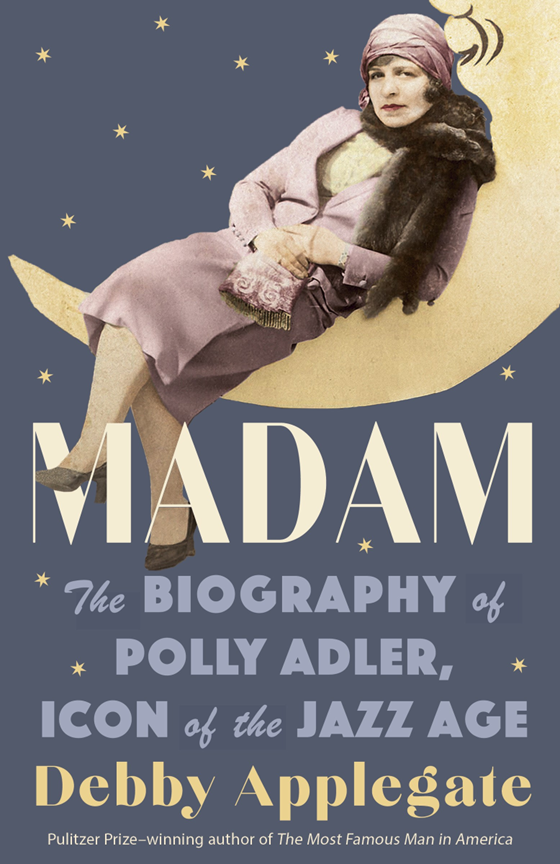
Reading’s book has proved a good resource for my project. It is also an inspirational model of writing, as is Debby Applegate’s biography Madam, about Polly Adler. I anticipate that Laurie Gwen Shapiro’s forthcoming book, The Aviator and the Showman, about Amelia Earhart, will form the third point of that inspirational model triangle.

I will be touching on these books (and others) plus exploring fascinating primary sources as I write my way through 2025 and the year of Jane Grant. Some of the more interesting findings will appear on the blog during the year, most likely at irregular intervals (Writing history is challenging, and, for me, writing about writing history is even more so.) Hope you will follow along.

On Reading (and not yet finishing) Madam: The Biography of Polly Adler, Icon of the Jazz Age By Debby Applegate

Back in the summer of 2024, I started reading Debby Applegate’s biography of Polly Adler, the (in)famous Manhattan madam of the 1920s. It was an obvious choice for me: a story about a little-known woman—today, not back then—written by a woman who turned what she learned in graduate school into a Pulitzer Prize winning writing career. Applegate won that award for her first book, The Most Famous Man in America, a biography of the nineteenth-century minister Henry Ward Beecher.

(That book also serves as the sample proposal in the extraordinarily useful Thinking Like Your Editor: How to Write Great Serious Nonfiction—and Get It Published by Susan Rabiner (Applegate’s literary agent) and Alfred Fortunato. My copy is dog-eared now. It is the resource I turn to when I need to write a book proposal. Now I am reading Tilar Mazzeo’s How to Write a Bestseller: An Insider’s Guide to Writing Narrative Nonfiction for General Audiences, which may prove to be equally valuable.)

Madam is Applegate’s second book. (I admire an author who takes their time to conduct quality research.) I knew going in that it would be good. My interest in Madam extended beyond character to setting. Right now I want to read as much as I can about New York City in the 1920s to get background information for my current book-in-progress about Jane Grant, co-founder of The New Yorker.

Polly Adler was born around 1900; Jane in 1891. When Polly arrived in New York City from Russia in 1913, Jane had already been there (from Kansas) for five years. Both changed their first names to make a break with their pasts. The two young women struggled to gain a foothold in the city so they could live the life of their dreams. Each got what she wanted, mostly, in some way.

It is not unreasonable to think their paths may have crossed in New York in the 1920s, though trying to imagine that encounter makes my head spin. Polly opened her first brothel at the beginning of that decade that was known for its roar. By 1924, as Applegate writes, “her house had become an after-hours clubhouse for the adventurous Broadway bohemians who gathered at the Algonquin Hotel for lunch.” Jane Grant was a member of the legendary Round Table that met at the Algonquin. As was her husband, the talented editor Harold Ross. Their home was another “after-hours clubhouse” for the Round Tablers, though the entertainment they provided did not include Polly’s specialty.

(I have come to think of Jane as the anti-Polly.)

With some trepidation, I looked for Harold Ross’s name in the index of Madam and found it. (Jane’s is not there.) I could hardly bring myself to read what was on the corresponding page—would he turn out to be a rat or a super rat? But according to Applegate, Ross was “one of the few who failed to fall for Polly’s charms.” The lone time friends dragged him to her brothel, he carried along a stack of manuscripts, which he read “while the fun eddied around him.” This left me with a lot to think about.

I read about a quarter of Madam before I set it aside. It had nothing to do with the quality of the biography, which is as excellent as I anticipated, but rather because I started to consider it an ideal model for my book on Jane Grant. Too ideal. I am still very much at the beginning of my project, and I started to worry that I would imitate Applegate’s style. I do not want to cross the line between modeling and imitating. I need space, considerable space right now, to identify that boundary, to develop my own style and voice based on how I think Jane’s story needs to be told.

This is not the way I typically respond to the secondary (or published) sources I read for my book research. Every so often, though, I encounter a book—whether during leisure reading or work reading—I admire so much that I am overwhelmed by a sense of futility. (Also known, perhaps, as imposter syndrome.) As in, why should I continue to do what I do when someone has already published the perfect gem of a book. (Rebecca Donner’s All the Frequent Troubles of Our Days, about Mildred Harnack, was the last book to strike me like that.)

The feeling eventually passes, and, of course, I go on to do what I do, because what I write ends up different than what anyone else writes. And maybe it is as good, maybe not. But that is what happens. I write the best book I can.

When I’m ready for my first round of revisions on the (still in progress) rough draft, I might pick up Debby Applegate’s book again. Or maybe I will wait for the second round. But I know I will finish reading that biography. I need to find out what happened to Polly Adler. And I need to pay close attention to how Applegate makes me care.

Up next: more on this year of Jane Grant.

My 2023 Reading, Part Two: Nonfiction (Plus a Bonus)

The best narrative nonfiction books I read in 2023 comprise an unusually short list. I think there was something about my reading mood last year that affected my reactions to books. “Best” and “favorite” are subjective, anyway, so I’m sticking to that as an explanation.

All of these books deal with the past, and all but one are biographies. The outlier of the group, though, could be described as a collection of mini-biographies. Here they are, roughly in the order of my admiration.

In Master Slave Husband Wife, Ilyon Woo traces the perilous journey from enslavement to freedom of Ellen and William Craft. The Crafts fled Georgia with Ellen disguised as an invalided white man and William posing as her “servant.” Their life in the “free” North was dangerous because of the Fugitive Slave Law, yet the couple became part of the great abolitionist movement in the years prior to the Civil War. It’s an unforgettable story of moral and physical courage.

Catherine McNeur introduces readers to Margaretta and Elizabeth Morris in the dual biography Mischievous Creatures. The historian makes a convincing case that the largely self-taught sisters, one an entomologist, the other a botanist, made significant contributions to scientific knowledge in the decades before the Civil War. Margaretta and Elizabeth are fascinating women, and McNeur expertly weaves in the science without slowing down the story of the women’s accomplishments and the barriers they faced because of their gender.

Leaning heavily on literary analysis and historical context, David Waldstreicher recreates the life of an eighteenth-century Black poet in The Odyssey of Phillis Wheatley. Kidnapped and enslaved as a child, Wheatley learned how to read and write while living in Boston and began turning out poetry as a teenager. This is a finely detailed story that took me some time to read, but I thought it was wonderful.

I learned a lot about South Africa from Jonny Steinberg’s dual biography, Winnie and Nelson. Steinberg traces apartheid through the lens of the Mandela marriage, focusing on Nelson’s long imprisonment and Winnie’s increasing political influence. It’s a riveting and important book.

Emma Southon’s lively voice adds an extra layer of enjoyment to A Rome of One’s Own, which reveals the history of the Roman empire through the lives of twenty-one mostly-forgotten women. This serves as a nice reminder that there was more to Rome than gladiators and pontificating politicians.

There were also a couple of other books I liked, both biographies. I appreciated learning more about the Queen of Crime in Agatha Christie: An Elusive Woman by Lucy Worsley, and it was interesting to find out about the intrepid twentieth-century journalist Elsie Robinson through Julia Sheeres and Allison Gilbert’s Listen, World!

Now for the bonus: memoirs. Last year, I included them in with the other nonfiction I read, but this time I decided it was more appropriate to give them their own category. While it’s true they are nonfiction, memoirs are very different from the historical, fact-based nonfiction that I usually read.

There are three memoirs I read in 2023 that I keep thinking about.

I’m certainly not the first person to rave about poet Maggie Smith’s You Could Make This Place Beautiful, but I may be among the last to have never run across her poem “Good Bones.” Its last line was turned into the title of her lyrical story of the unraveling of her marriage and her enduring love for her children.

Love for her children is a strong undercurrent in Life B, author and book critic (known in online circles as The Book Maven) Bethanne Patrick’s clear-eyed account of her decades-long struggle with double depression. She hits and maintains a sweet spot of narrative voice that is neither too bleak nor too Pollyanna-ish. I rooted for her all the way through.

Marsha Jacobson rounds out this trio of devoted mothers. In The Wrong Calamity she describes how she survived an abusive marriage, established herself as a successful businesswoman (even earning a Harvard MBA) and as a role model to her daughters, then suffered a shattering disappointment with her second marriage. Like both Smith and Patrick, Jacobson shows restraint in parceling out the gritty, personal details of these relationships, giving readers just what they need but never tipping into a salacious tell-all.

That’s it for my 2023 reading recap. I’m delighted (and slightly relieved) to report that 2024 is off to a blazing start. I could hardly bear to put down Vanessa Chan’s The Storm We Made and Anne Enright’s The Wren, the Wren, plus I’m swiftly moving through Mott Street by Ava Chin.

Up next: some pieces that are more or less connected to my new book project.

Are You a Fan of Narrative Nonfiction?

As a historian, I like stories about the past. Those of you who are regular readers of this blog (thank you) know about my fondness for historical fiction. But I’m also drawn to well-told tales of people and events from years gone by.

About a month ago I was invited by a small group of like-minded women to start a discussion group for fans of narrative nonfiction on Facebook. Illuminate: Bright Minds, Fabulous Nonfiction is now a thriving, yet still growing, community. Please consider joining me there, and you’ll get to know these wonderful authors:

Holly Tucker, a professor at Vanderbilt University, who just published a book about murder in Paris during the 1600s. It’s been generating quite the buzz.

book cover

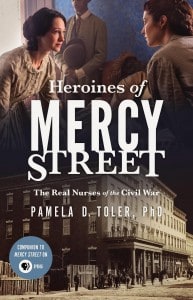
Pamela Toler, freelance writer and academic renegade, who recently published the companion book for the PBS series, Mercy Street. She’s currently working on a new book about strong women across time (details are still hush-hush).

Heroines of Mercy Street

Anne Boyd Rioux, professor at the University of New Orleans, whose most recent biography was reviewed on the cover of the New York Times Book Review. Her new project is about the American classic, Little Women.

Cover smaller


So come join us on Facebook and Illuminate your reading list!