The Japanese attacked Pearl Harbor in Hawaii on December 7, 1941, in less than two hours dropping bombs that killed over 2400 Americans and destroyed a large part of the U.S. fleet in the Pacific. This act of aggression brought the United States into World War II.
(National World War II Museum)
First Lady Eleanor Roosevelt gave a brief radio address that day, part of it directed at “the women of the country.” She acknowledged the tough times ahead and encouraged women to take care of themselves, their families, their communities. “Whatever is asked of us,” the First Lady said, “I am sure we can accomplish it.”
Peggy Utinsky probably did not hear Roosevelt’s words, but she did not need them to spur her into action. Peggy, a nurse, had been living in the Philippine Islands since the 1920s and had married Jack Utinsky, an engineer working for the U.S. military there. As tensions escalated between the United States and Japan in 1940 and 1941, Jack worried about the safety of the Philippines, located about 1900 miles from Japan.
Jack tried to send Peggy back to the states earlier in 1941, but she refused to go. While Jack was working to fortify the Bataan peninsula, Peggy rented an apartment in Manila and split her days between working at the Red Cross and a soldiers’ canteen.
The Japanese bombed the Philippines the same day they hit Hawaii–though because of the International Dateline, it was Monday, December 8 in the Philippines. Unlike their attack on Hawaii, this was a prelude to invasion and occupation. Peggy Utinsky didn’t wait until anyone asked anything of her. She kept working. Wounded civilians and military personnel crowded into Manila hospitals and emergency medical facilities. Peggy worked until she couldn’t stand up anymore. Then, nearly sightless in the blacked-out night, she picked her way back to her apartment along bomb-ravaged sidewalks. After a few hours of rest, she headed back to the hospital.
As the Japanese occupied the Philippines in early 1942, Peggy Utinsky undertook the dangerous work of smuggling supplies into the prisoner of war camps in the island of Luzon. She lost much during the war: her husband Jack died as a POW, she sold or bartered away her possessions to raise funds for her underground network, she suffered from physical and psychological ailments in the aftermath of her arrest and torture by the Japanese.
(NARA photo)
I wrote about Peggy and three other remarkable American women in Angels of the Underground, and I still remember them every year on this anniversary.
*Note: This is a revised version of a blog post from December 2016.
On August 25, 2023, with modest fanfare, the U.S. Army’s Fort A.P. Hill, located south of Fredericksburg, Virginia, near the town of Bowling Green, became Fort Walker. Dr. Mary Walker, who served the army as a civilian surgeon during the Civil War, remains the only woman to have received the Medal of Honor. Now she is the only woman to have a military installation named solely in her honor.*
(photo: Fort Walker on Facebook)
But that honor originally belonged to Ambrose Powell Hill, Jr., a native of Culpeper, Virginia. Born in 1825 to a family that held enslaved people, Hill graduated from the United States Military Academy in 1847 and served competently enough to earn a promotion to first lieutenant in 1851.
As politicians in Virginia debated secession following Abraham Lincoln’s presidential victory in 1860, Ambrose Hill resigned his U.S. army commission. He signed on as a colonel with the 13th Virginia Infantry Regiment when Virginia seceded from the United States. He became a brigadier general in 1862 and was promoted to lieutenant general in 1863. During the battle of Petersburg, a week before the end of the war in 1865, Hill was shot dead by a soldier of the United States army.
(photo: U.S. National Park Service)
A.P. Hill did a lot of things in his military career before and during the Civil War. Several websites provide details of his service, there is a lengthy YouTube documentary that labels him the Confederate Warrior, he appears in numerous books about the war, and he is the subject of at least two published biographies.
But the most important thing to know is that A.P. Hill served the Confederacy. He chose to renounce his allegiance to the United States and to make war on its people. Yet some eighty years later, his name was attached to a U.S. military installation. This was made possible because, as historians such as Karen Cox and Adam Domby have shown, white southerners successfully promoted the myth of the “lost cause”—that their forebears nobly fought the Civil War to protect their homes and families.**
Another eighty years later, in response to waves of racial justice activism, Congress established in 2021 the Commission on the Naming of Items of the Department of Defense that Commemorate the Confederate States of America or Any Person Who Served Voluntarily with the Confederate States of America to oversee the removal of Confederate names from property owned or controlled by the Department of Defense. The Naming Commission solicited recommendations for the nine designated military installations and narrowed the suggestions to ninety names. Several women appeared on the list, but it was dominated by men.
Still, Dr. Mary Walker made the final cut, and it is particularly fitting that an army post in Virginia now bears her name. In 1861, during the first year of the Civil War, Mary Walker, an 1855 graduate of the Syracuse Medical College, shuttered her private medical practice in New York and traveled to Washington, D.C. She failed to convince the secretary of war to commission her as a surgeon in the U.S. army, so she volunteered at the city’s Indiana Hospital, run by Dr. J.N. Green of the 19th Indiana Volunteers, who recognized her medical credentials and gratefully allowed her to work as a doctor.
Dr. Walker expanded her services into Virginia, tending to General Ambrose Burnside’s Army of the Potomac in the wake of the 1862 fighting at Fredericksburg. She treated men at Gettysburg and Chattanooga in 1863 before receiving a contract as a civilian surgeon for the army.
Confederate soldiers in northern Georgia arrested Mary Walker in 1864. She was posted at the time with the 52nd Ohio Volunteers at Lee and Gordon’s Mills and had been out in the surrounding countryside tending to sick civilians. The enemy soldiers found her activities suspicious. (Indeed, she was also gathering intelligence.) Dr. Walker spent several months as a prisoner of war in Castle Thunder in Richmond, Virginia, and gained her release through a prisoner swap.
(image: F. Dielman, artist; F. E. Sachse & Company, lithographer)
She went right back to work for the army, accepting an appointment at the Female Military Prison in Louisville, Kentucky. Dr. Walker may have expressed sympathy over her patients’ medical ailments, but she meted out punishment for their disloyal talk about the United States and their insistence on singing Confederate songs. During her final contract weeks at a refugee hospital in Clarksville, Tennessee, in the spring of 1865, Mary Walker caused a scene during Easter Sunday at the Episcopal Trinity Church when she interpreted the color scheme of the minister’s holiday decorations as too Confederate.
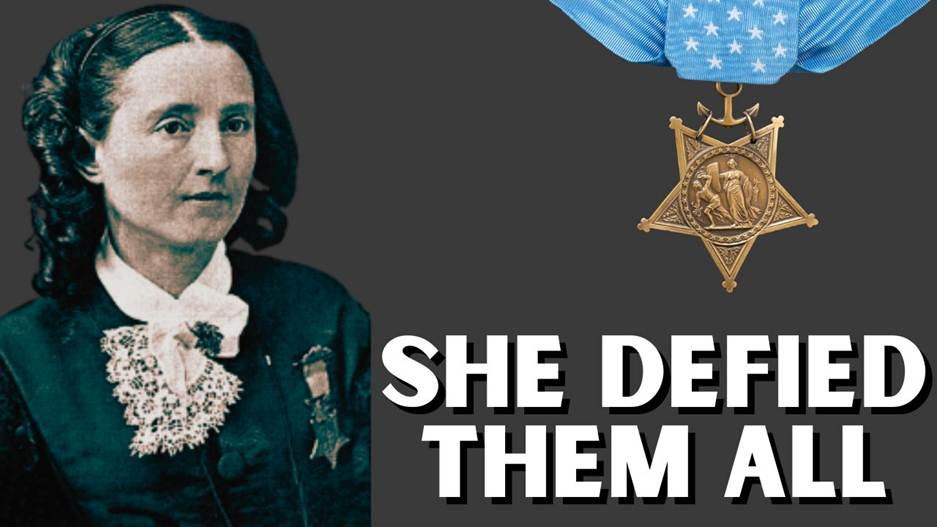
A few months after the Civil War ended, guided by the recommendations of the secretary of war and the judge advocate general who lauded her contributions to the army, President Andrew Johnson awarded Dr. Mary Walker the Medal of Honor.
(photo: Library of Congress)
Dr. Walker’s opinion of Confederates did not soften with their defeat. While in Paris attending the 1867 Exposition Universelle—a world’s fair—she was physically ejected from one of the United States exhibition halls. She resented a display of photos of Confederate generals, especially the one of Robert E. Lee. Its caption, she believed, was entirely too flattering. The American organizers ignored Dr. Walker’s complaint, so she tore down the caption card, prompting her swift removal.
It’s not hard to imagine how Mary Walker would have reacted to seeing the U.S. military name some of its installations after traitors of her country. She would have had no truck with “lost cause” sentimentalities. She would have known that those Confederate names did not belong on those establishments. She would have known that her name did.
(photo: see below)
*The former Fort Lee, also in Virginia, was renamed Fort Gregg-Adams, to honor Lieutenant General Arthur Gregg, the first Black man to achieve that rank, and Lieutenant Colonel Charity Adams, the first Black woman officer in the Women’s Army Auxiliary Corps.
**Anyone interested in the history of the “lost cause” myth and how it has reverberated through history should read Karen Cox, Dixie’s Daughters: The United Daughters of the Confederacy and the Preservation of Confederate Culture as well as her No Common Ground, Confederate Monuments and the Ongoing Fight for Racial Justice; and Adam Domby, The False Cause: Fraud, Fabrication, and White Supremacy in Confederate Memory.
Margaret Coalson Sherk Sams was born in Oklahoma in 1916 and grew up in California. She aspired to be a wife and mother, but she wanted to experience something of life outside her family home first, so she enrolled at Riverside Junior College in 1933. There, Margaret renewed an old high school friendship with Bob Sherk, who was studying to be a mining engineer. They started dating and fell in love before Bob decided to seek his fortune in the Philippine Islands. He left California in January 1936 to start a job in northern Luzon; she followed several months later and they married. Their son David was born in 1938.
The Sherks were living in Suyoc, a gold-mining town in the Benguet region, when the Japanese attacked Pearl Harbor and then Luzon in the Philippines in December 1941. Earlier that year, concerned about deteriorating relations between the U.S. and Japan, Bob had wanted to send Margaret and David back to California. Margaret was reluctant to split up the family, so when officials in the U.S. High Commissioner’s Office in Manila assured her she was safe, she and David remained.
The Sherks evacuated Suyoc mere steps in front of the invading Japanese army and ended up in Manila. Bob did his patriotic duty and joined the U.S. military forces as they headed to the Bataan peninsula to defend the island. Margaret and David ended up interned with thousands of other Allied nationals on the campus of Santo Tomas University in January 1942. They had been told to pack enough food and clothing for three days. They remained prisoners until 1945.
Margaret struggled to provide for David in the camp. She knew few people there and didn’t have much money to pay to have goods brought in from the outside. The Japanese provided little food and restricted Red Cross operations. Several months later, Margaret met Jerry Sams, an electronic engineer with a wife back in the states. He was kind to her and helped secure food and other necessities for David. They quickly fell in love and began an affair. Margaret pushed for a physical relationship because she wanted Jerry to feel tied to her. And despite the perilous conditions of the internment camp, she knew that having Jerry’s baby would cement their relationship and guarantee their survival.
In the years following their dramatic rescue in 1945, when Margaret was safely in the United States, she wrote about her experiences. She wanted to explain what happened in the camp and why. It’s an astonishing story that reveals much about how women of the mid-twentieth century were expected to conduct themselves. Margaret got on with family life; she waited more than thirty-five years before seeking a publisher for her book.
Lynn Z. Bloom, then Professor of English and the Aetna Chair of Writing at the University of Connecticut, learned of Margaret’s story. In 1980, Bloom, a specialist in women’s writing, autobiography, and memoir, had published an edited version of the diary of another American woman, Natalie Crouter, who was interned with her family in the northern Luzon city of Baguio. Bloom turned her editing skills to Margaret’s memoir, which was published by the University of Wisconsin Press in 1989 as Forbidden Family: A Wartime Memoir of the Philippines, 1941-1945.
I came across both Natalie Crouter’s diary and Margaret Sams’s memoir in the 1990s when I was researching my first book. Masterpiece Theater’s dramatization of A Town Like Alice, about British women in Malaya during World War II, had sparked my interest in civilian women caught up in active conflict zones. That first book, published by the University Press of Kansas, was called Prisoners in Paradise: American Women in the Wartime South Pacific. I included the experiences of Margaret Sams, Natalie Crouter, and dozens of other American women—those interned and those who managed to evade the Japanese.
It inspired me to dig deeper into some issues, resulting in the publication of two more books, to create a kind of Philippines trilogy: Citizen of Empire: Ethel Thomas Herold, an American in the Philippines and Angels of the Underground: The American Women who Resisted the Japanese in the Philippines in World War II. Then I was finished with writing about the Philippines, but not about American women. I subsequently wrote two biographies of very different women. (There are plenty of blog posts here about those books.) Since the publication of my Dale Evans biography nearly a year ago, I have been slowly moving toward a new biography project. The subject is still mostly a secret. It’s taken a long time to figure out the focus of the book—what I think this one woman’s life has to say about larger issues in twentieth-century America. I have to figure out how to get all the necessary research done. I have to estimate how long it will take to write the book. All of that is to come. And I’ll take it one step at a time.
In today’s language, Harriot Stanton Blatch was a suffragist nepo baby.
She was born in 1856 in Seneca Falls, New York, the sixth of Elizabeth Cady Stanton’s seven children. Throughout her childhood, reform occupied center stage in the household. Her mother was one of the organizers of the 1848 Women’s Rights Convention in Seneca Falls, which helped launch a movement that in some shape or form continues to this day. Harriot’s father, Henry, was an abolitionist, journalist, and politician.
Harriot received an undergraduate degree from Vassar College in 1878 and a master’s degree in 1894. In between, she joined the suffrage cause and helped her mother and her mother’s political partner, Susan B. Anthony, write their History of Woman Suffrage. Harriot also married a British businessman, William Henry Blatch, in 1882, and spent the next twenty years living in England with him and raising their two daughters, one of whom died young. By the 1890s, she’d become a proponent of “voluntary motherhood,” encouraging married women to choose when and how often to become pregnant, thus deciding when to have intercourse with their husbands.
(left to right: Nora Blatch, Elizabeth Cady Stanton, Harriot Stanton Blatch)
The Blatch family moved to New York City in 1902, following the death of Elizabeth Cady Stanton, and Harriot immersed herself in reform causes that highlighted the intersection of workers’ rights and women’s suffrage. After joining the Women’s Trade Union League, she founded, in 1907, what would come to be known as the Women’s Political Union. This brought some 20,000 New York City working women into the suffrage movement. Harriot further revitalized the movement by organizing public parades at a time when “proper” women didn’t flaunt themselves in such a way.
Harriot Stanton Blatch’s tactics and ideology overlapped with those of feminist Alice Paul; in 1915 she merged her Women’s Political Union with Paul’s Congressional Union, which became the National Woman’s Party. When the United States entered World War I, Harriot took on the directorship of the Woman’s Land Army, an organization that guaranteed farm labor would continue as American men joined the military.
After the war, she published two books: Mobilizing Woman-Power, a celebration of women’s contributions to the war effort and a brisk reminder of their duties as citizens, and A Woman’s Point of View: Some Roads to Peace, which focused on the affects of war on women and children and the role of women in shaping peace.
The Nineteenth Amendment passed in 1920, guaranteeing most American women the right to vote. Harriot became a proponent of the Equal Rights Amendment, viewing it as the next necessary step to securing women’s rights. In 1922, she published a co-edited collection of her mother’s papers, Elizabeth Cady Stanton as revealed in her letters, diary, and reminiscences. Shortly before Harriot’s death in 1940, she finished (with the help of feminist Alma Lutz) her own autobiography, Challenging Years: The Memoirs of Harriot Stanton Blatch.
Historian Ellen Carol DuBois brought Harriot Stanton Blatch’s career to life in the 1997 prize-winning biography, Harriot Stanton Blatch and the Winning of Woman Suffrage. DuBois, now retired as a professor of history and gender studies at the University of California, Los Angeles, is considered a pioneer in the field of women’s history. As a graduate student at Northwestern University, DuBois became involved with the Chicago Women’s Liberation Union, the radical wing of the 1960s women’s rights movement. Her 1978 book, Feminism and Suffrage: The Emergence of an Independent Women’s Movement in America, 1848-1869, was considered for many years as the best book on the suffrage movement, inspiring many other historians to explore its multiple facets.
A big thank you to everyone who has been dropping by every week to read these teasers, and some have been kind enough to leave messages about how much they are looking forward to reading the book. Dr. Mary Walker’s Civil War launches on June 1. If you follow me on Facebook and/or belong to the Nonfiction Fans group there, you will start seeing more book promotion activity. Preorders are still important to raise the book’s visibility. You can do that through Bookshop and help local bookstores in the process!
Now, on to the main event.
Chapter Nine: Women’s Rights During Radical Reconstruction
Although Mary Walker proudly wore her Medal of Honor, she understood the award allowed the government to recognize her achievements without giving her the retroactive commission she desired.
(National Archives)
This is my favorite photo of Walker. It captures her intensity and dedication; it signals her commitment to learning.
This was also one of my favorite chapters to research and write. Dr. Walker’s fight shifted from helping to save the Union to securing voting rights for women. Though it is easy to cheer her on for that, her views on race were not as laudable. You will be able to read more about that in Chapter Nine.
You must be logged in to post a comment.