Everyone Goes to Gladys’s: In Memory of December 7, 1941

In 1941, an American woman named Gladys Savary owned and operated one of the most well-known restaurants in Manila, the capital city of the Philippine Islands. She and her French husband André, always looking for new adventures, opened the Restaurant de Paris, “Manila’s Smartest Restaurant,” in 1932. But most of its considerable clientele simply referred to it as Gladys’s, and the place filled up night after night. Almost any American living in Manila would acknowledge that everyone goes to Gladys’s.

When the war started in Europe in 1939, André left the Philippines (and his marriage to Gladys) to join the French military. Despite the European hostilities and the growing unease about Japanese aggression in the Pacific, Gladys had no qualms about remaining in Manila. “I even became a convert to the popular theory that Japan wouldn’t do any attacking of the Philippines because she could just walk into them in 1946 when Philippine independence [from the United States] would become effective.”
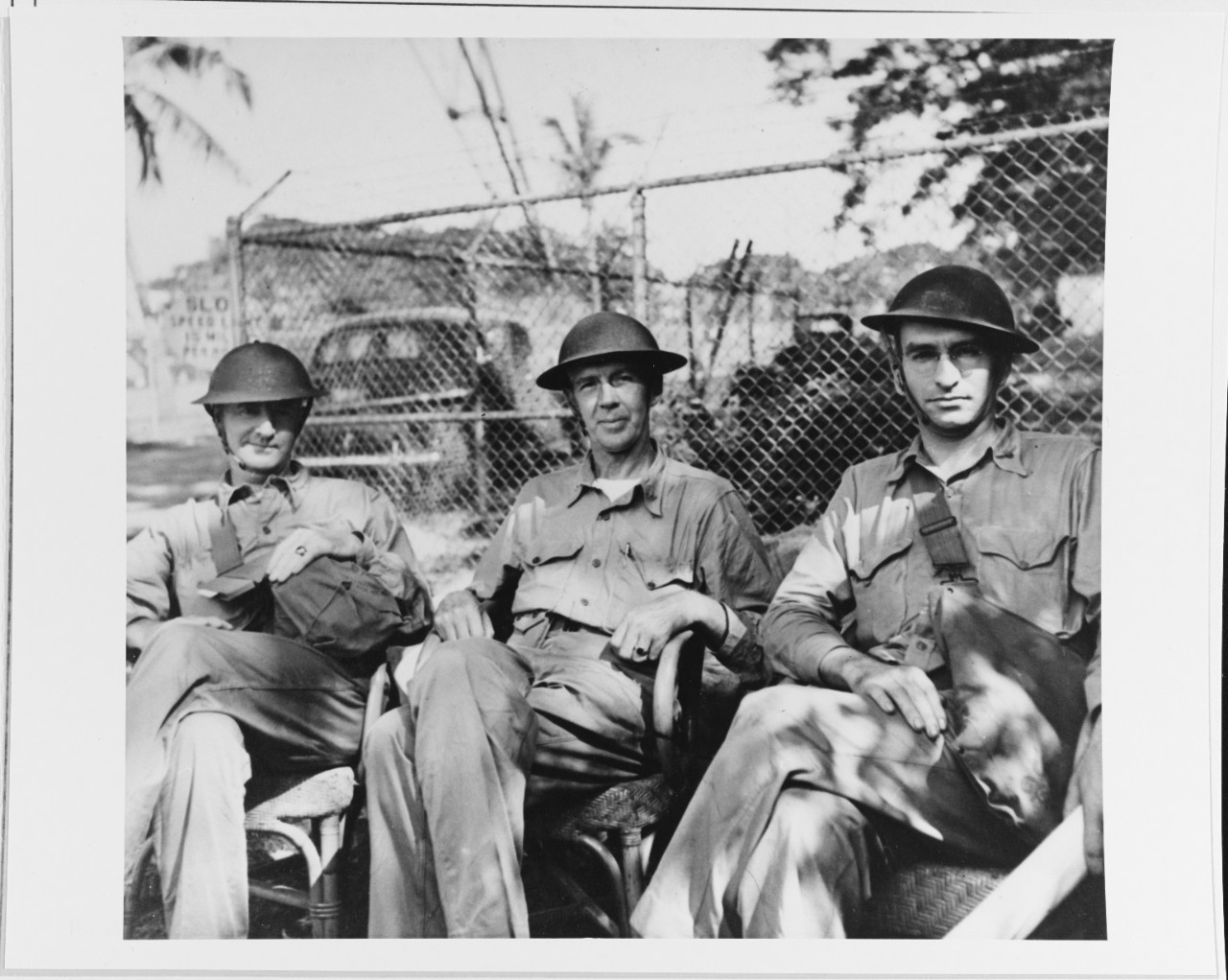
[Rear Admiral Francis W. Rockwell, USN (1886-1979), (center), Commandant of the 16th Naval District, at his headquarters after a Japanese air raid on Cavite Navy Yard, Philippines, 17 December 1941. With him are members of his staff: Lieutenant Commander Frank J. Grandfield (left) and Lieutenant Malcom Champlin. National Archives 80-G-243708]

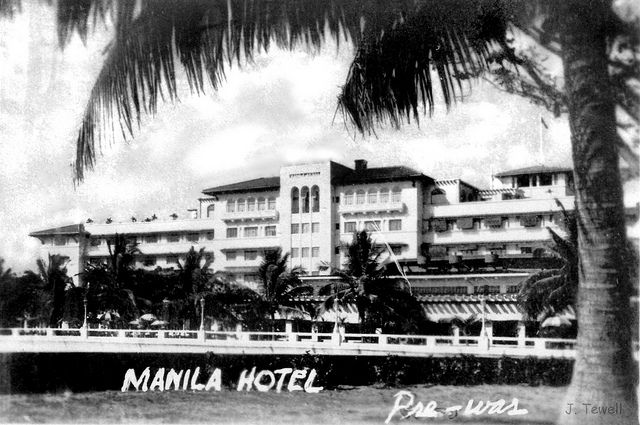
Gladys remained hopeful into the fall of 1941, though she witnessed daily the increased activities of the military in and around Manila. She never slept on Sunday night, December 7 (Manila is on the other side of the International Date Line). She had invited some friends to the restaurant for dinner in celebration of the promotion of a British naval officer she knew. After their meal, they headed over to the Jai Alai Club to watch a match, then stopped at a nightclub before moving on to the Manila Hotel for drinks on the pavilion. Gladys and her friends concluded their evening at an all-night gambling den where they played roulette until dawn.
Gladys had no time for sleep before she needed to get out to the market Monday morning to buy the day’s food for the restaurant. Her servant Nick brought her morning coffee and the newspaper and said, “Honolulu’s bombed. What’ll we do now?” Gladys’s first thought was about business. The restaurant would be busy, she predicted, because people were always hungry. She told Nick they would do their shopping as usual. “War or no war, we have to eat. Nobody can know what’ll happen.”

Indeed, she could not know, though she may have suspected, that things would get much worse. The Japanese bombed Manila, too, and by early 1942 they occupied the city. American nationals were rounded up and confined on the grounds of Santo Tomas University. But Gladys had no intention of sitting out the war in an internment camp. She decided to evade internment and do what she could to assist those who could not. She planned to undermine the Japanese occupiers whenever possible. She risked her life and resisted.

Gladys Savary was just one of many who defied the Japanese in the fight for freedom. I think about her every year on December 7 to remember and honor the variety of sacrifices millions of people made during World War II to stop the spread of tyranny. If you are interested in finding out exactly what Gladys did during the war, read Angels of the Underground: The American Women Who Resisted the Japanese in the Philippines in World War II.

https://global.oup.com/academic/product/angels-of-the-underground-9780199928248?cc=us&lang=en&

On This Day in 1941

The Japanese attacked Pearl Harbor in Hawaii on December 7, 1941, in less than two hours dropping bombs that killed over 2400 Americans and destroyed a large part of the U.S. fleet in the Pacific. This act of aggression brought the United States into World War II.

(National World War II Museum)

First Lady Eleanor Roosevelt gave a brief radio address that day, part of it directed at “the women of the country.” She acknowledged the tough times ahead and encouraged women to take care of themselves, their families, their communities. “Whatever is asked of us,” the First Lady said, “I am sure we can accomplish it.”

Peggy Utinsky probably did not hear Roosevelt’s words, but she did not need them to spur her into action. Peggy, a nurse, had been living in the Philippine Islands since the 1920s and had married Jack Utinsky, an engineer working for the U.S. military there. As tensions escalated between the United States and Japan in 1940 and 1941, Jack worried about the safety of the Philippines, located about 1900 miles from Japan.

Jack tried to send Peggy back to the states earlier in 1941, but she refused to go. While Jack was working to fortify the Bataan peninsula, Peggy rented an apartment in Manila and split her days between working at the Red Cross and a soldiers’ canteen.

The Japanese bombed the Philippines the same day they hit Hawaii–though because of the International Dateline, it was Monday, December 8 in the Philippines. Unlike their attack on Hawaii, this was a prelude to invasion and occupation. Peggy Utinsky didn’t wait until anyone asked anything of her. She kept working. Wounded civilians and military personnel crowded into Manila hospitals and emergency medical facilities. Peggy worked until she couldn’t stand up anymore. Then, nearly sightless in the blacked-out night, she picked her way back to her apartment along bomb-ravaged sidewalks. After a few hours of rest, she headed back to the hospital.

As the Japanese occupied the Philippines in early 1942, Peggy Utinsky undertook the dangerous work of smuggling supplies into the prisoner of war camps in the island of Luzon. She lost much during the war: her husband Jack died as a POW, she sold or bartered away her possessions to raise funds for her underground network, she suffered from physical and psychological ailments in the aftermath of her arrest and torture by the Japanese.

(NARA photo)

I wrote about Peggy and three other remarkable American women in Angels of the Underground, and I still remember them every year on this anniversary.

*Note: This is a revised version of a blog post from December 2016.

Queen of the West Wednesday, Chapter Four

Chapter Four. “I’m in Love with a Guy Who Flies in the Sky”: The Path to Hollywood Stardom

On August 24, 1941, the Chicago Tribune announced that Dale Evans, “the Chicago girl who has had considerable success in both radio and night clubs,” would make a guest appearance on one of WGN’s evening shows to sing “More Than You Know.”

(WGN Radio headquarters, 1935.)

A lot changed in Dale Evans’s life between the mid-1930s and the beginning of the 1940s. While she once identified with the sentiment of “I Can’t Get Started,” she finally moved ahead with her career, moving from Dallas to Chicago. Dale became so well-known in the Windy City that locals embraced her as one of their own, a “Chicago girl.” She sang on WGN and WBBM, appeared at swanky nightclubs with popular bands, and even toured for a while with a nationally known big band. All of these performances laid the foundation for the next step in Dale’s career, which she assumed would be Broadway.

But the next big opportunity came knocking from the other coast: Hollywood, California. Dale Evans arrived there in the late summer of 1941, with a one-year film studio contract. Instead of becoming a theater star, she would become a movie star.

The backlot at 20th Century Fox, circa 1940s

(Twentieth Century-Fox back lot, c. 1940s.)

As Dale prepared for her screen debut, the film project was put on hold. The Japanese bombed Pearl Harbor, drawing the United States into World War II. Over the next months, Dale scrambled to make sure her big break didn’t fall to pieces.

Prisoners in Paradise

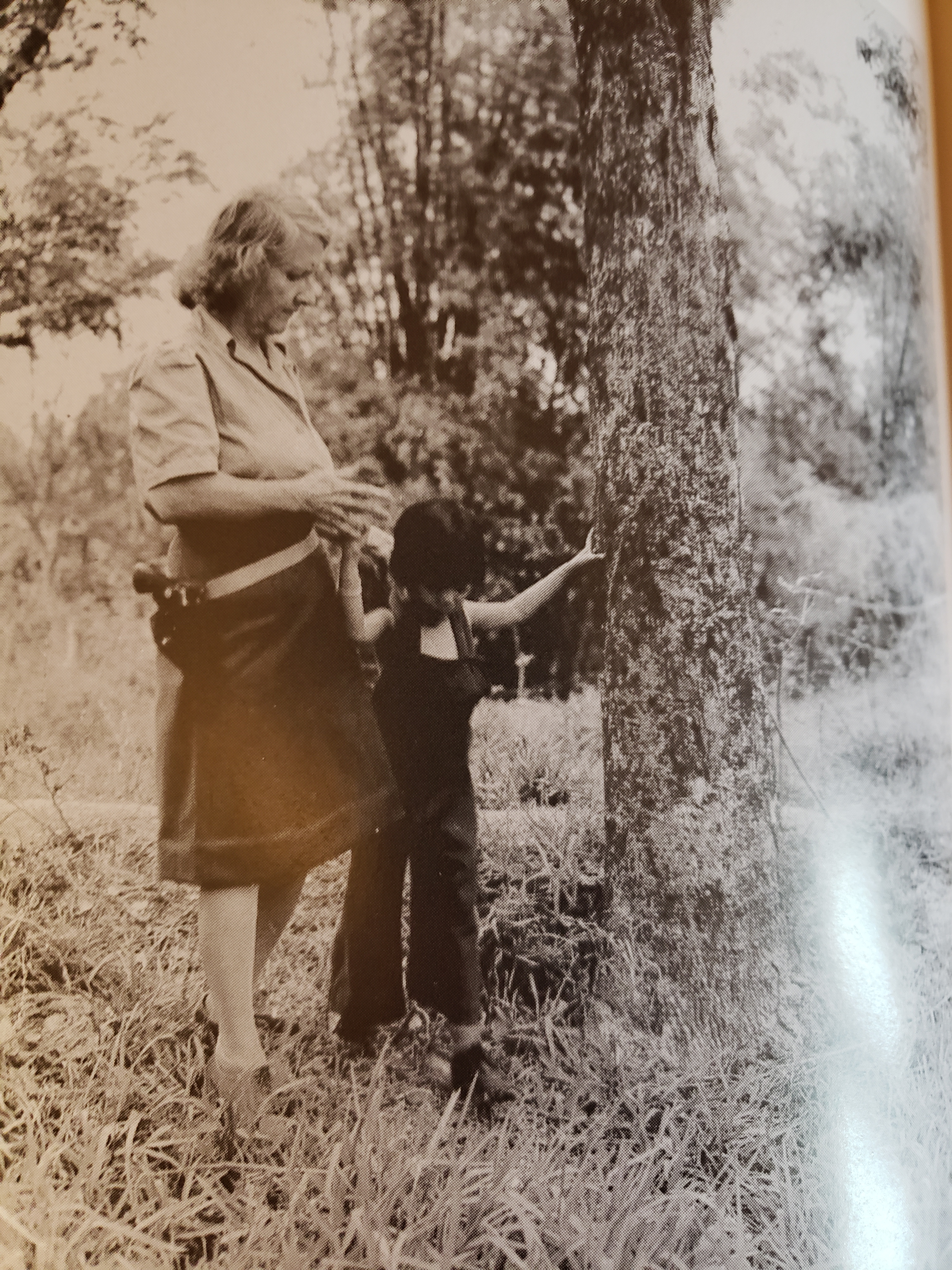
Natalie Crouter, a forty-six-year-old American wife and mother living in the Philippine Islands, sat down at the end of an evening in late October 1942 to write in her diary. She recounted a school pageant, which her two children, Fred and June, participated in, celebrating both Halloween and Thanksgiving. Natalie was especially moved by the Thanksgiving portion of the show, which retold the familiar story of the first Thanksgiving feast at Plymouth Rock. This year in particular, she felt a personal connection to the tale of people in a strange land worrying about food, getting along with an alien population, and just surviving.

Natalie ended her diary entry that evening lamenting that “we are waiting for America.” Her contemporaries may have regarded those five words as an opening phrase that would end “to win this war.” In the fall of 1942, Americans waited, hoped, and prayed for the United States to win its arduous battle against the Axis powers of Germany, Japan, and Italy. But American women did not wait in idleness. They expressed their patriotism and support for the war through action, taking up a variety of work ranging from riveting in airplane factories to enlisting in the armed forces to serving donuts and lemonade at USO socials.

In many ways, Natalie Crouter waited for victory just like other American wives and mothers. She kept a close eye on the activities of her two children, monitoring their progress in school, keeping track of their health, and discussing the war and its possible implications for their future.

A smart and resourceful woman, Natalie adjusted to doing without materials and foodstuffs, substituting new items into her family’s wardrobe and diet to replace the unattainable ones. She generally expressed optimism for a decisive Allied victory, but at times she despaired because it was taking so long.

The longer the delay, Natalie knew, the more likely she and her children, confined to a concentration camp, would die.

Coinciding with their attack on Pearl Harbor on December 7, 1941, the Japanese struck at other American territories, including the Philippine Islands. The Americans living there were trapped. When the Japanese invaded and occupied the islands in January 1942, the Crouters became enemy aliens. To prevent sabotage and humiliate the Allies, the Japanese rounded up all Allied civilians, including women and children. The Japanese viewed them as hostages, valuable bargaining chips.

Natalie, her husband Jerry, and their two children were interned along with about five hundred other civilians in Baguio, a mountain resort city north of Manila on the island of Luzon. Altogether, close to fourteen thousand American civilians spent about three years as prisoners of the Japanese.

The Crouter family was relatively lucky, since they managed to stay in the same camp. But to frighten and demoralize their captives, the Japanese decreed “no commingling” and forbade families to live together. Natalie and the children lived in one barrack, with Jerry housed separately. Visits were allowed, but touching was limited. Family life was altered, strained, with the children struggling to adjust and make sense of their new reality. Fear was a daily companion.

The Japanese understood what they were doing. They not only had hostages, they had compliant hostages. The adults in the camps proved reluctant to overtly resist Japanese authority. Parents like Natalie and Jerry did not want to risk any retaliation that might be taken out on the children.

To find out what happened to the Crouters and other Americans, you can read

or my own,

978-0-7006-1003-7

which opens with Natalie’s story. The cover photo was taken in the Baguio camp, before the worst of the wartime deprivations took hold.

An edited version of Natalie’s diary was published in the 1980s:

Image result for forbidden family crouter


Depictions of D-Day

As a historian who has written quite a bit about World War II (okay, three books), nothing looms as large as D-Day, Operation Overlord, launched on June 6, 1944. Allied forces stormed the Normandy beaches and fought their way east to Germany. The war ended in Europe in May 1945.

Into the Jaws of Death 23-0455M edit.jpg

(NARA)

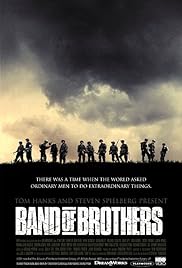
What a lot of people today know about D-Day probably comes from Steven Spielberg’s 1998 movie Saving Private Ryan, which is lauded for its realistic depiction of the landing on Omaha Beach. And in 2001, fans of the movie likely tuned in to HBO’s limited series, Band of Brothers, to follow the exploits of Easy Company, the men who parachuted into Normandy. The series was based on Stephen Ambrose’s popular 1992 book of the same name.

Image result for band of brothers

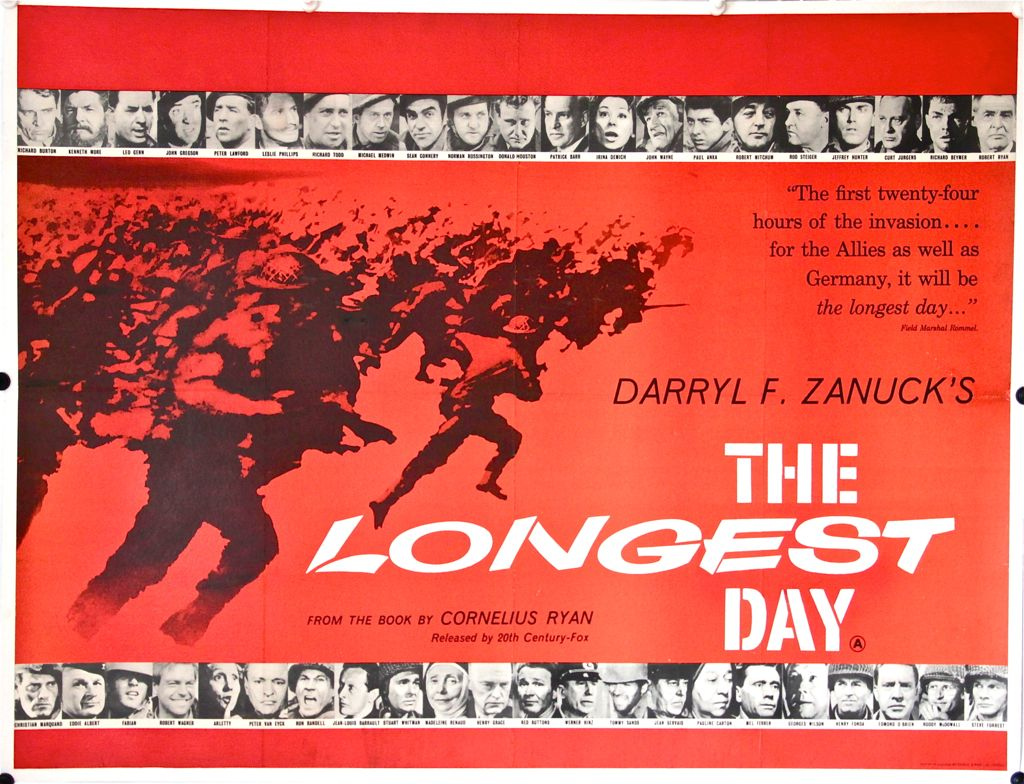
While both of these projects benefitted from updated, modern filming techniques, the structure of their stories is decades old. Assemble a motley crew of men, give them a mission, and watch what happens. Sure, these newer film versions have vivid color and up close violence. But they don’t have the gritty black-and-white moodiness of the 1962 Darryl Zanuck epic, The Longest Day. And they don’t have John Wayne as Lt. Col. Ben Vandervoort, a real-life hero.

Image result for the longest day movie

All of these are Hollywood, and no matter how many claims film and series creators make for authenticity, they cannot be regarded as accurate history. Scads of books have been published about D-Day. One of the most recent–and one of the best–about soldiers’ experiences in Europe is Mary Louise Roberts’s What Soldiers Do.

What Soldiers Do

According to the book’s synopsis: “Roberts tells the fascinating and troubling story of how the US military command systematically spread—and then exploited—the myth of French women as sexually experienced and available. The resulting chaos—ranging from flagrant public sex with prostitutes to outright rape and rampant venereal disease—horrified the war-weary and demoralized French population. The sexual predation, and the blithe response of the American military leadership, also caused serious friction between the two nations just as they were attempting to settle questions of long-term control over the liberated territories and the restoration of French sovereignty.”

This view of D-Day and its aftermath isn’t likely to make it to the screen, big or little. But for those interested in a deeper understanding of World War II, Roberts’s book is essential reading.