I am happy to welcome author Nancy B. Kennedy to the blog today. We share an interest in the women’s suffrage movement, and Nancy recently published a book for young readers called Women Win the Vote! It focuses on nineteen people involved in the passage of the 19th Amendment, so I thought she would be the perfect person to talk to about other women’s rights supporters of Dr. Mary Walker’s time. Here’s what Nancy had to say:

Would you think it frivolous if I talked about the fashion choices of the American suffragists? Well, a hundred and more years ago, clothing wasn’t a simple matter of personal style and taste. It was serious business that proscribed much about a woman’s life.
My friend Theresa Kaminski has written a book about Dr. Mary Walker, a Civil War surgeon who had a lot to say about clothing. In my book about the suffragists, Women Win the Vote! 19 for the 19th Amendment, I also had occasion to address women’s clothing.
In the time period we write about, women’s clothing was heavy and restrictive: petticoats and corsets, multi-layered bodices with long sleeves and high collars, heavy skirts that swept down to the floors. Women couldn’t even get a break at the beach, where they had to wear woolen stockings even to dip a toe in the water.

(Smithsonian)
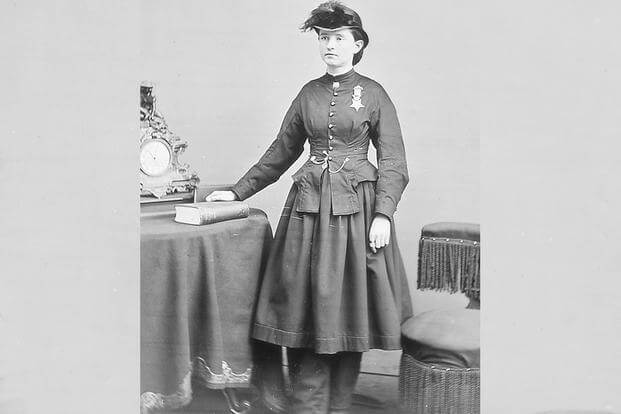
Theresa’s Mary Walker (1832-1919) wore men’s clothing because of its comfort and appropriateness for her work as a doctor. In her time, women could be arrested for wearing men’s clothing, yet she persisted!
From the same time period, I write about Frances Willard (1839-1898), a suffragist and president of the Women’s Christian Temperance Union. Hearing these credentials, you might think she was a battle-axe with strict rules for women’s lives. In fact, she was one of the most relaxed and relatable suffragists I encountered.

(Willard at 23, FrancesWillardHouse.org)
In her memoir, Frances Willard despairs over her 16th birthday — the day she calls her martyrdom. On that day, she had to abandon her child’s loose dresses and sturdy shoes and adopt the attire of a woman. To the petticoats, corsets and long skirts, she had to add ribboned bonnets and gloves. She had to grow out and pin up her hair — it took eighteen hairpins, she tells us.
Frances bemoans the restrictions that clothing imposed on women. She lists the articles of clothing women had to don just to go for a walk — a list so onerous that women rarely bothered. Some suffragists did try the so-called “bloomer costume,” a short dress worn over loose trousers, but they were so relentlessly ridiculed that they gave it up, fearing the controversy would hurt the suffrage cause.
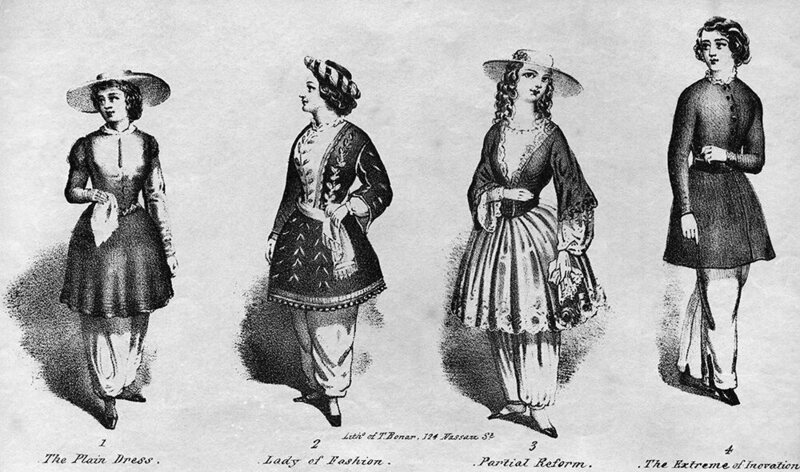
(Kean Collection)
Frances not only wanted freedom of movement, but also educational and financial freedom. “Girls should definitely be set at work after their school days end, even as boys are, to learn some bread-winning employment that will give them an independent status,” she wrote. She knew that dress reform would enable women to move comfortably in a world that until then had been organized around men.
Even when talking about the vote, Frances’s thoughts went to clothing. If women had the vote, she opined, they could enter politics as men did, “clad in the garments of power!”

(Willard in the 1890s, FrancesWillardHouse,org)
In her 50s, Frances learned how to ride a bicycle, an activity that was thought unseemly and unhealthy for women. On a bike, she could shed some of her hated clothing and whiz through the world as never before. She wrote a book about her experience, A Wheel Within a Wheel, that became a bestseller. Clearly, many women wanted freedoms that had long been denied them.

(Willard on her bicycle, Gladys; FrancesWillardHouse.org)
Now back to Dr. Mary Walker. She persisted in wearing men’s clothing, even clapping top hats on her head. Unfortunately, suffragists weren’t happy about her choices, again fearing that their cause would be hurt by the outliers. Victoria Woodhull came under the same censure — her bohemian dress and unrestrained lifestyle caused a huge rift in the suffrage movement.
But as you follow the suffrage cause into the 1900s, you see hemlines inching upward. Petticoats and corsets disappear — at least on the younger generation — dresses become loose and flowing, and feet are shod in more comfortable shoes that allowed women to march in suffrage parades and protests. Women, and therefore their causes, became visible to the world.
So you see, clothing was more than a matter of fashion — it was no less a matter than women claiming their place in the public and political life of our country.
Thanks to Nancy for this insight on fashion and suffrage. You can find out more about Nancy and her work on her website.



 Theresa Kaminski
You must be logged in to post a comment.