My 2024 Reading, Part Two: Nonfiction

This year’s list of my favorite nonfiction contains two more books than last year. (I gave seven nonfiction books five stars on Good Reads in 2024 and five in 2023.) But like last year, I am also including a bonus section of books that I liked.

Biographies dominated these seven favorites of 2024. (Unlike last year, I read very few memoirs in 2024.) Most of the biographies were about women, though one, a family biography, features both men and women. Another, which also was not a biography (or at least a traditional biography), centers on a man but has a couple of strong female secondary characters. Its author is the only man to appear on this list of seven. Make of this what you will. (Mostly that there are a lot of women’s stories out there to explore and lots of women writers to do so.) Here are the books, roughly in the order in which I read them.

1. Mott Street: A Chinese American Family’s Story of Exclusion and Homecoming by Ava Chin. I remember being totally drawn into this book at the beginning of 2024, as I was getting ready to make my first trip to New York City. It is wonderfully written, with a delicate balance of history and family stories. Chin has produced an emotional yet not overly sentimental family biography.
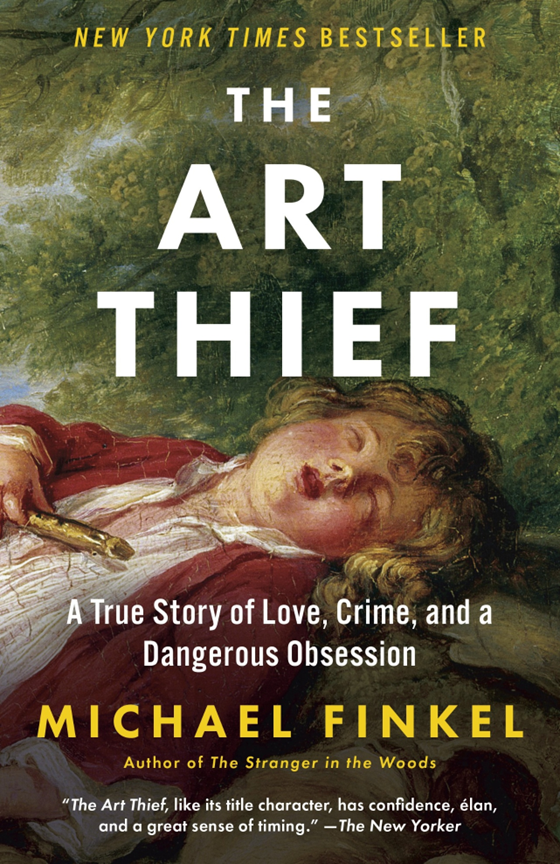
2. The Art Thief: A True Story of Love, Crime, and a Dangerous Obsession by Michael Finkel. I was a bit late to this book mostly because it is not the kind of thing I usually read. But I was convinced by the title and the cover design to pick it up from the library and never regretted the decision. Finkel briskly tells the wild story of Stéphane Bréitwieser, who stole about $2 billion worth of art from various European museums. Then there is the revelation of what happened to some of the pieces. Yikes.
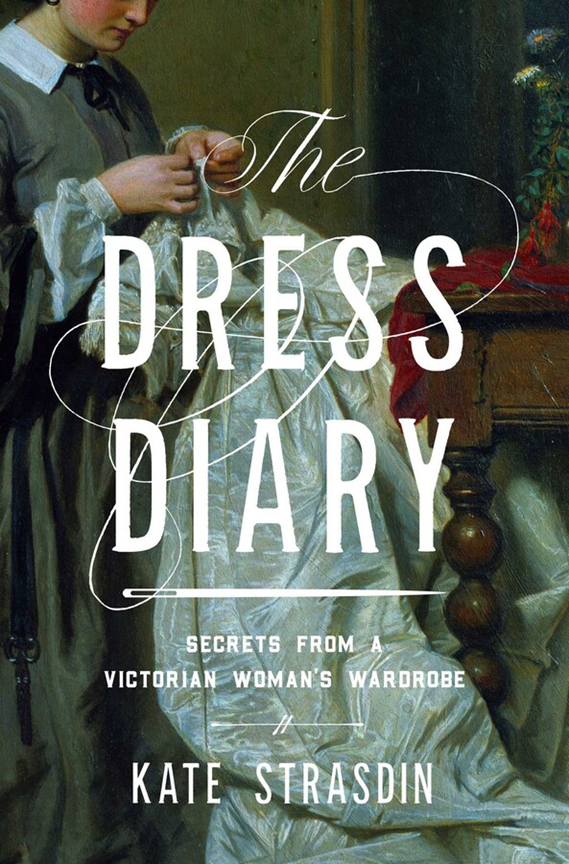
3. The Dress Diary: Secrets From a Victorian Woman’s Wardrobe by Kate Strasdin. Using surviving clothing fragments belonging to Anne Sykes, Strasdin skillfully recreates the world of this nineteenth-century Englishwoman. The author’s expertise as a fashion historian and museum curator really shines through in this creative history.

4. The Silenced Muse: Emily Hale, T.S. Eliot, and the Role of a Lifetime by Sara Fitzgerald. Emily Hale has appeared as a minor character in previous books about the poet Eliot, but Fitzgerald flips the relationship, investigating it from Hale’s perspective. (This does not end well for Eliot’s reputation as a human being.) Hale emerges as a fully formed character with a fascinating life.

5. Portrait of a Woman:Art, Rivalry, and Revolution in the Life of Adélaïde Labille-Guiard by Bridget Quinn. Adélaïde Labille-Guiard was a well-known and well-regarded painter in France during the 1700s, at least up until the French Revolution. Quinn makes good use of the scant information available on the artist’s life to restore her to her proper place in the historical record. And Quinn’s breezy writing style makes this biography a delight to read.
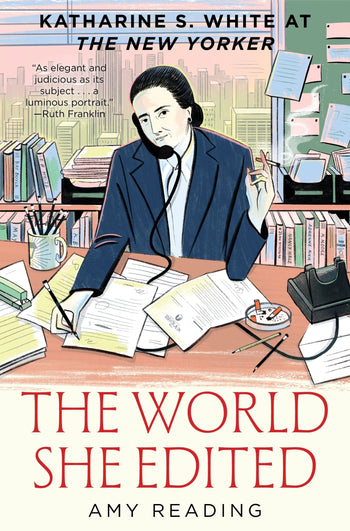
6. The World She Edited: Katharine S. White at The New Yorker by Amy Reading. The long-time fiction editor of The New Yorker magazine, which celebrates its 100th anniversary this year, receives a well-deserved biography that focuses on White’s ability to recognize talented writers and get their work published in the magazine. It is a fascinating portrait of an important literary life.

7. Loving Sylvia Plath: A Reclamation by Emily Van Duyne. Ted Hughes (like T.S. Eliot above) does not come off well in Van Duyne’s trenchant probing of not just Plath’s life, but how others have written about that life. Van Duyne makes a convincing—and haunting—case for Hughes as the ultimate in unreliable narrators. Reclamation, indeed.

Of the two bonus books from my 2024 reading, one is very much in line with most of the favorites listed above. Drew Gilpin Faust’s memoir, Necessary Trouble: Growing Up at Midcentury is an engaging account of the prominent historian’s involvement with the various social and political movements of the 1960s.

The other, Leave While the Party’s Good: The Life and Legacy of Baseball Executive Harry Dalton by Lee Kluck, is a book that anyone who knows me would not believe that I ever picked up. I am not a sports person. I don’t watch games or watch movies or shows about sports. (Well, okay, I did like Bend It Like Beckham and Bull Durham, and I have watched Field of Dreams. But otherwise, no.) (And actually, growing up at 2912, baseball was ubiquitous during the spring and summer. I knew spring had arrived when my mom set up her ironing board in front of the television in the family room so she could watch the Cubs while she ironed. I still know a lot about baseball.)

Lee Kluck was, many years ago, a student of mine, and I followed his writing journey with great interest. He has produced a nicely researched and crisply written biography of an important figure in major league baseball. The University of Nebraska Press, known for its sports series, published his book. So, yay for Lee and for Harry Dalton. If you or anyone you know is into sports biographies, do not miss this one.

That is a wrap on my favorites of 2024. Up next: some thoughts on a very good book I started reading in 2024 but have yet to finish.

May all the books you read in 2025 be good ones.

My 2023 Reading, Part Two: Nonfiction (Plus a Bonus)

The best narrative nonfiction books I read in 2023 comprise an unusually short list. I think there was something about my reading mood last year that affected my reactions to books. “Best” and “favorite” are subjective, anyway, so I’m sticking to that as an explanation.

All of these books deal with the past, and all but one are biographies. The outlier of the group, though, could be described as a collection of mini-biographies. Here they are, roughly in the order of my admiration.

In Master Slave Husband Wife, Ilyon Woo traces the perilous journey from enslavement to freedom of Ellen and William Craft. The Crafts fled Georgia with Ellen disguised as an invalided white man and William posing as her “servant.” Their life in the “free” North was dangerous because of the Fugitive Slave Law, yet the couple became part of the great abolitionist movement in the years prior to the Civil War. It’s an unforgettable story of moral and physical courage.

Catherine McNeur introduces readers to Margaretta and Elizabeth Morris in the dual biography Mischievous Creatures. The historian makes a convincing case that the largely self-taught sisters, one an entomologist, the other a botanist, made significant contributions to scientific knowledge in the decades before the Civil War. Margaretta and Elizabeth are fascinating women, and McNeur expertly weaves in the science without slowing down the story of the women’s accomplishments and the barriers they faced because of their gender.

Leaning heavily on literary analysis and historical context, David Waldstreicher recreates the life of an eighteenth-century Black poet in The Odyssey of Phillis Wheatley. Kidnapped and enslaved as a child, Wheatley learned how to read and write while living in Boston and began turning out poetry as a teenager. This is a finely detailed story that took me some time to read, but I thought it was wonderful.

I learned a lot about South Africa from Jonny Steinberg’s dual biography, Winnie and Nelson. Steinberg traces apartheid through the lens of the Mandela marriage, focusing on Nelson’s long imprisonment and Winnie’s increasing political influence. It’s a riveting and important book.

Emma Southon’s lively voice adds an extra layer of enjoyment to A Rome of One’s Own, which reveals the history of the Roman empire through the lives of twenty-one mostly-forgotten women. This serves as a nice reminder that there was more to Rome than gladiators and pontificating politicians.

There were also a couple of other books I liked, both biographies. I appreciated learning more about the Queen of Crime in Agatha Christie: An Elusive Woman by Lucy Worsley, and it was interesting to find out about the intrepid twentieth-century journalist Elsie Robinson through Julia Sheeres and Allison Gilbert’s Listen, World!

Now for the bonus: memoirs. Last year, I included them in with the other nonfiction I read, but this time I decided it was more appropriate to give them their own category. While it’s true they are nonfiction, memoirs are very different from the historical, fact-based nonfiction that I usually read.

There are three memoirs I read in 2023 that I keep thinking about.

I’m certainly not the first person to rave about poet Maggie Smith’s You Could Make This Place Beautiful, but I may be among the last to have never run across her poem “Good Bones.” Its last line was turned into the title of her lyrical story of the unraveling of her marriage and her enduring love for her children.

Love for her children is a strong undercurrent in Life B, author and book critic (known in online circles as The Book Maven) Bethanne Patrick’s clear-eyed account of her decades-long struggle with double depression. She hits and maintains a sweet spot of narrative voice that is neither too bleak nor too Pollyanna-ish. I rooted for her all the way through.

Marsha Jacobson rounds out this trio of devoted mothers. In The Wrong Calamity she describes how she survived an abusive marriage, established herself as a successful businesswoman (even earning a Harvard MBA) and as a role model to her daughters, then suffered a shattering disappointment with her second marriage. Like both Smith and Patrick, Jacobson shows restraint in parceling out the gritty, personal details of these relationships, giving readers just what they need but never tipping into a salacious tell-all.

That’s it for my 2023 reading recap. I’m delighted (and slightly relieved) to report that 2024 is off to a blazing start. I could hardly bear to put down Vanessa Chan’s The Storm We Made and Anne Enright’s The Wren, the Wren, plus I’m swiftly moving through Mott Street by Ava Chin.

Up next: some pieces that are more or less connected to my new book project.

Queen of the West Wednesday, Chapters Thirteen and Fourteen

This is it–the final Queen of the West Wednesday. The book officially launches on Friday, April 15. It’s hard to believe I started this series way back on February 2! Thanks for sticking with it or for popping in now and then. Here are the final two chapters, along with their opening lines.

Chapter Thirteen. A Date with Dale: Maintaining a Television Career

A period of calm set in for Dale Evans and Roy Rogers, so they took the opportunity to try something new to reach more existing fans and perhaps acquire new ones.

It was the late 1960s, and Dale was in her mid-fifties. She and Roy still hoped to land a prime time television show but had no luck. They opened a museum in Apple Valley to showcase their movie and t.v. careers. Dale wrote books as she wrestled with the social, political, and cultural changes of the decade. In the early 1970s she began planning her own Christian talk show. After more than a decade, it finally appeared in 1985 on the Trinity Broadcasting Network as A Date with Dale, a thirty-minute weekly program that focused on Christian and spiritual topics.

Roy Rogers Museum - Apple Valley, California | Apple valley california,  California, Roy rogers

(postcard of the museum in Apple Valley, CA)

Chapter Fourteen. “Thank Heavens for Dale Evans”: Becoming the Legendary Cowgirl

While Dale Evans was never exactly put on a pedestal, she received more honors during this late stage of her life, often accompanied by descriptions of her as a “legend.”

In 1990, a new, all-female group then known as the Dixie Chicks, wrote a song about her. Through that decade, despite a myriad of health problems, Dale filmed episodes of A Date with Dale, recorded more songs, and wrote more books. She endured the death of her beloved husband, Roy Rogers, in 1998, and died at home three years later, surrounded by family.

DixieChicksThankHeavensforDaleEvans.jpg

Happy trails, everyone!

Queen of the West Wednesday, Chapter Five

Chapter Five. The Cowboy and the Senorita: Rising Star at Republic Pictures

In a fit of pique, Dale Evans severed her relationship with Art Rush and signed with Danny Winkler, a friend of Joe Rivkin and an agent long associated with Myron Selznick’s firm.

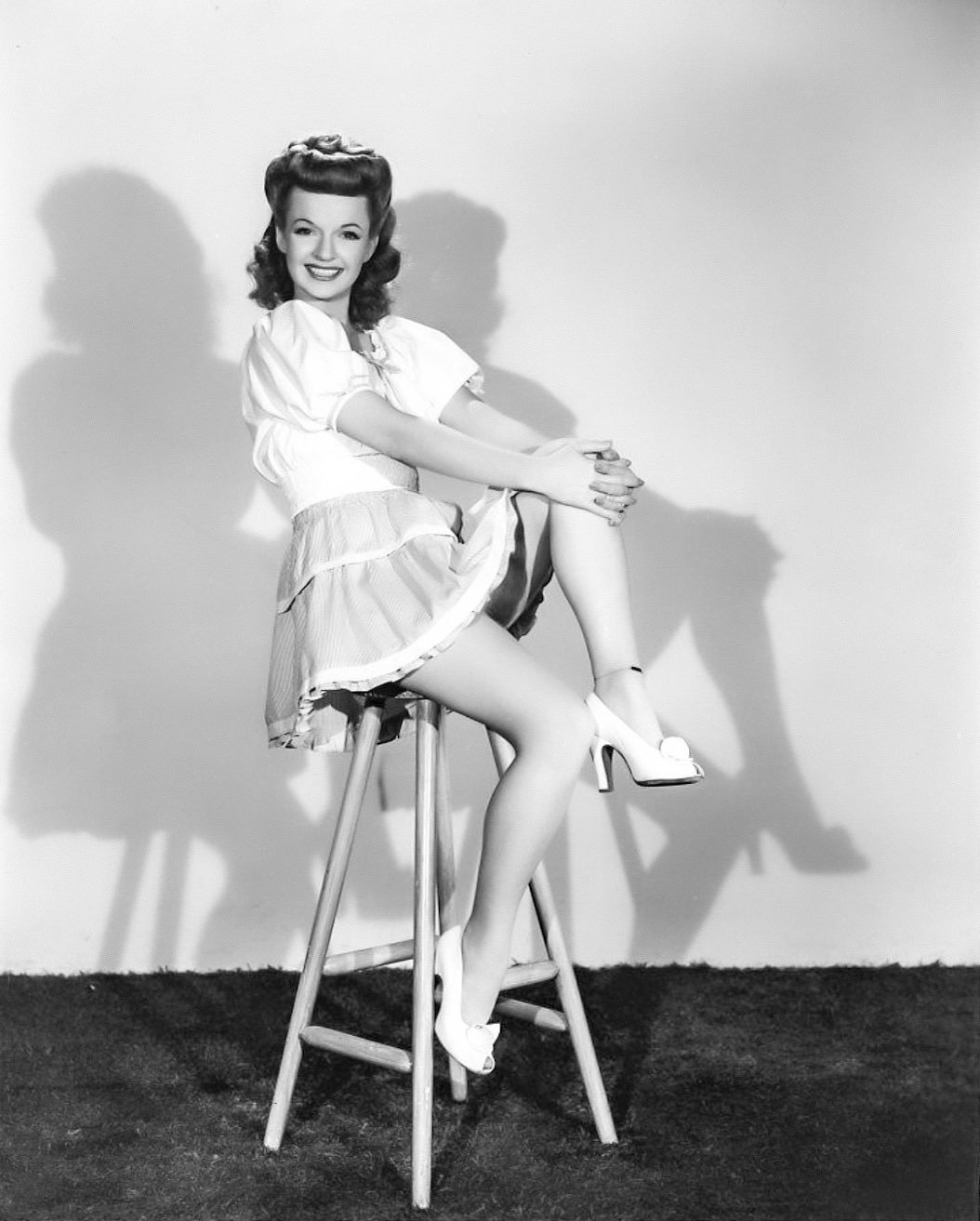
Dale Evans - ca.1942
Pic Source: @cjubarrington (Twitter)

(Dale Evans c. 1942)

Dale had not even been in Hollywood for a year and a half, and she was already on her third agent. Losing Joe Rivkin, who brought her out there in the first place, had been out of her control. With the United States at war, Rivkin signed up for military service. He recommended that Dale talk to Art Rush about representation. Rush had worked for RCA Victor Records before opening his own talent agency in 1939, with some high-profile singers/actors signing on.

Front entrance to the Hollywood Canteen, Vine St., Hollywood, 1942

(Hollywood Canteen on Vine Street, 1942)

Though Dale Evans and Art Rush initially worked well together, it only took a few months for her to conclude that he was not paying adequate attention to her career. She accused him of spending all his time promoting his favorite client, his rising star, the singing cowboy Roy Rogers. Dale had nothing against Roy. Rush had introduced the two of them when they both appeared at an Army air base in California to perform for the troops. Dale liked Roy, found him “a very real person.” But she had no intention of playing second fiddle to him with Art Rush. So Dale fired Rush and moved on to her third agent.

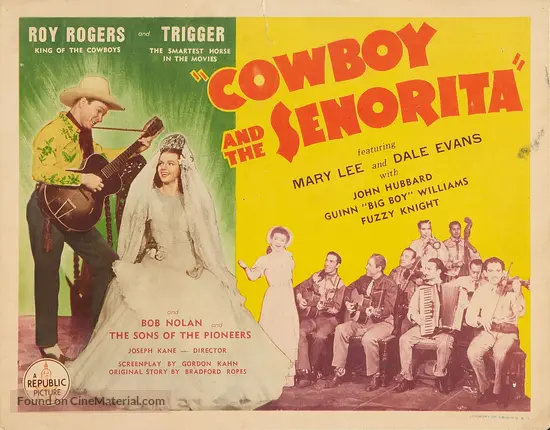
In early 1943, Danny Winkler arranged an audition at Republic Pictures. Dale Evans wowed everyone at the small studio, and she was hired. Ironically, Roy Rogers was also under contract there, one of the studio’s biggest “B”-movie stars. And in another twist, Dale’s career at Republic did not really take off until she was featured in 1944’s The Cowboy and the Senorita–with Roy Rogers.

Cowboy and the Senorita (1944) movie poster

This was not what Dale Evans envisioned for her Hollywood stardom. She had to figure out what to do about it.