Guest Post: Nancy B. Kennedy on Frances Willard

I am happy to welcome author Nancy B. Kennedy to the blog today. We share an interest in the women’s suffrage movement, and Nancy recently published a book for young readers called Women Win the Vote! It focuses on nineteen people involved in the passage of the 19th Amendment, so I thought she would be the perfect person to talk to about other women’s rights supporters of Dr. Mary Walker’s time. Here’s what Nancy had to say:

Would you think it frivolous if I talked about the fashion choices of the American suffragists? Well, a hundred and more years ago, clothing wasn’t a simple matter of personal style and taste. It was serious business that proscribed much about a woman’s life.

My friend Theresa Kaminski has written a book about Dr. Mary Walker, a Civil War surgeon who had a lot to say about clothing. In my book about the suffragists, Women Win the Vote! 19 for the 19th Amendment, I also had occasion to address women’s clothing.

In the time period we write about, women’s clothing was heavy and restrictive: petticoats and corsets, multi-layered bodices with long sleeves and high collars, heavy skirts that swept down to the floors. Women couldn’t even get a break at the beach, where they had to wear woolen stockings even to dip a toe in the water.

Fierce fashion from 19th century Puerto Rico | National Museum of ...

(Smithsonian)

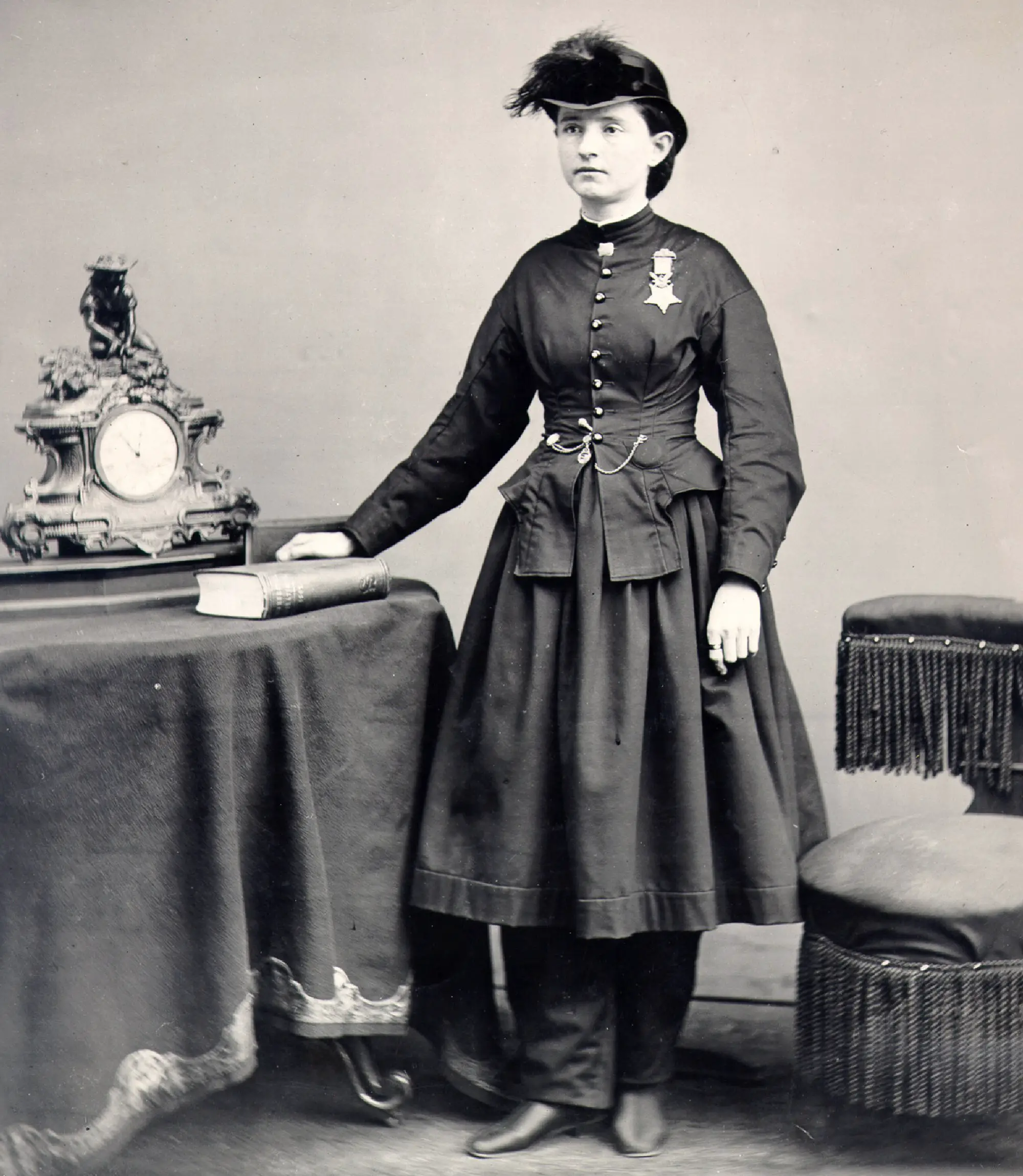
Theresa’s Mary Walker (1832-1919) wore men’s clothing because of its comfort and appropriateness for her work as a doctor. In her time, women could be arrested for wearing men’s clothing, yet she persisted!

From the same time period, I write about Frances Willard (1839-1898), a suffragist and president of the Women’s Christian Temperance Union. Hearing these credentials, you might think she was a battle-axe with strict rules for women’s lives. In fact, she was one of the most relaxed and relatable suffragists I encountered.

Frances Willard at 23

(Willard at 23, FrancesWillardHouse.org)

In her memoir, Frances Willard despairs over her 16th birthday — the day she calls her martyrdom. On that day, she had to abandon her child’s loose dresses and sturdy shoes and adopt the attire of a woman. To the petticoats, corsets and long skirts, she had to add ribboned bonnets and gloves. She had to grow out and pin up her hair — it took eighteen hairpins, she tells us.

Frances bemoans the restrictions that clothing imposed on women. She lists the articles of clothing women had to don just to go for a walk — a list so onerous that women rarely bothered. Some suffragists did try the so-called “bloomer costume,” a short dress worn over loose trousers, but they were so relentlessly ridiculed that they gave it up, fearing the controversy would hurt the suffrage cause.
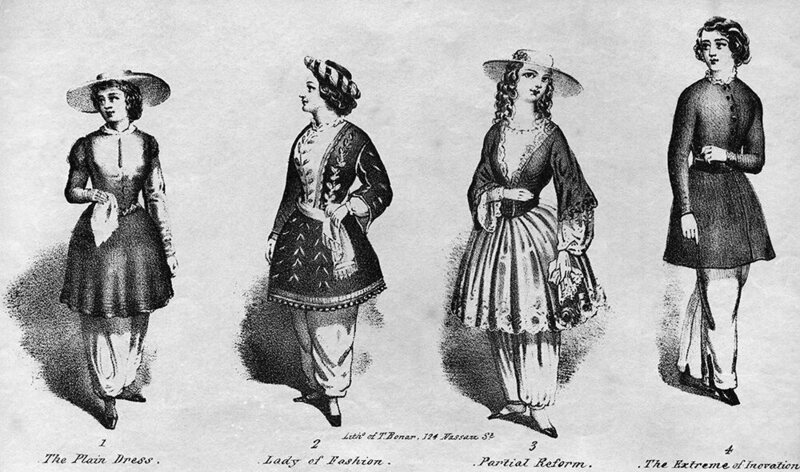
Kean Collection / Getty Images

(Kean Collection)

Frances not only wanted freedom of movement, but also educational and financial freedom. “Girls should definitely be set at work after their school days end, even as boys are, to learn some bread-winning employment that will give them an independent status,” she wrote. She knew that dress reform would enable women to move comfortably in a world that until then had been organized around men.

Even when talking about the vote, Frances’s thoughts went to clothing. If women had the vote, she opined, they could enter politics as men did, “clad in the garments of power!”

Willard in the 1890s

(Willard in the 1890s, FrancesWillardHouse,org)

In her 50s, Frances learned how to ride a bicycle, an activity that was thought unseemly and unhealthy for women. On a bike, she could shed some of her hated clothing and whiz through the world as never before. She wrote a book about her experience, A Wheel Within a Wheel, that became a bestseller. Clearly, many women wanted freedoms that had long been denied them.

Frances Willard riding her bicycle, Gladys

(Willard on her bicycle, Gladys; FrancesWillardHouse.org)

Now back to Dr. Mary Walker. She persisted in wearing men’s clothing, even clapping top hats on her head. Unfortunately, suffragists weren’t happy about her choices, again fearing that their cause would be hurt by the outliers. Victoria Woodhull came under the same censure — her bohemian dress and unrestrained lifestyle caused a huge rift in the suffrage movement.

But as you follow the suffrage cause into the 1900s, you see hemlines inching upward. Petticoats  and corsets disappear — at least on the younger generation — dresses become loose and flowing, and feet are shod in more comfortable shoes that allowed women to march in suffrage parades and protests. Women, and therefore their causes, became visible to the world.

So you see, clothing was more than a matter of fashion — it was no less a matter than women claiming their place in the public and political life of our country.

Thanks to Nancy for this insight on fashion and suffrage. You can find out more about Nancy and her work on her website.

Dr. Mary Walker Wednesday #9

A big thank you to everyone who has been dropping by every week to read these teasers, and some have been kind enough to leave messages about how much they are looking forward to reading the book. Dr. Mary Walker’s Civil War launches on June 1. If you follow me on Facebook and/or belong to the Nonfiction Fans group there, you will start seeing more book promotion activity. Preorders are still important to raise the book’s visibility. You can do that through Bookshop and help local bookstores in the process!

Now, on to the main event.

Chapter Nine: Women’s Rights During Radical Reconstruction

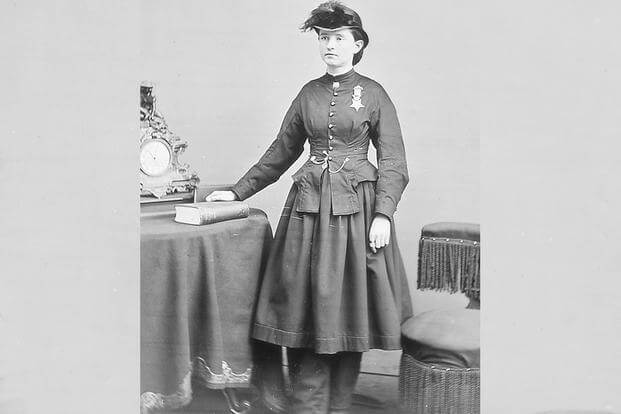
Although Mary Walker proudly wore her Medal of Honor, she understood the award allowed the government to recognize her achievements without giving her the retroactive commission she desired.

Dr. Mary E. Walker wore her Medal of Honor around her neck for the rest of her life. (National Archives photo)

(National Archives)

This is my favorite photo of Walker. It captures her intensity and dedication; it signals her commitment to learning.

This was also one of my favorite chapters to research and write. Dr. Walker’s fight shifted from helping to save the Union to securing voting rights for women. Though it is easy to cheer her on for that, her views on race were not as laudable. You will be able to read more about that in Chapter Nine.


Women’s History Month 2020

This year’s Women’s History Month theme marks the 100th anniversary of the ratification of the 19th Amendment.

valiant women

It’s also known as the women’s suffrage amendment, but every time I describe it that way, I like to clarify that though the amendment was supposed to apply to women–as in all adult women–in reality, racial discrimination prevented most women of color from voting. Many early histories of the women’s suffrage movement sideline these racial issues, barely acknowledging the contributions, for example, of African American women in cultivating support for the amendment.

Historian Cathleen Cahill has a book coming out this fall called Recasting the Vote: How Women of Color Transformed the Suffrage Movement. According to the book description: “It is a collective biography of six suffragists–Yankton Dakota Sioux author and activist Gertrude Bonnin (Zitkala-Ša); Wisconsin Oneida writer Laura Cornelius Kellogg; Turtle Mountain Chippewa and French lawyer Marie Bottineau Baldwin; African American poet and clubwoman Carrie Williams Clifford; Mabel Ping Hau Lee, the first Chinese woman in the United States to earn her PhD ; and New Mexican Hispana politician and writer Nina Otero Warren–both before and after the ratification of the Nineteenth Amendment.” This looks fascinating.

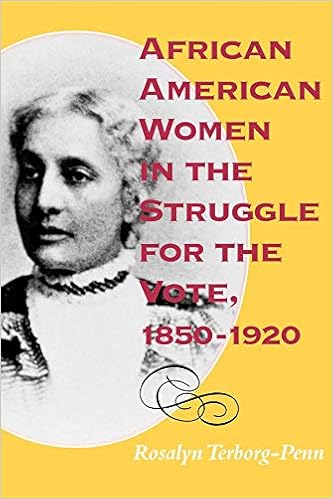
While you wait for Cahill’s book, consider picking up a copy of Rosalyn Terborg-Penn’s classic African American Women in the Struggle for the Vote, 1850-1920.

Image result for rosalyn terborg-penn african american women and the struggle to vote

You’ll meet lots of great women in this book, too, and won’t soon forget them.


The Casual Silencing of Women

In 1863, Dr. Mary Walker, who donated her medical expertise to the US army during the Civil War since it would not commission her because she was a woman, wrote in an article for the women’s rights journal, The Sibyl:

“Not until this ‘cruel war’ has ceased, and peace shall again be ours, and a dozen histories be written containing all the facts and events that each historian shall have collected, and the noble women from all be compiled, not, I say, until then shall the world know how much women have done.”

MEW 1864 Drexel(Drexel University, College of Medicine, Archives and Special Collections)
Mary Walker understood the importance of history, and she understood the difficulties women faced in getting their voices heard. She encountered gender discrimination her entire life because of her choice in fashion, her decision to become a doctor, and her dedication to the women’s suffrage movement. If the world did not know how much women did during the Civil War and acknowledge their contributions, nothing would change, women would never achieve equality.

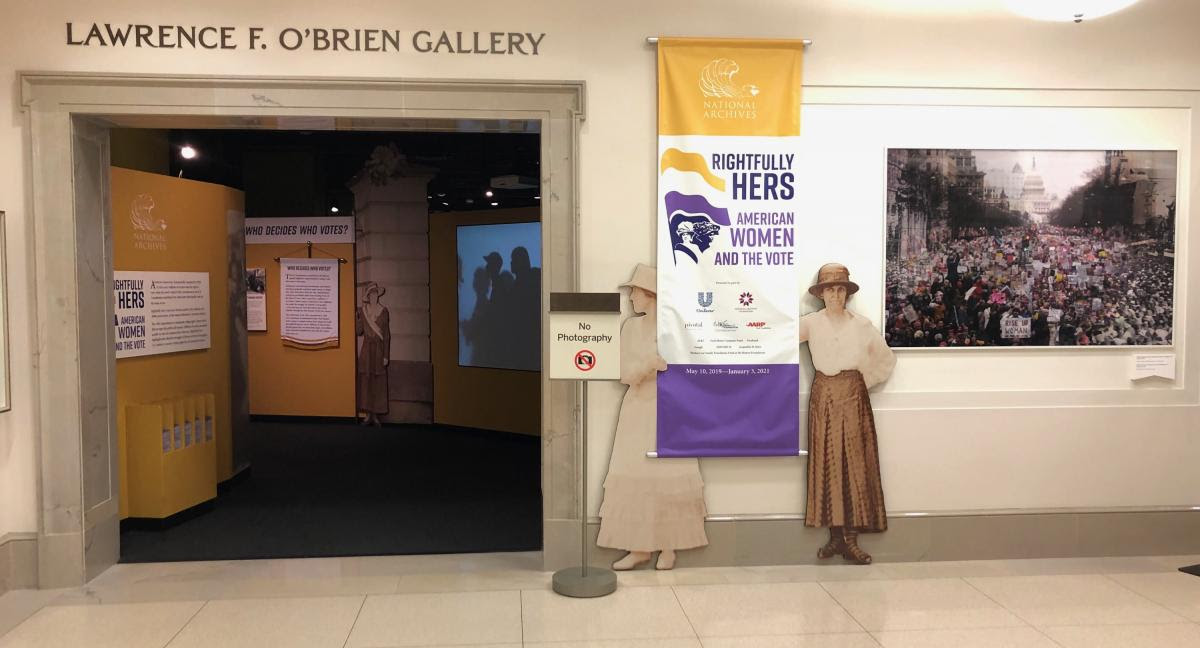
I thought about Dr. Walker this morning as I came across a link to a Washington Post article in my Twitter feed. Joe Heim reported about a photo display in the National Archives meant to honor the centennial of women’s suffrage. One picture, taken at the 2017 Women’s March by Getty photographer Mario Tama, had been altered, blurring out the name of the current POTUS and the words vagina and pussy.

The voices of the women involved in that protest had been erased, their concerns–and their anger–blotted out.

Why? Heim quoted from an email from the spokesperson for the National Archives, Miriam Kleiman: “As a non-partisan, non-political federal agency, we blurred references to the President’s name on some posters, so as not to engage in current political controversy.” Vagina and pussy received the same treatment out of concerns that the words could be viewed as “inappropriate” for students and other young people visiting the Archives.

Historians were quick to level criticism, rejecting Kleiman’s distinction that “In this case, the image is part of a promotional display, not an artifact.” Purdue University’s Wendy Kline pointed out, “Doctoring a commemorative photograph buys right into the notion that it’s okay to silence women’s voice and actions.”

In 2020, one hundred years after women got the right to vote–which was supposed to reinforce their equality of citizenship–women still have to fight against this erasure.

Karin Wulf, from the College of William and Mary, made another important observation. “The Archives has always been self-conscious about its responsibility to educate about source material, and in this case they could have said, or should have said, ‘We edited this image in the following way for the following reasons.’ ” She also posted an insightful Twitter thread on the matter.

To its credit, the National Archives took these concerns and criticisms seriously. In a matter of hours, it admitted, “We made a mistake,” and apologized.

Image(John Valceanu photo)

It is a good apology, timely and sincere. The image was taken down. The Archives will review its policies.

Leaving that image in place would have validated the notion that it is okay to blur or leave out things that we disagree with or make us uncomfortable. And that is not the way to preserve history. (It is surprising that anyone at the National Archives, which the United States entrusts with its historical documents, thought this was okay. It knows it has to do better.)

And once again, women are confronted with how casually their voices can be erased from the historical record.

Dr. Mary Walker would be appalled, but not surprised.


Happy Birthday to Dr. Mary Walker

Dr. Mary Edwards Walker, the only female recipient of the Medal of Honor, was born on November 26, 1832, in Oswego, New York.

Dr. Mary Edwards Walker was born in the town of Oswego in 1832. She served as a surgeon in the Civil War before being captured crossing enemy lines to treat wounded civilians. She was awarded the Congressional Medal of Honor for her valor; the only woman in history to receive the distinction. She devoted her life to social causes, becoming a prominent writer and lecturer and advocating for the abolition of slavery as well as promoting women's suffrage and dress reform. Image courtesy of the Matthew Brady Collection of Civil War Photographs in the National Archives in Washington, D.C.(National Archives)

She grew up believing in abolition and women’s rights. During a time when most medical schools refused to admit women, Mary Walker found one that did–the Syracuse Medical College–and graduated in 1855.

In 1861, not long after the start of the Civil War, Dr. Walker shuttered her private practice in Rome, New York, and traveled to Washington, D.C., where she requested a commission as an assistant surgeon in the U.S. Army. Denied because of her gender, Walker volunteered, working at hospitals in the capital city as well as in the field. In 1865, President Andrew Johnson awarded her the Medal of Honor for her services as a physician during the war.

Mary Walker was a controversial figure. Not only had she chosen a “man’s profession,” she also adopted reform dress. Commonly known as the Bloomer costume, Dr. Walker wore trousers under a shortened skirt. She was arrested several times for wearing “men’s clothing” in public yet she never gave up her bloomers. It was a woman’s right, she believed, to wear what she wanted and to do the kind of work she wanted.

A prolific writer and public speaker, Dr. Mary Walker campaigned for women’s voting rights after the Civil War. She died in 1919, the year before the ratification of the Nineteenth Amendment.

The details of her extraordinary life can be found in my forthcoming book, Dr. Mary Walker’s Civil War, available for preorder now.