Here on the blog, I have designated 2025 as the year of Jane Grant, mostly because it marks the centennial of The New Yorker, the magazine Jane co-founded with her first husband, Harold Ross.
(Jane Grant, c. 1917. Jane Grant Photograph Collection, PH141, University of Oregon Libraries Special Collections)
Also, because for more than a year, I have been engrossed with writing the (very) rough draft of a book about her. I hope this is the year I finish the draft and start reworking it into a less messy version, with a clearer shape, sharper writing, and more vivid story arcs.
My Jane Grant book is not a cradle-to-grave biography. It focuses instead on how Jane got The New Yorker off the ground in 1925 and kept it going. To accomplish this, I explore her journalism career in New York City in the 1910s and 1920s, plus her marriage and subsequent divorce from Harold Ross. All bolstered by an unwavering dedication to the pursuit of gender equality.
Other books have told The New Yorker’s story, but they have been, predictably, male centered. Jane Grant’s presence is sidelined in them, her role largely subsumed under that of “wife.”
As Amy Reading points out in The World She Edited, her marvelous 2024 biography of the magazine’s long-time fiction editor Katharine White:
“But there’s another way to tell the magazine’s origin story: by traveling along the networks forged by the women who were there from the beginning and who have been barely mentioned in histories of the magazine.” Reading’s book traces how White’s tenure at The New Yorker (like Jane Grant’s involvement, as I will demonstrate) “shows quite simply that so many of The New Yorker’s early successes were due to the efforts of feminist women who interpreted the magazine’s obsession with sophistication in a way guaranteed to appeal to readers like themselves—educated, active participants in the city’s cultural life.”
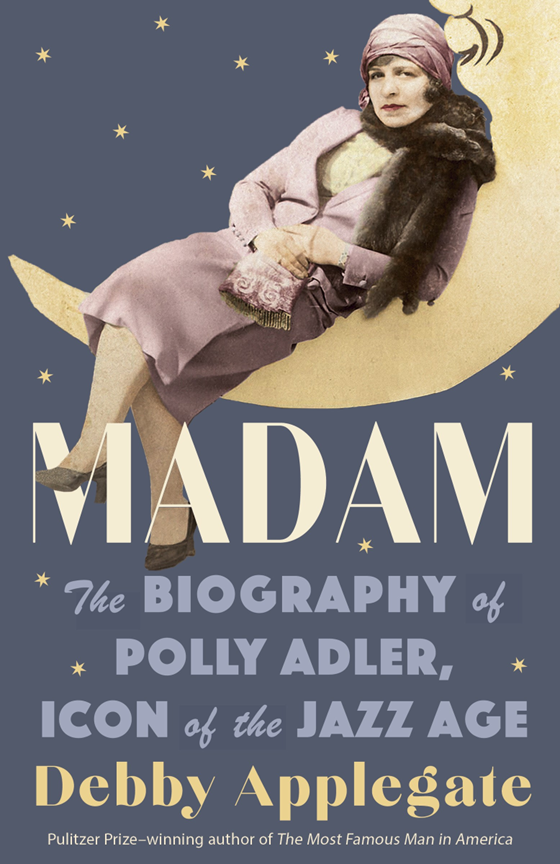
Reading’s book has proved a good resource for my project. It is also an inspirational model of writing, as is Debby Applegate’s biographyMadam, about Polly Adler. I anticipate that Laurie Gwen Shapiro’s forthcoming book, The Aviator and the Showman, about Amelia Earhart, will form the third point of that inspirational model triangle.
I will be touching on these books (and others) plus exploring fascinating primary sources as I write my way through 2025 and the year of Jane Grant. Some of the more interesting findings will appear on the blog during the year, most likely at irregular intervals (Writing history is challenging, and, for me, writing about writing history is even more so.) Hope you will follow along.
Back in the summer of 2024, I started reading Debby Applegate’s biography of Polly Adler, the (in)famous Manhattan madam of the 1920s. It was an obvious choice for me: a story about a little-known woman—today, not back then—written by a woman who turned what she learned in graduate school into a Pulitzer Prize winning writing career. Applegate won that award for her first book, The Most Famous Man in America, a biography of the nineteenth-century minister Henry Ward Beecher.
(That book also serves as the sample proposal in the extraordinarily useful Thinking Like Your Editor: How to Write Great Serious Nonfiction—and Get It Published by Susan Rabiner (Applegate’s literary agent) and Alfred Fortunato. My copy is dog-eared now. It is the resource I turn to when I need to write a book proposal. Now I am reading Tilar Mazzeo’s How to Write a Bestseller: An Insider’s Guide to Writing Narrative Nonfiction for General Audiences, which may prove to be equally valuable.)
Madam is Applegate’s second book. (I admire an author who takes their time to conduct quality research.) I knew going in that it would be good. My interest in Madam extended beyond character to setting. Right now I want to read as much as I can about New York City in the 1920s to get background information for my current book-in-progress about Jane Grant, co-founder of The New Yorker.
Polly Adler was born around 1900; Jane in 1891. When Polly arrived in New York City from Russia in 1913, Jane had already been there (from Kansas) for five years. Both changed their first names to make a break with their pasts. The two young women struggled to gain a foothold in the city so they could live the life of their dreams. Each got what she wanted, mostly, in some way.
It is not unreasonable to think their paths may have crossed in New York in the 1920s, though trying to imagine that encounter makes my head spin. Polly opened her first brothel at the beginning of that decade that was known for its roar. By 1924, as Applegate writes, “her house had become an after-hours clubhouse for the adventurous Broadway bohemians who gathered at the Algonquin Hotel for lunch.” Jane Grant was a member of the legendary Round Table that met at the Algonquin. As was her husband, the talented editor Harold Ross. Their home was another “after-hours clubhouse” for the Round Tablers, though the entertainment they provided did not include Polly’s specialty.
(I have come to think of Jane as the anti-Polly.)
With some trepidation, I looked for Harold Ross’s name in the index of Madam and found it. (Jane’s is not there.) I could hardly bring myself to read what was on the corresponding page—would he turn out to be a rat or a super rat? But according to Applegate, Ross was “one of the few who failed to fall for Polly’s charms.” The lone time friends dragged him to her brothel, he carried along a stack of manuscripts, which he read “while the fun eddied around him.” This left me with a lot to think about.
I read about a quarter of Madam before I set it aside. It had nothing to do with the quality of the biography, which is as excellent as I anticipated, but rather because I started to consider it an ideal model for my book on Jane Grant. Too ideal. I am still very much at the beginning of my project, and I started to worry that I would imitate Applegate’s style. I do not want to cross the line between modeling and imitating. I need space, considerable space right now, to identify that boundary, to develop my own style and voice based on how I think Jane’s story needs to be told.
This is not the way I typically respond to the secondary (or published) sources I read for my book research. Every so often, though, I encounter a book—whether during leisure reading or work reading—I admire so much that I am overwhelmed by a sense of futility. (Also known, perhaps, as imposter syndrome.) As in, why should I continue to do what I do when someone has already published the perfect gem of a book. (Rebecca Donner’s All the Frequent Troubles of Our Days, about Mildred Harnack, was the last book to strike me like that.)
The feeling eventually passes, and, of course, I go on to do what I do, because what I write ends up different than what anyone else writes. And maybe it is as good, maybe not. But that is what happens. I write the best book I can.
When I’m ready for my first round of revisions on the (still in progress) rough draft, I might pick up Debby Applegate’s book again. Or maybe I will wait for the second round. But I know I will finish reading that biography. I need to find out what happened to Polly Adler. And I need to pay close attention to how Applegate makes me care.
In October 2023, on my way out West for a research trip, I spent a couple of days with my siblings in the Chicago suburbs, which is always a treat. And it gave me the time to help my sister Kathi go through the last few boxes of photos from our childhood home at 2912.
Kathi set all the boxes on her big dining room table, which once belonged to our mom’s mother and served as the grownup table for holiday dinners. Many of the photos in those boxes depicted our parents, Mike and Irene, at various stages of their younger lives, with their extended family members.
Most snapshots lacked identifying information that would have provided the who, where, and when. With some regret, we threw them away. Kathi kept saying, as we pitched photo after photo, these were our parents’ memories, not ours.
But I couldn’t help holding on to some of their memories, because they have seeped into mine. That’s because our mom, the great storyteller of the family, loved to relate tales about her relatives. I think of these handed-down memories as momories.
Uncle Gaston is one of them. These days, when we four siblings are together and reminiscing, just a mention of Uncle Gaston will trigger a lot of laughs. That’s because we remember our mom talking about this relative of hers who died before any of us were born. We were impatient with those stories when she told them because they had nothing to do with us. Sometimes we teased her that she made him up—we couldn’t imagine anyone with the name Gaston. So the momories I have of Uncle Gaston are limited to his World War I service in the navy that never took him further away from home than Lake Michigan.*
That day with my sister I was delighted to find a black and white picture of three people, their names written in full on the back: Uncle Gaston along with his wife Evelyn, and Evelyn’s sister, Irene. That Irene—later called Nana by us—was the paternal grandmother of our mom, which means Gaston was our mom’s grand uncle by marriage. There’s no location or date noted on the snapshot, though Evelyn’s peep-toed, ankle-strap shoes suggest the picture was taken in the late 1940s or early 1950s.
Irene senior, already widowed by the time she posed for that photo, stands next to Gaston. She wears a fashionably tilted hat and a slight smile. She looks jaunty. Another photo from that box shows Irene on a street on the Isle of Capri in 1953, the year she turned seventy, sitting on a donkey. She appears remarkably capable, though not totally at ease, as she holds the reins. The man standing to her left looks at her, impressed.
I have my own memories of Irene senior because I knew her for the first several years of my life. As a child, I wouldn’t have recognized her as the woman in those two photos. I knew her as the Nana who wore housedresses and, at Thanksgiving and Christmas, baked pumpkin pies (with lard crusts) in the kitchen of her Berwyn bungalow. If we great-grandchildren behaved while visiting, she let us go into the pantry and coax a cookie—iced oatmeal or an almond-studded Windmill—from its crackling plastic package. (Holiday pies were homemade; cookies were not.) But only if we behaved. Nana wasn’t indulgent.
I learned from census records that Irene was born in 1883 and grew up in Chicago, the eldest of five siblings (including Evelyn) whose father was a cabinet maker from Germany. She worked for a time as a clerk in a pickling factory before, at age nineteen, she married Edward, a salesman for a plumbing supply business.** During the 1910s, the company transferred Edward to Kansas
City, Missouri. He, Irene, and their two sons remained there through part of the 1920s but returned to Illinois before the end of the decade, settling in a new two-bedroom brick bungalow in Berwyn.
What follows is a momory, a story our mom, Irene junior, told often. Sometime after 1930, when the economic reversals of the Great Depression had sunk in, Edward and Irene’s son George, his wife Martha, and their two children, George, Jr. and Irene junior, came to live with them in their Berwyn home. George and Martha had recently bought their own brick bungalow in nearby Elmwood Park, but because of the Depression, there was only enough money across two households to save one home. So our mom ended up growing up in the Berwyn bungalow, surrounded by extended family members.***
(Irene senior is at the top right, Irene junior is on the floor with her dog Jerry, in the living room of the Berwyn bungalow, December 1950.)
Our mom would not like me referring to her as Irene junior. She always said she hated her name, but I don’t think that’s because she hated her grandmother. Resented, maybe, on some level because Irene junior also did not like having extended family members around. The Berwyn bungalow belonged to Irene senior, yet even after the Depression ended, George and Martha remained there with their two children. Irene junior never had her parents all to herself. She spent the rest of her life determined never to live with any of her children, and she never did.
But I think a lot about the relationship between the two Irenes. I’ll get into that next time in A 2912 Tale of Photographs, Memories, and Momories, Part II: Irene senior and Irene junior
Additional asides about the family:
* Gaston served in the Navy Auxiliary Reserve in 1918, then married Evelyn the following year. In civilian life he mostly worked in the milk industry, first as a driver, then as a salesman for Bowman Dairy. Evelyn stayed at home, which was a rented apartment in Chicago, and raised their daughter, Aline, who was likely named for Gaston’s younger sister, Aline, who died in 1914 at age twenty.
Through the decades, after the deaths of her aunt and uncle, our mom kept in touch with her cousin Aline, even when Aline settled with her husband way out in California. (Irene junior didn’t approve of people moving away from where they grew up. To her, no place was better than the Chicago suburbs.) As teenagers, Kathi and I accompanied our dad on a business trip to California. We stayed at Aline’s house, which had a swimming pool in the backyard and was located within an easy driving distance of Disney Land. We even took a day trip to Tijuana where I bought a very hip brown suede jacket with fringe. I still have the jacket.
** Edward had a younger sister named Albina who became a statistician, and our mom sometimes told stories about her, none of which I remember in detail. But we had two such great names in the extended family.
***Our mom never shared the details of that decision. Did Edward, as patriarch, pull rank? Did the size of the house factor in? (The Berwyn place had more square footage.) Was the mortgage payment on that house lower, making it more affordable? Edward and George, both salesmen, would have realized that their jobs were always in jeopardy. Did they both manage to hold on to full-time positions or did they find their hours and salaries cut? Did they have to move on to different sales jobs? Was there ever a discussion of Irene senior and/or Martha looking for work? How did Martha and her mother-in-law get along, especially with young children in the house to raise? I think of all these things now, but of course they never occurred to me to ask such questions when I was a child listening to our mom.
I look forward to the beginning of each new year so I can round up and reflect on the reading I’ve done over the preceding year. Pulling together my own “favorites” lists of fiction and nonfiction will take me a bit longer than usual because I’ve got a big thing happening starting next week.
I’ll be in New York City (for the first time ever) to complete a Short-Term Research Fellowship at the New York Public Library. For two weeks I get to comb through the records of The New Yorker magazine, which was co-founded in 1925 by Jane Grant, the subject of my next biography. I’m thrilled and honored to receive this support from the NYPL.
(Audrey Hepburn in Breakfast at Tiffany’s. Nothing remotely like what I’ll be doing in New York.)
(Library of Congress photo. Where I’ll actually spend most of my time.)
This will be the second major research trip for my new book project, which is tentatively titled The Jazz-Age Feminism of Jane Grant. Back in October, I traveled to the University of Oregon to research Grant’s papers, housed in the archives of the Knight Library.
I started to write a blog post about that experience, which turned into quite a different piece that’s still unfinished but not abandoned. So, after I post my 2023 reading lists in late January, I’ll polish the unfinished piece and get that up, then, in time for Women’s History Month, there will be a couple of articles about these research trips and an update on the status of my book project.
Until then, here’s a link to a post I wrote for Shepherd, a reading recommendation site, about my three favorite novels that I read before October 2023. It’ll give you a sneak peek at what will be in my full list.
In today’s language, Harriot Stanton Blatch was a suffragist nepo baby.
She was born in 1856 in Seneca Falls, New York, the sixth of Elizabeth Cady Stanton’s seven children. Throughout her childhood, reform occupied center stage in the household. Her mother was one of the organizers of the 1848 Women’s Rights Convention in Seneca Falls, which helped launch a movement that in some shape or form continues to this day. Harriot’s father, Henry, was an abolitionist, journalist, and politician.
Harriot received an undergraduate degree from Vassar College in 1878 and a master’s degree in 1894. In between, she joined the suffrage cause and helped her mother and her mother’s political partner, Susan B. Anthony, write their History of Woman Suffrage. Harriot also married a British businessman, William Henry Blatch, in 1882, and spent the next twenty years living in England with him and raising their two daughters, one of whom died young. By the 1890s, she’d become a proponent of “voluntary motherhood,” encouraging married women to choose when and how often to become pregnant, thus deciding when to have intercourse with their husbands.
(left to right: Nora Blatch, Elizabeth Cady Stanton, Harriot Stanton Blatch)
The Blatch family moved to New York City in 1902, following the death of Elizabeth Cady Stanton, and Harriot immersed herself in reform causes that highlighted the intersection of workers’ rights and women’s suffrage. After joining the Women’s Trade Union League, she founded, in 1907, what would come to be known as the Women’s Political Union. This brought some 20,000 New York City working women into the suffrage movement. Harriot further revitalized the movement by organizing public parades at a time when “proper” women didn’t flaunt themselves in such a way.
Harriot Stanton Blatch’s tactics and ideology overlapped with those of feminist Alice Paul; in 1915 she merged her Women’s Political Union with Paul’s Congressional Union, which became the National Woman’s Party. When the United States entered World War I, Harriot took on the directorship of the Woman’s Land Army, an organization that guaranteed farm labor would continue as American men joined the military.
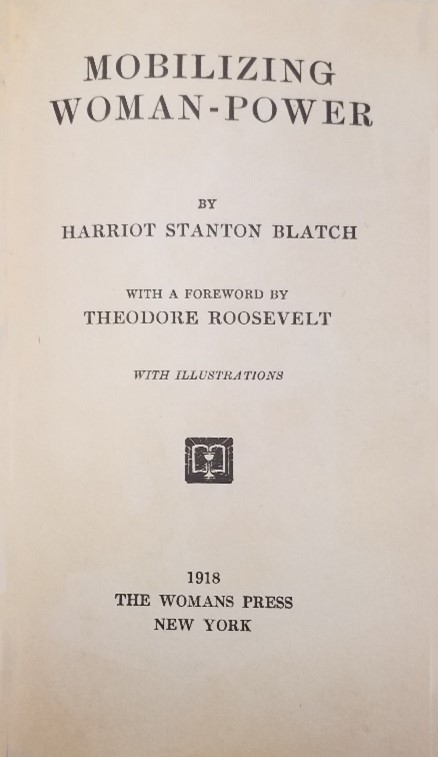
After the war, she published two books: Mobilizing Woman-Power, a celebration of women’s contributions to the war effort and a brisk reminder of their duties as citizens, and A Woman’s Point of View: Some Roads to Peace, which focused on the affects of war on women and children and the role of women in shaping peace.
The Nineteenth Amendment passed in 1920, guaranteeing most American women the right to vote. Harriot became a proponent of the Equal Rights Amendment, viewing it as the next necessary step to securing women’s rights. In 1922, she published a co-edited collection of her mother’s papers, Elizabeth Cady Stanton as revealed in her letters, diary, and reminiscences. Shortly before Harriot’s death in 1940, she finished (with the help of feminist Alma Lutz) her own autobiography, Challenging Years: The Memoirs of Harriot Stanton Blatch.
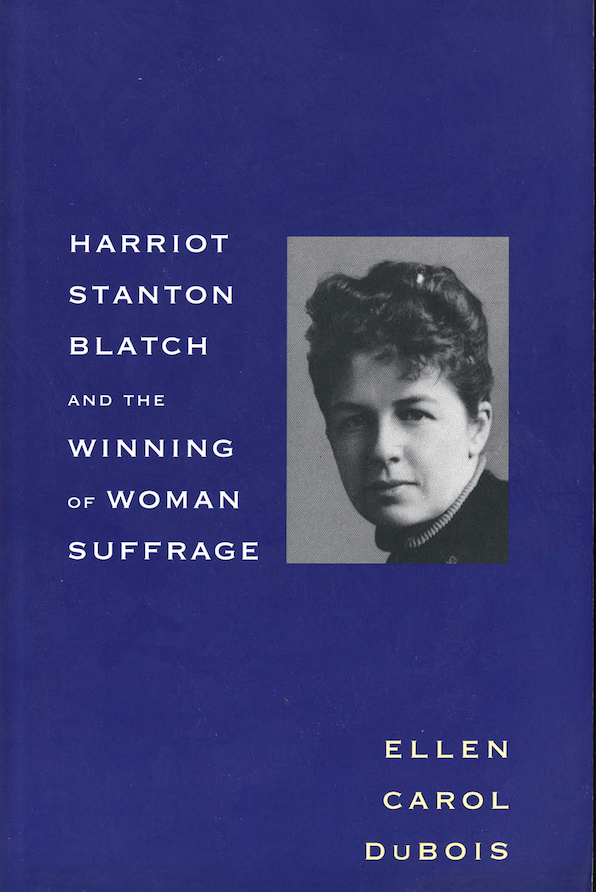
Historian Ellen Carol DuBois brought Harriot Stanton Blatch’s career to life in the 1997 prize-winning biography, Harriot Stanton Blatch and the Winning of Woman Suffrage. DuBois, now retired as a professor of history and gender studies at the University of California, Los Angeles, is considered a pioneer in the field of women’s history. As a graduate student at Northwestern University, DuBois became involved with the Chicago Women’s Liberation Union, the radical wing of the 1960s women’s rights movement. Her 1978 book, Feminism and Suffrage: The Emergence of an Independent Women’s Movement in America, 1848-1869, was considered for many years as the best book on the suffrage movement, inspiring many other historians to explore its multiple facets.




 Theresa Kaminski
You must be logged in to post a comment.